
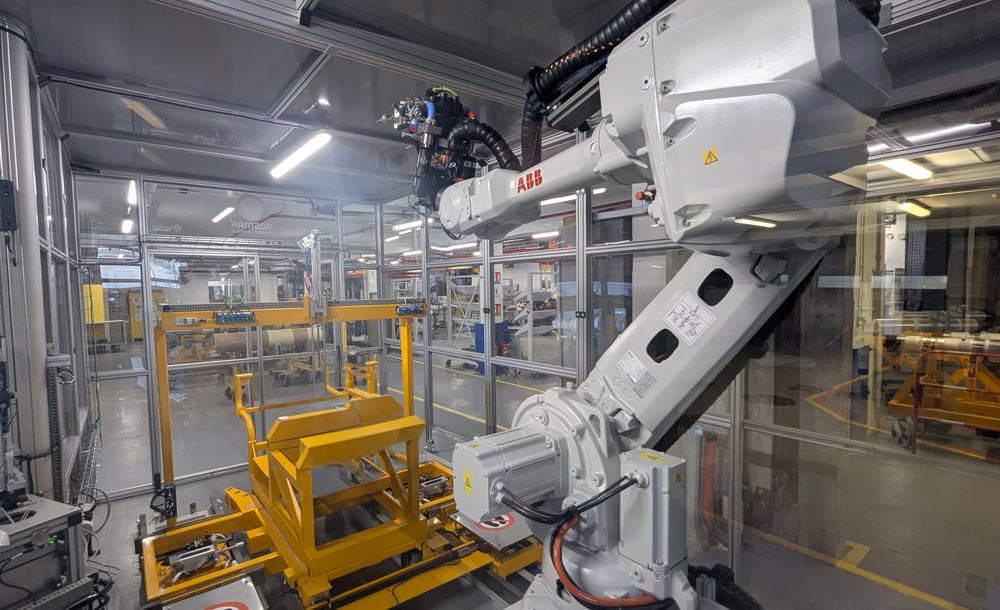
Quality, process reliability and full traceability are non-negotiable in aerospace manufacturing. Yet manufacturers are under growing pressure to automate complex tasks that have always been done by hand. French integrator AKEOPLUS has responded with a robot cell that dispenses a two-component sealant onto large, painted metal parts. The cell uses the MVTec HALCON machine vision software to locate each component and calculate the corrections it needs. The result is sealant placed to within ±0.2 mm across a very large working area.
In aircraft production, even tiny deviations decide whether a part is good or not. That includes sealing jobs on complex geometries. The bead has to be continuous, even and in exactly the right place, because gaps, offsets or uneven thickness weaken the seal. Until now this work had never been automated. The parts vary in size and come in many versions, which made the job too demanding.
An aerospace manufacturer still wanted to automate this manual step. The job was to apply a primer and then a two-component sealant around bronze or stainless steel bearings fitted into painted metal parts. It was an unpleasant job for operators: the materials smell strongly, and some of them can be harmful to health.
AKEOPLUS was chosen for the project. Founded in 2006 and based in France, between Geneva and Lyon, the company builds custom robotic solutions that combine robots, vision sensors, advanced algorithms and artificial intelligence. “This was not just about making a robot follow a path. We had to automate a process that depended heavily on the skill and care of the operators. The cell has to handle different parts and application areas, find the real position of the bearings and apply the sealant the same way every time,” says Maxime Motisi, an AKEOPLUS engineer who specializes in robotic dispensing.
A large workspace, controlled by machine vision
Before automation, an operator mixed a batch of sealant and then had only about two hours before it cured and became unusable. The job was physically and technically demanding as well as time-critical. On top of that, a transparent primer had to be brushed onto every sealing area by hand, which took a lot of labor and gave different results from one operator to the next.
The project goals were clear: automate as much of the process as possible, from fluid supply and part scanning to primer and sealant application. The system also had to monitor material flow and detect bubbles or irregularities before they caused defects in the bead. Because the process runs on its own, operators could move away from a task that was bad for their health. Automation would also make the process more robust against variations in quality.
“Flexibility was a top priority for the customer. The system has to handle many different parts with very different geometries and configurations. The robot’s workspace is roughly 2,000 × 2,000 × 2,000 mm. The challenge is to let the robot reliably find the relevant areas in this large volume and adapt its movements to where the part actually is,” explains Adrien Queyroi of AKEOPLUS.
Parts are also never placed in exactly the same spot, and the position errors were too large for a mechanical fixturing solution. The customer also wanted to handle the parts as little as possible. Mechanical probing would have added process steps, more contact with the part and possibly longer cycle times. For AKEOPLUS, machine vision was the only workable approach, and MVTec HALCON became the core of the system.
A fully automated workflow
Each run starts with a setup phase. Consumables such as primer tools and sealant nozzles are installed, and a few manual dispensing cycles fill the lines and the whole material path. The part is then brought into the cell, where a positioner roughly aligns it in front of the robot.
The robot then scans the part with a 3D profilometer. It covers the predefined areas, including the bronze bearings that will be primed and sealed. The 3D data shows where each bearing really is, and the programmed paths are corrected to match.
Next, the robot picks up a swab tool, loads primer at the station and applies it to the sealing areas. It then switches tools again and dispenses the sealant along the programmed bead paths. Travel speed sets the bead size: faster for thin beads, slower for thick ones.
Once sealing is finished, the part leaves the cell. While the robot waits for the next part, it moves to a flushing position and purges sealant from the mixer so the material cannot polymerize inside it.
The real challenge: vision in 3D space
Many technologies had to work together precisely: a six-axis robot, a 3D profilometer, a laser fork for tool recalibration, a dispensing system for primer and two-component sealant, a swab tool, sealant nozzles, a part positioner, process-monitoring sensors and a control system with built-in algorithms.
“Each of these elements has its own accuracy limits. The robot, the laser fork, the profilometer, the hand-eye calibration and the algorithms all add tolerances to the system. Part of our work was managing and combining these effects to reach an overall bead positioning accuracy of ±0.2 mm,” says Adrien Queyroi.
The hardest part was finding the component and working out its exact pose in space. That means calculating all six degrees of freedom for every bearing, even though the bearings differ in shape and size. Because the sealing tolerance is so tight, the vision system can add only a very small error. The large part and its bearings also carry manufacturing and assembly deviations that exceed the sealing tolerance. On top of that, the positioner only brings the part to within a few centimeters of its target, which is far from enough for dispensing.
“The challenge was to generate a precise robot path from a part that is never quite the same. That is exactly where 3D machine vision shines. It compensates for manufacturing, assembly and operator variations and makes the robotic process possible in the first place,” says Maxime Motisi.
HALCON at the heart of the system
HALCON handles several key tasks in this application. It processes the profilometer data, converts X, Y and Z images into point clouds, combines 2D and 3D operators, and works with CAD data and 3D object models.
“HALCON offers many functions that are essential for robotic applications based on 3D data: robust 3D methods, 3D object models, combined 2D and 3D processing, and an efficient way to integrate complex vision logic into industrial processes. For high-precision applications, this combination is a decisive advantage,” says Jan Gärtner, Product Manager HALCON at MVTec.
For AKEOPLUS, development and integration speed mattered as much as functionality. All workflows were built with the HALCON library and MVTec’s HDevelop IDE. The AKEOPLUS framework “AkeoSpine” then runs the scripts directly through HDevEngine, so no extra engineering is needed to move into production.
Operator guidance is another benefit. A wizard built with HALCON’s GUI, windowing and plotting functions walks users step by step through setting up the Surface Model and its parameters when they teach new bearings or subprograms. In production, the configured subprogram then finds each bearing from the live 3D scan. HALCON’s hardware independence also mattered, since every cell has to be adapted to a specific customer environment. The software’s documentation, examples, tutorials and Solution Guides make development easier still.
“It is important for us that our vision engineers can work independently. With HDevelop, the HALCON library and its visualization tools, we can develop, test, debug and integrate the application into the overall process. That means fewer interfaces and faster implementation,” Maxime Motisi notes.
Results: consistent beads and a technology showcase
The cell has been running since spring 2026 and impressed the customer soon after start-up. The sealant beads are even, thin and consistent. The system meets one of its main goals: it turns a difficult manual task into a repeatable process and takes the burden off workers.
For the customer, the cell is more than one automation project. It is a technology showcase. It proves that even aerospace processes built on manual skill can be automated when robotics, dispensing technology and machine vision work together properly.
“Many tasks that still rely on manual skill today will be automated in the coming years. Combining machine vision, AI and robotics will lead to highly adaptive, intelligent and autonomous systems. This cell shows very concretely what is already possible today,” concludes Maxime Motisi.