
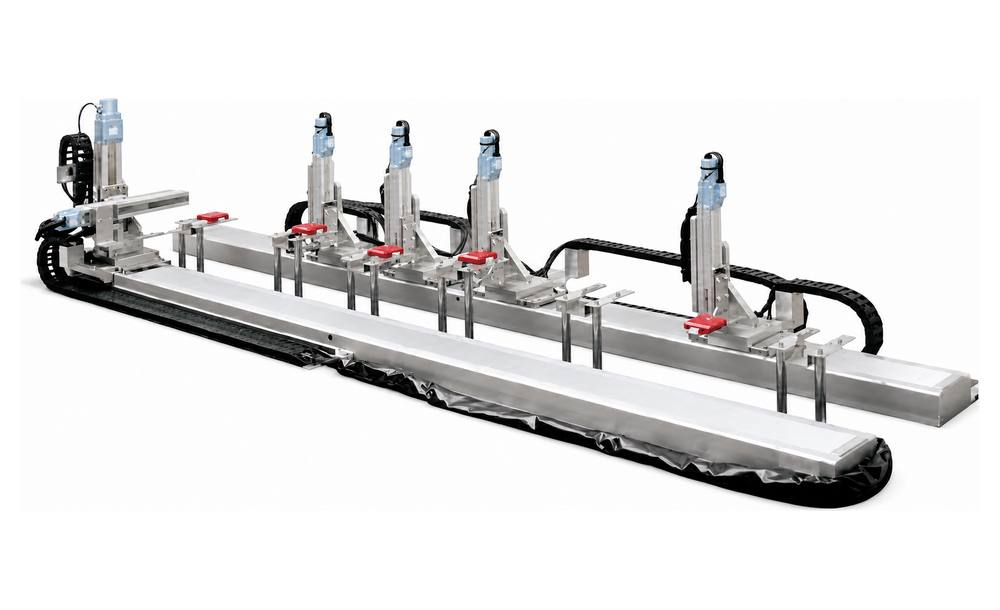
Yamaha PHASER linear motor robots push productivity beyond ball-screw limits
A system integrator in Japan was asked by a customer to deliver a factory automation solution that went further than conventional precision drives could. The team met the challenge with Yamaha’s PHASER single-axis robots.
The Factory Automation Section of Yamaha Robotics supplies its PHASER robots to machine builders. They move payloads much faster over long distances without losing positioning accuracy.
The customer wanted more productivity from automation built on ball-screw drives, the usual choice for precision motion control in industry. Its engineers turned to Yamaha’s linear motor technology.
No critical-speed limitation
Ball-screw drives are limited by critical speed. Yamaha’s PHASER robots are not. They can handle longer strokes and shorter cycle times while keeping very high accuracy and reliability. This gives system integrators room to build more advanced automation for manufacturers who want more productive lines.
The MF models of the PHASER series use flat magnets. Their high thrust moves payloads of up to 160 kg over strokes of up to 4 metres, with high precision and dynamics. The axes stay compact, and durable stainless-steel covers keep dirt and foreign particles out of the drive. Compared with ball-screw axes, they have far fewer sliding and rotating parts, so they run much more quietly.
Case 1: 40% shorter cycle time
The Japanese integrator had to meet two customer requirements, both about handling workpieces faster. The first was to speed up a two-step process in which parts travelled 500 mm.
The existing technology had little room left to improve. Critical speed depends on the unsupported length of the ball screw, and it stopped the screw from turning any faster. Running the machine at a higher speed was therefore not an option.
The team designed a new solution around Yamaha PHASER linear motor actuators and cut the cycle time by about 40%.
Case 2: four operations on a single axis
The second request was to simplify a four-step process. It ran on two separate ball-screw drives, with an extra robot passing parts from one to the other. That transfer was error-prone and hurt productivity. The two drives also took up a lot of floor space and were hard to keep aligned. Merging them into one longer drive would not work, because a longer ball screw has a lower critical speed.
The integrator replaced everything with a single 1-metre PHASER unit and built one inline system for all the processes. Floor space went down and parts moved between stations faster. The total cycle time, including processing time, dropped from 2.04 to 1.76 seconds.
Yamaha’s in-house position sensing
Yamaha’s position measurement system resists dirt, condensation and oil, so position detection stays stable and accurate. The linear scales use Yamaha’s own magnetic signal detection technology. A magnetic encoder gives position feedback over long strokes at low cost. Semi-absolute encoders find the carriage position within seconds of power-up. Closed-loop control positions the carriage with a repeatability of ±5 µm.
In linear motion, the position encoder is key intellectual property. Yamaha designs and builds its encoders in-house, which keeps them available with short lead times for machine building and maintenance. Its engineers also know the technology in depth and can give customers specialist technical support.
Custom configurations
The robots come with one or two carriages as standard. Two carriages help when cycle and setup times need to improve, or when there is little room for more axis combinations. Custom versions can run three or more carriages on one axis, and a collision-avoidance program helps set up several carriages safely. For loads over 160 kg, Yamaha can supply a dual-axis (biaxial) drive configuration with an optimised controller for synchronised motion.
Performance and versatility
PHASER linear axes let users adjust performance settings individually, which suits dynamic, high-precision tasks. The contactless drive gives a long service life even at high duty cycles. Typical uses include general automation, electronics manufacturing, assembly and test systems, gantries and food processing.
Ready to scale
Switching to PHASER linear motor drives let the Japanese integrator deliver two automation solutions that are faster, take less floor space and raise productivity. The drives are also quieter and reliable, and they lower the operator’s total cost of ownership. Their speed and precision also let the team take on more ambitious projects in the future.