
Murrelektronik and Danfoss bring decentralized automation into the robot arm
Murrelektronik has teamed up with Danfoss and autonox Robotics on a robotics concept. It shows that cabinet-free, decentralized automation can now reach all the way into an industrial robot arm. The project builds on Murrelektronik’s Vario-X platform. Vario-X takes control, power distribution and I/O out of the control cabinet and mounts them directly on the machine.
Why centralized servo systems hold robotics back
In a conventional robot cell, every servo motor needs its own power and feedback cables running back to a central cabinet. That means complex wiring, long cable runs and large cabinets, which add cost, slow down commissioning and take up floor space. Murrelektronik wanted to show that the decentralized approach of Vario-X can remove these limits in machine-integrated robotics too.
A 6-axis robot with servo drives on the arm
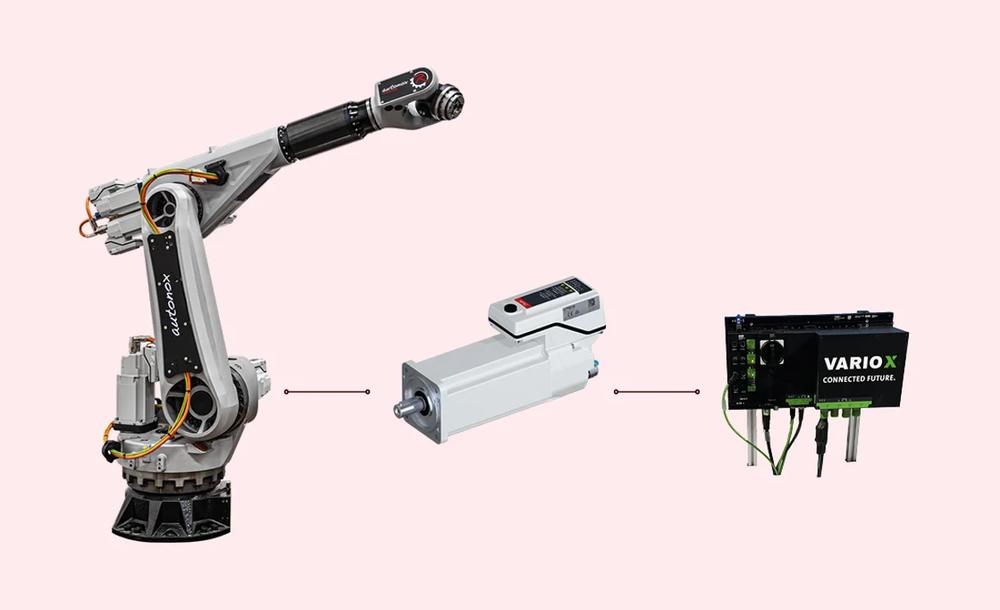
For the demonstrator, the partners used a 6-axis industrial robot designed for material handling, assembly, dispensing and welding. The motion control comes from Danfoss’s VLT® FlexMotion™ platform:
- VLT® Integrated Servo Drive ISD® 520: servo drive and servo motor in one compact unit, mounted directly on each robot axis.
- VLT® Power Supply Module PSM 520: fitted with the Decentral Access Module (DAM) option board, which feeds central power to the decentralized drives.
- Hybrid cables: wired in a daisy chain from drive to drive, so each motor no longer needs its own cable back to the cabinet.
The Vario-X unit acts as the decentralized control and power node next to the robot. autonox Robotics took care of the mechanics and supported commissioning. The development took six months.
Results: smaller cabinet, far less cable
The decentralized design reduced the control cabinet footprint by 60% and cut cable length by up to 80%. Cabling costs went down and commissioning became simpler.
What VLT® FlexMotion™ brings to robotics
- Decentralized servo drives mounted on the machine, which frees up cabinet space.
- Dynamic, high-precision motion control.
- Clean daisy-chain cabling with fewer cables.
- Open communication with the main industrial protocols.
- Advanced safety functions and integrated safety brakes.
- Drives compact enough to mount directly on the robot arm.
- A wide choice of drive sizes and motor torque variants for each axis.
- Support for modular, flexible machine architectures.
- Silicon carbide (SiC) power modules for better thermal efficiency and performance.
What the partners say
Marco Bosch, Global Head of Solution Engineering at Murrelektronik, explained that the ISD 520 fitted the concept very well. He stressed that modern robots need advanced safe motion functions, because Safe Torque Off alone is no longer enough to balance flexibility, productivity and safety.
Julien Schuhler, Head of R&D at autonox Robotics, noted that the daisy-chain architecture pays off most in delta kinematics. There, integrated servo drives, less hybrid cabling and open interfaces improve dynamics and reduce integration and maintenance work.
For Christian Schröder, Global Business Development Manager Motion Drives at Danfoss, combining the ISD 520 with the know-how of Murrelektronik and autonox produced a robotics solution with a much smaller installation footprint. In his view, the partners are delivering a picture of future machine building, not just components.