
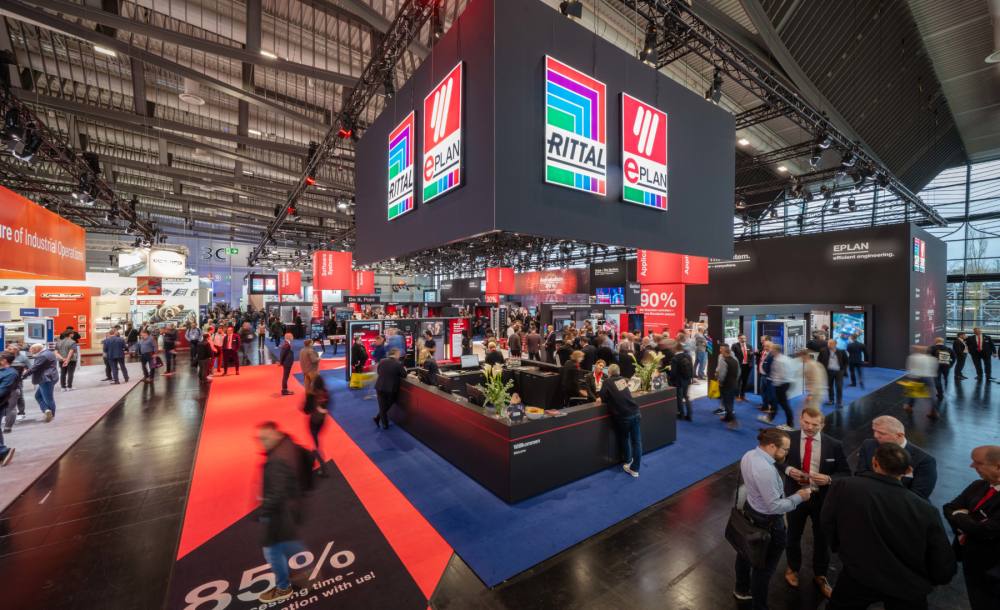
Rittal and Eplan will use SPS 2026 in Nuremberg (Hall 3C, Booth 321) to promote a systemic approach to productivity. Instead of optimising single steps, the two companies link the digital twin, panel production, and energy and IT infrastructure into one consistent data chain. As a result, engineering data is reused from the first schematic to maintenance in the field.
Uwe Scharf, Managing Director Sales Germany and Europe at Rittal, puts it simply: faster engineering or lower component consumption is no longer enough. In his view, companies need consistent data and well-coordinated solutions to raise productivity across the whole business.
Energy transparency starts in power distribution
Energy consumption remains a major challenge for industry. At the same time, designers of power distribution for machines, data centres and buildings must show customers when and where energy is used. However, measurement technology in complex systems is often expensive, and the engineering effort is high.
For this reason, Rittal and Eplan will set up a dedicated energy management area at the booth. There, they will show solutions that make electrical energy measurement simpler. These solutions also prepare the ground for intelligent load management. In addition, visitor feedback will flow directly into future development.
For AI applications, Rittal also shows remote power panels that distribute power close to the IT infrastructure. Prebuilt application examples and complete engineering data shorten project planning.
Product Change Notifications in the Eplan Cloud
Machine builders often learn about product changes or discontinued components too late. Consequently, running projects slip and extra coordination is needed. To address this, Eplan has developed Product Change Notifications (PCN), presented at SPS together with Phoenix Contact and other manufacturers.
With PCN, component makers report changes through the Eplan Cloud. Affected Eplan users then receive targeted information early. The solution relies on standardised product data based on the Asset Administration Shell (AAS) and ECLASS Advanced. According to Dr. Marco Litto, Senior Vice President Strategy and Corporate Programs at Eplan, more than ten manufacturers are already working on the final implementation.
More automation from engineering to assembly
Several tools on the booth show how end-to-end data simplifies daily work:
- Automated Project Generation (Eplan): creates schematics from predefined macros. Now it also places components automatically in the Eplan Pro Panel 3D model, based on a predefined layout and bill of materials.
- Support arm configurator (Rittal): selects support arm systems by load capacity and dimensions. It then delivers 3D data, CAD data and the bill of materials for the enclosure’s digital twin.
- Rittal Automation Systems: machines use engineering data directly for mechanical machining and automated wire processing.
- RiLineX: the modular power distribution platform keeps growing, with partners building compatible components that need no adapters. Engineers configure it in Eplan, while Eplan Smart Production guides assembly step by step.
Readers who followed the launch can revisit our report on the RiLineX premiere at SPS 2024. Rittal also publishes the official RiLineX platform overview.

Partner demos with Rockwell Automation
On the Rittal and Eplan booth, visitors can compare a physical electrical cabinet designed in Eplan with its digital twin. Meanwhile, the Rockwell Automation booth hosts a Motion Cabinet. Here, a CompactLogix PLC controls a high-speed Delta robot from autonox. The demo combines Eplan with Emulate3D for virtual testing and commissioning. Furthermore, it uses the ArmorKinetix range, which carries power, control and feedback over a single cable.
Why it matters for engineers
For panel builders and machine builders, the main benefit is fewer manual handovers. Data created once in Eplan feeds 3D layout, machining, wiring, assembly and service. Rittal states that this data can cut maintenance costs by up to 30% through preventive and planned maintenance. It also reduces the risk of unplanned downtime. Finally, Rittal adds augmented reality remote assistance and a new contract model aimed at maximum plant availability.
More news from both companies is available in our Rittal news section and Eplan news section, as well as in our SPS fair coverage.