
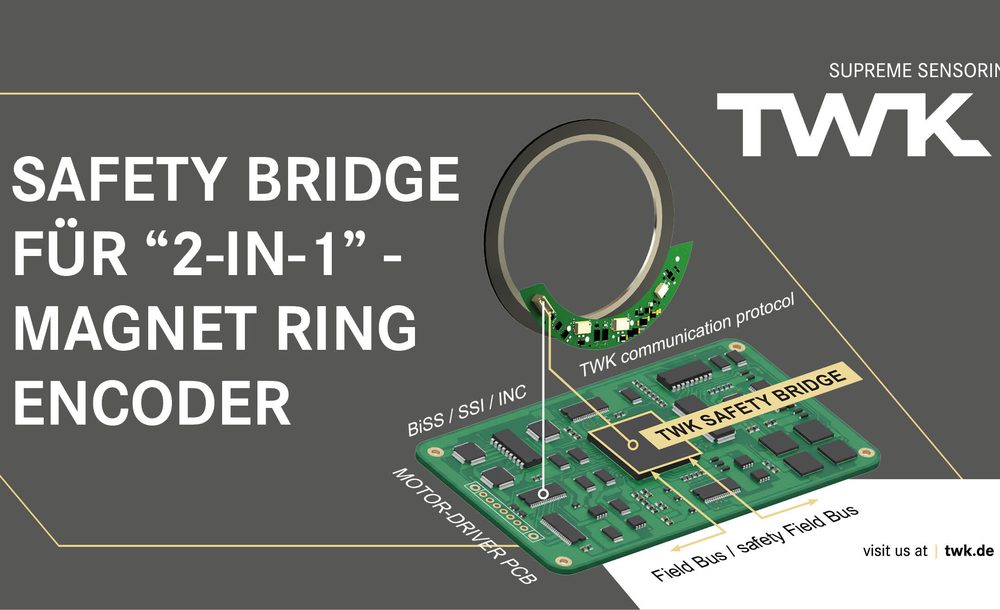
TWK has introduced the Safety Bridge, a solution for safety-critical position feedback in robot joints. It works together with the company’s new ring encoders. The goal is to cut system costs while the robot still meets its functional safety requirements.
Two requirements for every robot joint
A good industrial robot moves precisely, with carefully calibrated acceleration and braking. Each joint has its own motor drive, so the motor controller has to react in real time. In addition, all joints must be coordinated for a smooth and efficient motion sequence. The second requirement is functional safety.
The ISO 10218-1/2:2025 standard defines the safety measures that make an industrial robot safe. Its design requirements include safely limited position, safely limited speed and safe stop. Encoders therefore have two jobs. They measure position and speed, and they support the functional safety of the system.
A modular approach
TWK argues for a clear split of expertise. Robot manufacturers know motion control, user interfaces and AI models. TWK specializes in functionally safe position sensing. This split depends on clearly defined mechanical and electronic interfaces. Each module works independently, and a more advanced version can replace it as long as the interfaces stay the same. As a result, companies can save time, development cost and system cost, and bring innovations to market faster.
New ring encoders
The new ring encoders are the base for this approach.
- Design: split into rotor and stator components, with inner diameters of up to 200 mm.
- Interfaces: several interfaces at the same time, with resolutions of up to 21 bits that can be set separately for each interface.
- Versions: different designs and sizes, with or without a housing (as a bare board).
- Temperature: depending on the design, ambient temperatures of up to 125 °C.
How the Safety Bridge works
The Safety Bridge suits joints with very little space at the measurement point. TWK uses a designated section of the motor control board. In close collaboration with the customer, it designs the components for the safe fieldbus interface: EtherCAT FSoE, PROFIsafe or CANopen Safety.
At the measurement point, only the minimally equipped and customizable ring encoder remains. It sends the data for fast motor control to the nearby motor control board. The signals can be BiSS-C, SSI, SIN/COS or incremental. It also sends additional safety data to the safety module on the motor board through the TWK Communication Protocol. Together, these parts form the TWK Safety Bridge.
The daisy-chain fieldbus already runs from one joint to the next, from one motor board to the next. Now it also carries the safety data on the position and speed of the robot axes. No additional cables are required.
Why it matters for robot manufacturers
The approach combines the manufacturer’s know-how in high-speed motor control with TWK’s position-sensing systems certified to IEC 61508 and ISO 13849-1. Robot manufacturers receive a documented safety component. They can integrate it as a module into their own safety architecture and validate it according to ISO 10218-1/2:2025. Moreover, the ring encoder at the joint stays small, because the safety electronics sit on the motor board. TWK states that this reduces development and system costs significantly.
More information is available on the TWK website. On our site, you can find more TWK news. Related reading: TWK at SPS 2024: KIT and ring encoders.