
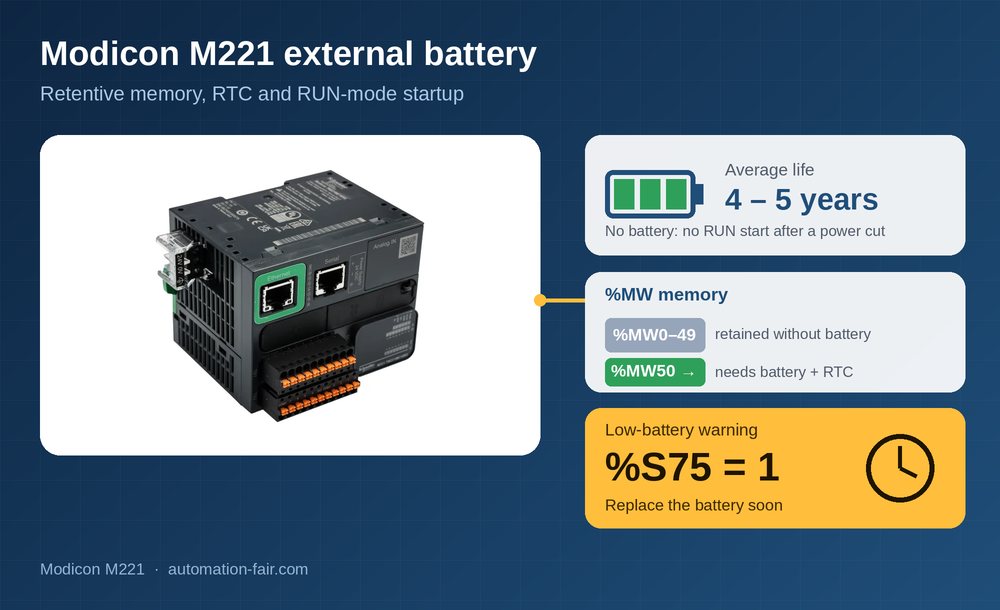
Schneider Electric explains in one of its technical FAQs what the external battery of the Modicon M221 logic controller is for, and why it should always be installed. The answer matters to anyone maintaining machines built around this compact PLC, because it affects both retentive data and the way the controller starts after a power cut.
What the M221 battery keeps alive
The battery has two main jobs: it preserves the contents of the %MW memory words from %MW50 onwards, and it keeps the real-time clock (RTC) running while the controller is unpowered.
Words %MW0 to %MW49 are retained without a battery, so memory retention is split into two zones with different behaviour.
| Element | Behaviour without power |
|---|---|
| %MW0 to %MW49 | Retained without a battery |
| %MW50 onwards | Need the battery to be retained |
| Real-time clock (RTC) | Needs the battery to keep the time |
A battery that is needed in practice
According to Schneider Electric, the battery is always required in practice: without it, the controller cannot start in RUN mode after a power failure. For machine designers and maintenance teams, that makes the battery a component to monitor rather than an optional accessory.
How to detect a low battery
The system bit %S75 lets the program detect when the battery is low. When %S75 is 1, the battery should be replaced soon. The average service life is 4 to 5 years.
- Battery-dependent retentive zone: %MW50 onwards.
- Low-battery warning bit: %S75.
- Average battery life: 4 to 5 years.
Why it matters for integrators and maintenance
With these figures, an integrator can decide which words should hold critical values, and maintenance can schedule battery replacement ahead of time. A practical approach is to use %S75 to raise a warning on the HMI or supervisory system, so the machine does not fail to restart after a power outage.
For related controller news, see the new Modicon M660 motion controller and the Schneider Electric news category.