
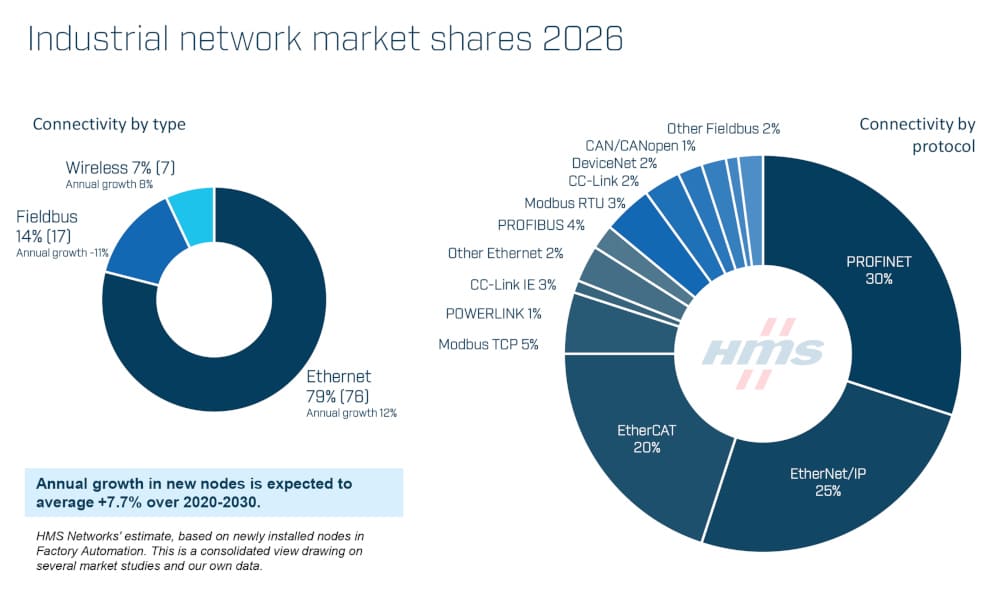
According to the 2026 industrial communication report by HMS Networks, the multi-year migration from conventional fieldbus setups to Industrial Ethernet persists. Representing twelve years of continuous market tracking regarding factory and machine automation systems, the study highlights that Industrial Ethernet captures 79% of current node installations globally.
This reflects an increase from 76% in 2025 and a massive leap from the 34% share recorded when tracking started in 2015.
A five-year outlook indicates an average annual growth of roughly +7.7% for newly deployed nodes, fueled largely by the ongoing transition from legacy fieldbus systems to Industrial Ethernet. This forecast, validated by HMS Networks’ 2026 report, follows a period of market stabilization in 2025 after the deceleration experienced in 2024.
Normal inventory cycles and steady component supply have returned to automated industries, allowing factory investments to rebound globally, despite persistent difficulties in the European automotive market.
“Twelve years of data tell a remarkably consistent story. The migration from fieldbus to Industrial Ethernet is now in its later stages, but the more interesting question is what happens next. When nearly everything is Ethernet, the conversation shifts from ‘which protocol?’ to ‘what is running on top of it?’, functional safety, cybersecurity, TSN, OPC UA, Single Pair Ethernet, IT/OT convergence. That is where the complexity, and the differentiation, will increasingly sit,” says Magnus Jansson, Director of Product Marketing, at HMS Networks.
“The 2026 numbers also reinforce something we have been seeing in our industry survey: cybersecurity is now cited by nearly half of respondents as a top integration challenge, and 93% expect OT cybersecurity to change substantially over the next five years. The protocols matter, but the layers above them increasingly define how factories actually operate.” Magnus continues.
PROFINET leads the Industrial Ethernet market
- PROFINET strengthens its lead at 30% (up from 27%)
- EtherNet/IP follows at 25% (up from 23%)
- EtherCAT continues a strong trajectory at 20% (up from 17%)
- Modbus TCP holds steady at 5%
- CC-Link IE remains stable at 3%
- POWERLINK declines to 1% (from 3%)
- Other Ethernet protocols account for the remaining 2% as market consolidation around the major networks continues
Fieldbus drops to 14% as PROFIBUS decline
New installations of fieldbus systems dropped to a 14% market share, down from 17% the previous year. This downward trend is clearly visible in PROFIBUS metrics published by PROFIBUS & PROFINET International, which revealed a 9% dip from 1.1 million new nodes in 2024 to 1.0 million in 2025. Both HMS Networks’ proprietary internal statistics and their broader sector surveys validate this reduction.
- PROFIBUS remains the largest fieldbus but drops to 4% (from 5%)
- Modbus RTU holds steady at 3%, reflecting its continued role as the universal low-cost serial protocol
- CC-Link, DeviceNet and CAN/CANopen each remain in the 1–2% range with modest further decline
- Other Fieldbus protocols collectively account for 2%, down from 4%, as the long tail of legacy networks fades
Wireless remains steady at 7%
Wireless technologies continue to connect 7% of new node installations, unchanged from 2025. Wireless retains its established role as a complement to wired industrial networks, particularly valuable for mobile equipment such as AGVs (automated guided vehicles) and AMRs (autonomous mobile robots), retrofitted machinery, and IIoT sensors in hard-to-reach locations.
5G remains an area of significant interest but slow industrial deployment. The complexity of private 5G infrastructure is the most commonly cited barrier. Early industrial 5G deployments continue to grow, particularly in Asia, but the technology has yet to deliver the breakthrough adoption many in the industry expected.
Regional insights
Europe: PROFINET and EtherCAT continue to lead, with strong activity around APL (Advanced Physical Layer) for process automation and SPE (Single Pair Ethernet) for sensor-level connectivity. PROFIBUS decline is most visible in Europe, where the install base is largest and the migration to PROFINET most advanced.
North America: EtherNet/IP remains the dominant protocol, particularly in automotive and discrete manufacturing. Adoption of IO-Link, APL and SPE is gaining clear momentum, supported by interest in OT cybersecurity ahead of the regulatory landscape taking shape around CRA and IEC 62443.
Asia: PROFINET and EtherCAT both continue to grow in the Chinese market. CC-Link IE, the first industrial protocol with TSN mechanism, maintains a strong regional foothold.