
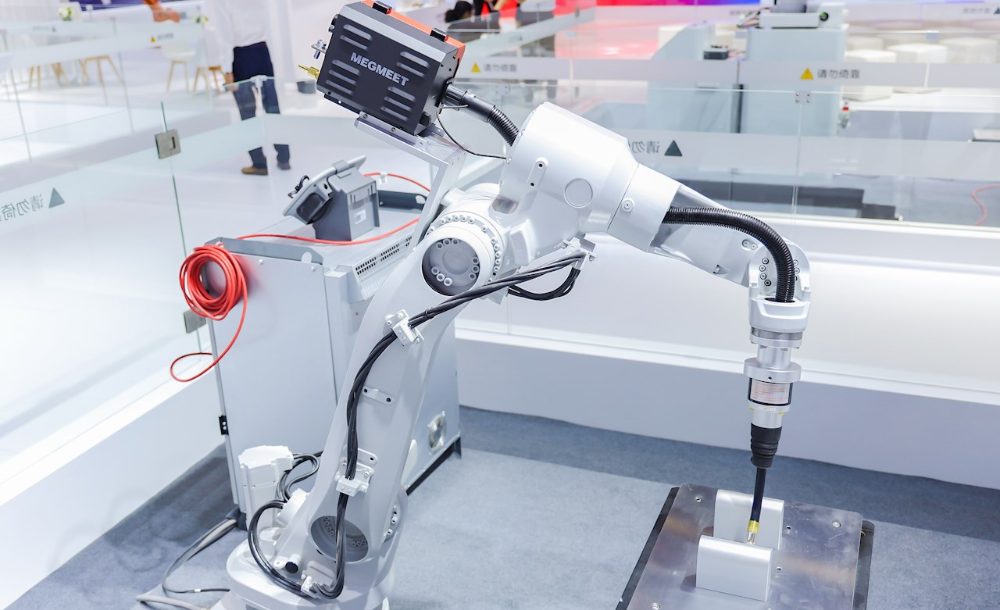
ABB Robotics has added two compact articulated robots to its industrial portfolio: the IRB 1700 and the IRB 1700ID. Designed for high-speed precision work in electronics, automotive and general industry, the new family is rated for up to 20% shorter cycle times than comparable robots on the market, while cutting energy use and stretching maintenance intervals.
Five variants from 6 to 12 kg
The IRB 1700 family covers payloads from 6 kg to 12 kg across five variants. All of them run on ABB’s OmniCore controller platform.
The IRB 1700ID version uses ABB’s Integrated Dressing (ID) concept: process cables and hoses run inside the arm instead of along its outside. For welding, deburring or dispensing cells this means fewer snag points, less dress-pack wear and a simpler installation.
Key specifications
| Parameter | IRB 1700 / IRB 1700ID |
|---|---|
| Payload range | 6 kg to 12 kg (five variants) |
| Path repeatability | Down to 0.03 mm |
| Joint speed | Up to 700 °/s |
| Cycle time | Up to 20% shorter than comparable robots |
| Power consumption | Up to 15% lower than the IRB 1600 (same payload, OmniCore) |
| Service interval | Up to 20,000 h between oil changes |
| Footprint | 50% smaller than the predecessor |
| Controller | ABB OmniCore |
Typical applications
The combination of fine path repeatability and high joint speed targets tasks where both accuracy and throughput count:
- Material handling and machine tending
- Arc welding
- Deburring and sanding
- Electronics assembly, including AI server rack assembly, a segment ABB highlights because of the fast growth in demand for AI computing hardware
Software and programming tools
The new robots are part of ABB’s Autonomous Versatile Robotics (AVR) strategy and can use the company’s software stack: RobotStudio for offline programming and simulation, the AI Robot Trainer, automatic collision-free path planning and OmniCore EyeMotion for vision-based guidance. Programmers already working with ABB tools, such as the generative AI assistant in RobotStudio, can reuse the same environment.
Why it matters for engineers and integrators
For machine builders, the 50% smaller footprint compared with the previous generation makes it easier to fit a robot into tight cells or to place more robots along the same line. The IRB 1700ID’s internal routing is a practical advantage in welding and surface finishing, where external dress packs are a frequent source of downtime.
On the operating side, ABB quotes up to 15% lower power consumption than the IRB 1600 under the same payload and controller, and oil-change intervals of up to 20,000 hours, which reduces planned maintenance stops. According to Craig McDonnell, Managing Director, Business Line Industries at ABB Robotics, the family offers manufacturers and integrators “a flexible platform for high-performance automation”.
First public showing at CIIF 2026
ABB presented the IRB 1700 and IRB 1700ID for the first time at the China International Industry Fair (CIIF) in Shanghai, held from 12 to 16 October 2026, with a working arc welding and sanding cell on its stand. More news from the manufacturer is available in our ABB product news section.