
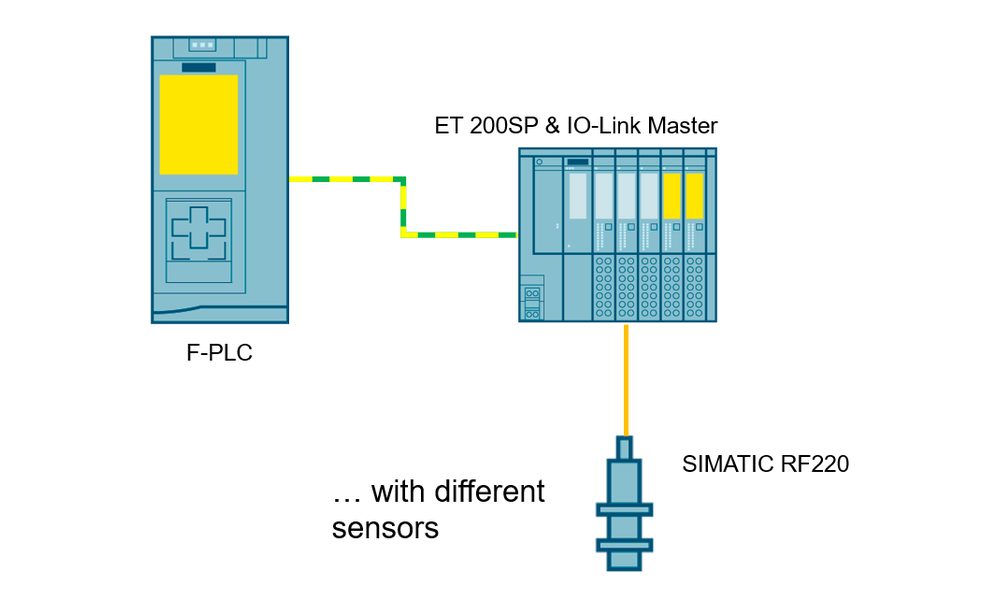
Siemens has released an application example that lets a fail-safe PLC read and write integer (Int) and double-integer (DInt) values on RFID tags safely through an IO-Link master. It is designed for safe positioning functions, where the position of a machine or carriage is identified by the tag in front of the reader.
Architecture: F-PLC, IO-Link master and RFID reader
The setup uses a fail-safe CPU, an IO-Link master (an ET 200SP in Siemens’ diagram) and an RFID reader with tags, a SIMATIC RF220 in the example. Communication with the standard components runs over a black channel. Safety does not depend on the reader or master but on software blocks in the safety program. For this reason Siemens requires a direct connection between components, with no data-storage devices in the line, because they could deliver delayed values.
Three operating modes
- Static (LSafe_readRfidStatic): the same tag is read repeatedly, with no movement between reader and tag. The block switches the antenna off and on cyclically to detect stuck-at faults.
- Dynamic (LSafe_readRfidDynamic): the reader moves past several tags, and the user knows which tag to expect next. It supports single reads (executeReading) and cyclic reads (continuousReading). In this mode the user must detect stuck-at faults, for example with a safe speed signal and a fixed tag.
- Write (LSafe_writeRfid): writes the value to the tag together with two masking values that are checked when it is read. Use it only during commissioning, never to change values in production.
If the RFID master reports an error, an antenna or read timer expires, or the masking check fails, the block outputs a substitute value and needs an acknowledgement before it reads again. Monitoring times (tag validity, antenna cycle, antenna switching and reading) are set to match the hardware, and Siemens recommends keeping them as short as possible.
Safety level and supported CPUs
As software, the blocks reach up to SIL 3 / PL e. For the complete system to reach SIL 2 / PL d, the actuator subsystem must also meet SIL 2 / PL d, and evaluating it is the user’s responsibility. The example follows EN 62061:2021 and EN ISO 13849-1:2023. Changing a block invalidates the safety assessment.
| Family | CPUs | Minimum firmware |
|---|---|---|
| S7-1200 F | 1212FC, 1214FC and 1215FC (DC/DC/DC and DC/DC/Relay) | V4.6 |
| S7-1500 F / TF | 1511F to 1518F (incl. 1518F MFP), 1511TF, 1515TF, 1517TF and 1518TF | V3.0 |
| ET 200SP F | 1510SP F, 1512SP F and 1514SP F | V3.0 |
| Software controllers | CPU 1507S F (V30.0), CPU 1508S F (V2.6), CPU 1505SP (F) V2 (V21.9) | Model-dependent |
Reader and tag requirements
- A defined read distance and direction, with only one tag read at a time.
- The reader memory must be cleared when the antenna is off. The reader must not cache values or release them with a delay.
- Protection against memory corruption, and known antenna switching and read times.
- One reader per function. With several readers, the user is responsible for keeping them separate and free of interference.
The user must also define a unique tag numbering scheme, mount the tags securely and overwrite removed tags with invalid values.
Why it matters for engineers
Until now, RFID over IO-Link was mostly used for product or tool identification without a safety function. With these blocks, a standard reader can become part of a safety chain, for example to enable zones or speeds based on the position of a carriage or shuttle. The trade-off is that much of the responsibility stays with the user: validating the hardware, managing the tags and evaluating the actuators.
The blocks and full documentation are available on the application example page in Siemens Industry Online Support. For the non-safety side, Siemens also provides an example on reading and writing RFID data with S7-1500 via IO-Link. For more news from the manufacturer, see the Siemens product news on Automation Fair.com