
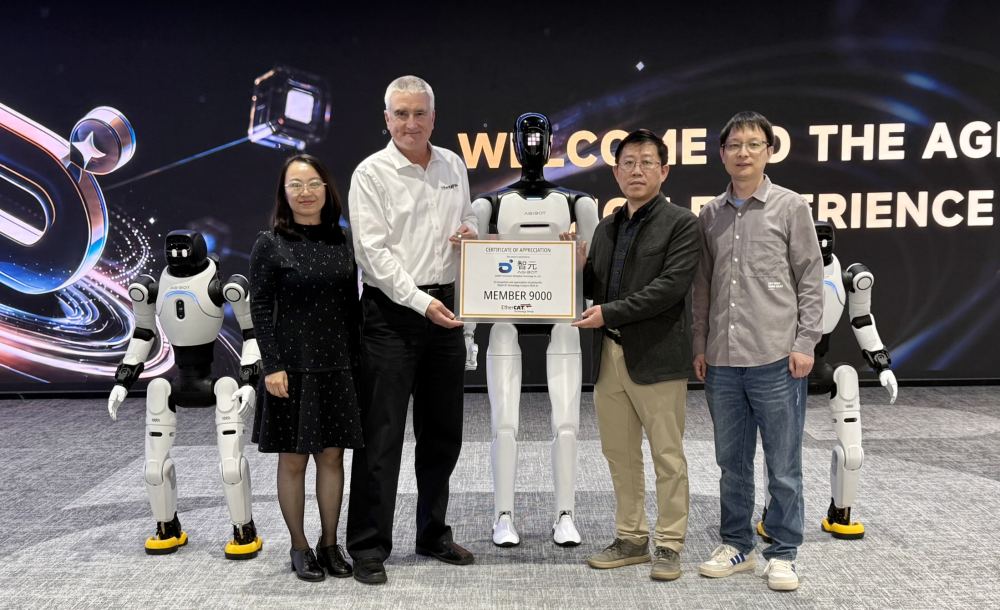
The EtherCAT Technology Group (ETG) has welcomed Agibot as its 9,000th member. The Shanghai-based company builds general-purpose humanoid robots and embodied AI systems. It has produced more than 20,000 humanoid robots so far, which makes it the market leader in this segment.
Why Agibot chose EtherCAT
For a humanoid robot, every joint is a servo axis that must react within microseconds. Agibot already uses EtherCAT in several of its robot models. According to Hu Kuang, Director of Ecosystem at Agibot, the protocol’s very high real-time performance and low latency make it a natural fit for robotic joint control.
Membership adds a further benefit. Agibot expects to gain a deeper understanding of the technology and to apply it more effectively. In addition, the company wants to integrate EtherCAT into its wider hardware ecosystem. It also plans to work with other ETG members to spread EtherCAT in Physical AI applications.
Who is Agibot?
Agibot focuses on embodied AI, meaning AI that acts in the physical world through a robot body. Its “Three Intelligences in One” architecture combines three capabilities in a single system:
- Locomotion Intelligence: walking and moving through the environment.
- Interaction Intelligence: communicating with people and the surroundings.
- Manipulation Intelligence: grasping and handling objects.
The portfolio covers humanoid robots, quadrupeds, dexterous systems and commercial cleaning solutions. Target markets include industry, logistics, services, education and research. In September 2026, the 20,000th Agibot robot left the production line.
ETG in figures
Martin Rostan, Executive Director of the ETG, sees EtherCAT as well positioned in humanoid robotics. He points out that these systems need reliable, high-performance communication and tight synchronization. He also reports a sharp rise in membership applications over recent months. NVIDIA’s recommendation of EtherCAT for Physical AI applications has further boosted this trend.
| Metric | Value |
|---|---|
| Members | Over 9,000 |
| Countries | 81 |
| New members per year (last decade) | Over 400 |
| New members expected in 2026 | More than 700 |
| Members by region | Asia 44%, Europe 36%, Americas 19%, other 1% |
| EtherCAT nodes installed | More than 100 million |
| Founded | November 2003 |
The ETG supports its members with technical help and information. It also safeguards the openness of EtherCAT and drives the further development of the technology. EtherCAT was introduced in 2003 and has been an IEC and SEMI standard since 2007. Full details are available on the official EtherCAT technology page.
Why it matters for engineers
Humanoid robots push motion control to its limits. A single robot contains dozens of joints, and each one must stay synchronized with the others. As a result, the fieldbus becomes a critical design choice. The arrival of the market’s largest humanoid producer therefore signals that EtherCAT is moving beyond classic machine building into Physical AI.
For drive and component suppliers, this opens a clear opportunity. Servo drives, joint actuators and sensors with EtherCAT interfaces could find a new and fast-growing market. Meanwhile, integrators and machine builders can reuse their existing EtherCAT know-how when robots like these reach factory floors. Asia’s strong share of ETG membership also shows where much of this growth comes from, as the recent Chinese edition of the EtherCAT Compendium confirms.
More information about the company and its robots is available on the Agibot website. Earlier ETG milestones are covered in our report on EtherCAT reaching 88 million nodes.