
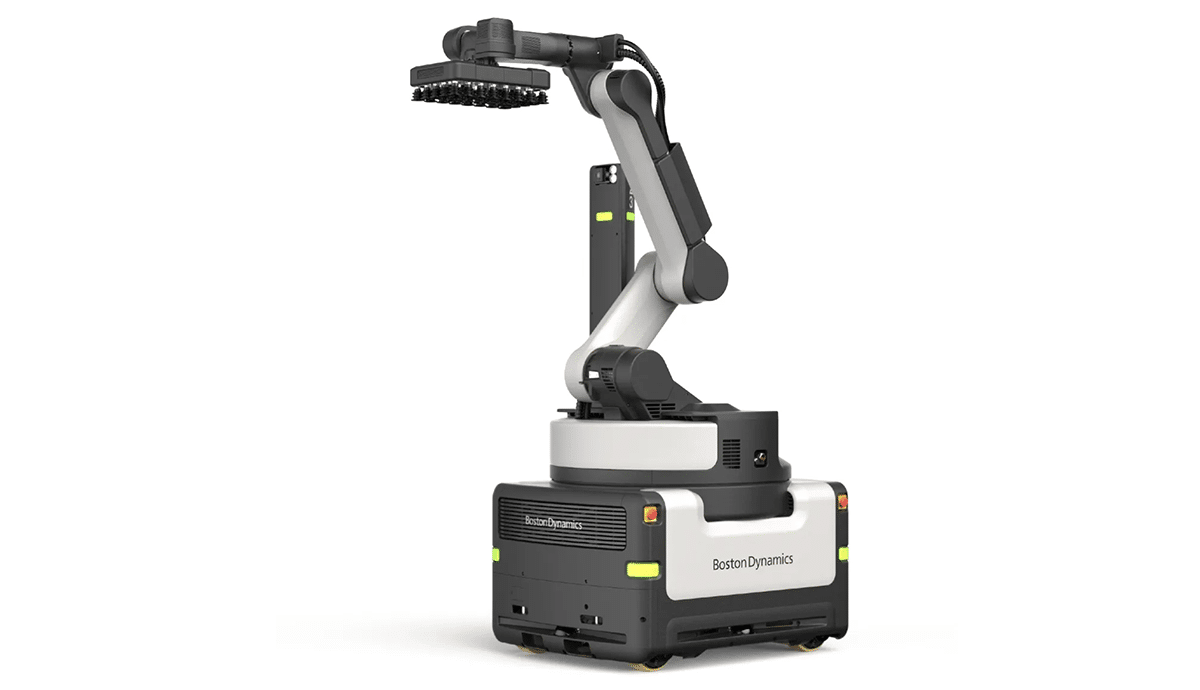
Intralogistics automation is taking a massive leap forward toward maximum operational reliability. Mobile robotics pioneer Boston Dynamics has officially unveiled Stretch Gen 2, the next generation of its autonomous mobile trailer and container unloading robot. This comprehensive hardware upgrade focuses not just on raw speed, but on solving the single biggest challenge in high-volume supply chain environments: maximizing uptime and radically simplifying on-site maintenance.
As a first mover in the robotic unloading space, Stretch remains the clear logistics market leader. To develop this new version, the American engineering team analyzed data from more than 100,000 operational hours in real-world deployments and tens of millions of cases handled by first-generation fleets. Armed with these insights, they completely re-engineered the hardware to target and eliminate the most common causes of unplanned downtime.
Structural Redesign and Critical Cable Reduction
The physical enhancements integrated into the Boston Dynamics Stretch are designed to give the machine heavy-duty, automotive-grade durability. Key hardware modifications include:
- 81 Percent Reduction in Internal Cabling: By removing roughly a half-mile of internal wiring and complex dynamic harnesses, the robot eliminates the single largest source of intermittent electrical faults and wiring wear.
- Automotive-Grade Connectors: Heavy-duty connections have been implemented to withstand the high-frequency vibrations caused by rapid, high-torque box handling and driving over uneven warehouse floors.
- Continuous Rotation Joints: New joints move completely beyond 360 degrees, eliminating hard stops that previously caused mechanical stress and premature component fatigue.
- Upgraded Vacuum Gripper: Equipped with completely new valve systems and more precise proximity sensing to optimize fast-paced picking and placement.
- Enhanced Safety and Shell Materials: The exterior panels feature new shock-absorbing compounds. Additionally, the emergency stop (e-stop) has been lowered and recessed to prevent accidental stoppages caused by falling packages.
“Plug and Play” Modular Maintenance
When a service call is necessary, intervention times have been drastically reduced through a strict modular framework. For example, a full swerve drive swap now takes about one hour, down from a full day in the previous generation.
The use of standardized high-strength fasteners minimizes the need for frequent tool changes during hands-on repairs. Furthermore, Stretch Gen 2 introduces advanced onboard diagnostics and maintenance tools. This empowers a customer’s own facility maintenance team to handle routine service directly, minimizing dependence on outside technical support and keeping the robots working on the dock.
Autonomous Fleet Performance and Evolving Software
On the operational front, the system maintains peak productivity rates, capable of unloading up to 1,000 cases per hour. The final output depends on variables like case weight and how neatly packages are stacked, and it can be optimized using a smart multipick feature.
The robot’s internal computing platform has also been entirely redesigned. Regular software releases continuously optimize case detection, motion planning, and world modeling across an entire fleet—bringing ongoing performance gains without requiring a single physical hardware change.
Stretch Gen 2 features integrated lighting to operate with total autonomy inside dark trailers, a high-density battery pack that easily lasts two full shifts, and a fast charger capable of reaching a 90 percent charge in just 75 minutes. Finally, its pre-trained computer vision system recognizes the vast majority of packaging types right out of the box, ensuring immediate deployment on day one with zero custom programming required.