
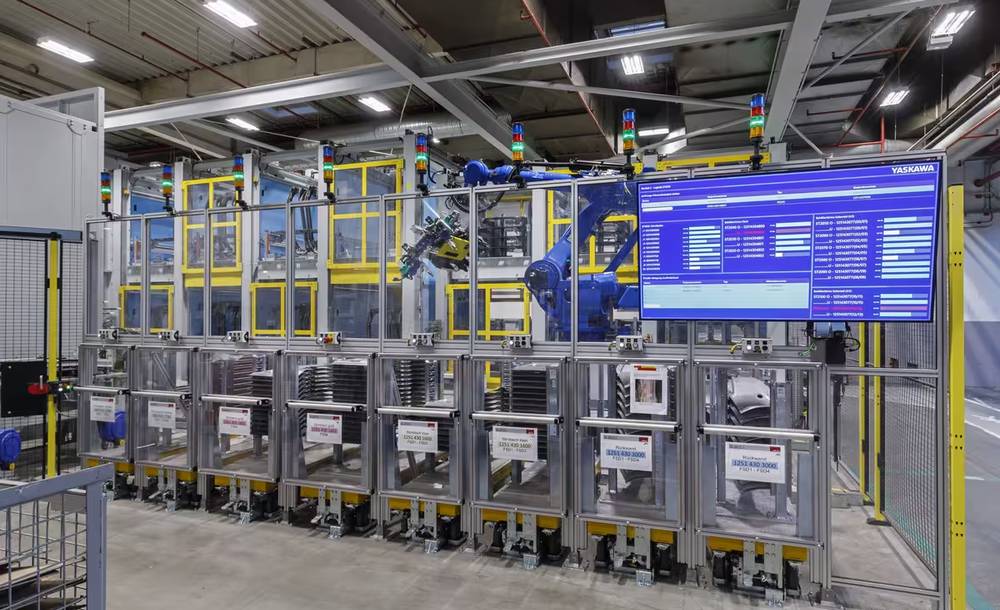
Linde Material Handling now welds the frames and overhead guards of its new 1251 electric forklift series on a highly automated line in Aschaffenburg, Germany. Yaskawa planned and built the system. However, the most interesting part is not the 33 robots. It is the Yaskawa Production System (YPS), the control layer that links every welding station to the plant’s MES and ERP.
The challenge: order-specific forklifts at high volume
Linde MH does not build forklifts for stock. Instead, each truck is produced to order. The welding line therefore has to handle seven frame variants and fourteen overhead guard variants. Frames differ in wheel layout (three or four wheels) and battery type (lead-acid exchange battery or lithium-ion).
At the same time, volumes are high. As a result, the plant needed a line that is both flexible and fully traceable down to each weld.
The solution: 33 robots and one control platform
The Yaskawa arc welding system is split into two modules. In total, 33 robots tack, weld and handle parts. Manual stations for loading complex fixtures sit alongside the automated cells.
YPS ties all of this together. The two companies included it from the very first planning stage. The data flow works like this:
- YPS receives production orders from MES and ERP.
- It passes robot motions, setup and clamping steps and the parameters of every weld point down to robot and PLC level.
- After each job, quality and status data go back to MES and ERP automatically.
The whole project took almost four years from first concept to commissioning. During commissioning and ramp-up, the YPS team worked permanently on site.
Transparency at every station
A large monitor in the hall shows daily and per-shift output of frames and guards. It also displays target/actual deviations and the Overall Equipment Effectiveness (OEE) of the line.
In addition, monitors around the line show the live status of each cell. Colour codes tell operators at a glance whether a station runs in automatic mode, needs maintenance or has a fault. Consequently, operators can react faster and avoid downtime.
Poka-yoke worker guidance
At the manual stations, sensors check that each component sits in the correct position. Each station’s screen shows the loading sequence, the correct position and the current step. “They also visualize feedback from the sensors, ensuring that all processes are transparent and error-free,” says Christopher Taupp, Project Manager Industrialization Projects at Linde MH.
Furthermore, YPS sets the target welding parameters and records the actual values for every weld at every station. Linde MH uses this data for documentation and for targeted process optimization.
Inline weld inspection and remote “zoom-in”
An inline test cell runs two automatic checks. First, it measures the geometry of each frame-and-guard assembly against target values. Second, it inspects the weld seams to DIN EN ISO 5817. This check covers seam length, position and geometry, and it detects pores and end craters.
All results are linked to the component ID. Two monitors show a photo of the part with the non-conforming zones marked for manual review. For service, technicians can also use a tablet to “zoom in” on a cell, right down to a single hydraulic block or valve. This proved useful during start-up, too.
Digital twin for offline programming
Every station also exists as a complete 3D cell in the YPS environment. Engineers can therefore program and optimize robot paths offline, without stopping production. For example, they can improve seam quality or robot motions in simulation first. The same model is used for reachability and collision checks of fixtures and motion sequences.
Why it matters for engineers
Many robot welding cells still run as islands, with quality data stored locally, if at all. This project shows a different approach. Here, one platform handles order intake, cell control, worker guidance, weld data, inline inspection and simulation.
For integrators and plant engineers, the key lesson is timing. YPS was part of the design from day one rather than added after commissioning. In addition, YPS is modular. Available packages include:
- Shift planning, process monitoring and reporting
- Traceability, machine data acquisition (MDA) and operational data acquisition (ODA)
- Dashboard designer and worker guidance
- SQL database viewer and editor
- MES-ERP integration
- Smart maintenance, quality monitoring and energy monitoring
After several months of operation, Linde MH confirms that the line fully meets its requirements. You can read the original Yaskawa case study for more details. For more news from the manufacturer, see our Yaskawa news section, the article on Yaskawa turnkey welding systems at EuroBLECH 2024 and our digital twins and simulation coverage.