
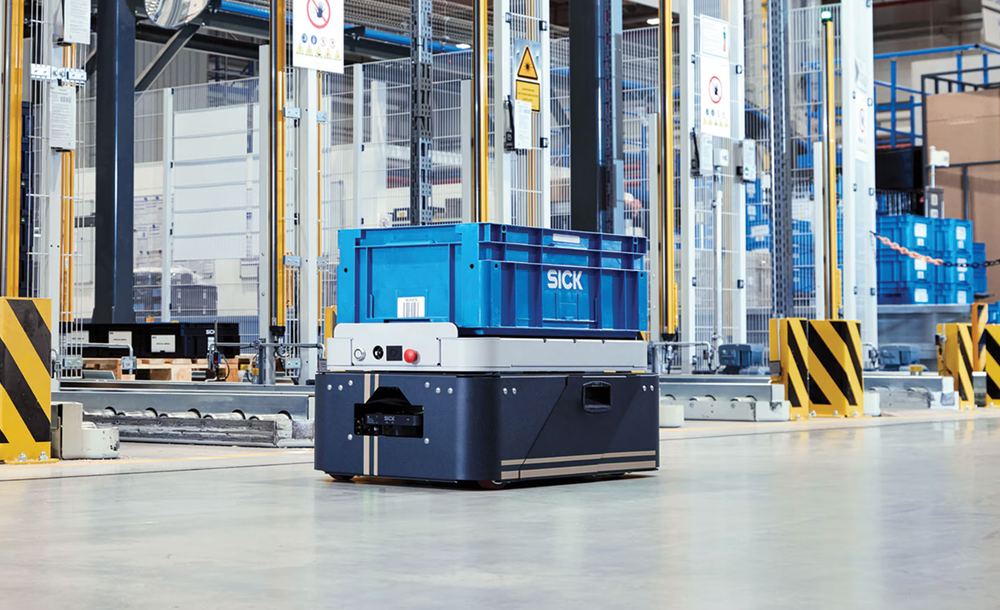
SICK is exploring the next generation of industrial safety together with NVIDIA. The company is testing its Dynamic Safety concept with the NVIDIA Halos safety platform for physical AI. Moreover, the aim is to extend perception and simulation capabilities for robots and autonomous machines.
Why Dynamic Safety matters
Industrial plants are becoming more connected and more autonomous. People, robots, mobile machines and infrastructure now share the same spaces. This creates new opportunities for productivity and flexibility. However, it also raises new requirements for how systems perceive and respond to their surroundings.
SICK Dynamic Safety addresses this need. It combines trusted industrial sensing and machine-safety expertise with richer perception, spatial awareness and contextual awareness. Therefore, robots and machines can work more flexibly when the environment changes.
What SICK and NVIDIA are exploring
The collaboration looks at how sensing, machine safety, perception, AI and simulation can work together. In particular, SICK wants to learn where each technology creates the most value for customers. The work covers four areas:
- NVIDIA Halos on IGX Thor: SICK is testing integration with the NVIDIA Halos safety platform on NVIDIA IGX Thor. The work explores inside-out and outside-in robot perception.
- NVIDIA Metropolis and Cosmos: Both can support visual AI agents and synthetic data generation. Thus, teams can test and deploy robots in logistically complex industrial settings.
- NVIDIA Isaac Sim: It already provides a foundation for SICK virtual sensor models.
- Halos AI Systems Inspection Lab: SICK is a member of this lab. The lab supports the assessment of functional safety, cybersecurity and AI safety in physical AI systems.
Dr. Niels Syassen, Member of the Executive Board for Technology and Digitalization at SICK, expects the partnership to help customers “increase flexibility and productivity”. At the same time, people, robots and autonomous systems should collaborate more safely.
NVIDIA shares this view. Riccardo Mariani, Vice President of Industry Safety at NVIDIA, stresses that safety must scale with physical AI. This matters because robots are entering more dynamic environments.
Why it matters for engineers
For PLC programmers, integrators and machine builders, this is a signal of direction, not a product launch. SICK describes the work as exploratory. Consequently, no products, specifications or availability dates have been announced yet.
Nevertheless, the news shows where safety design is heading. First, functional safety, cybersecurity and AI safety are now assessed together for physical AI. Second, virtual sensor models in simulation give teams a way to test sensing concepts before they reach the shop floor. Finally, richer perception can help machines react to context instead of simply stopping.
SICK already offers related solutions today. For example, read about Visionary AI-Assist for people detection or the safety and AI vision highlights at SPS 2026. In addition, more news from the manufacturer is available in the SICK news category.