
Delta Electronics has published a technical note showing how to control tank level with a variable frequency drive and no external PLC. It covers three setups: two-point control with digital level switches, two-point control with an analog level sensor, and continuous level control through the drive’s built-in PID. Each comes with parameter settings for the C200, C2000 and M300 series and, where applicable, for the VFD-E, VFD-EL and VFD-EL-W compact drives.
Option 1: two-point control with digital level switches
This is the simplest arrangement and works on every drive family covered by the note. Two 24 V digital signals mark the upper and lower tank level and are wired straight to the drive’s digital inputs.
- Filling: the lower level signal starts the pump, the upper one stops it.
- Emptying: the upper level signal starts the pump, the lower one stops it.
- Pumping over from one tank to another: the starting sensors are connected in parallel and the stopping sensors in series.
The schematics in the note show the sensors in the empty-tank state, and an optional enable contact can be added to the wiring.
| Function | C200, C2000, M300 | VFD-E, VFD-EL, VFD-EL-W |
|---|---|---|
| Operation command source | 00-21 = 1 | 02.01 = 1 or 2 |
| Operation control | 02-00 = 3 | 04.04 = 2 |
| Enable drive | 02-04 = 49 | 04.06 = 16 04-09 = 8 |
Option 2: two-point control with an analog level sensor
For C200, C2000 and M300 drives, the two level switches can be replaced by a single analog sensor. The pump runs between two levels set as a percentage of the sensor range, so the thresholds can be changed from the keypad instead of by moving switches in the tank. Delta points out that this configuration does not support pumping over between tanks.
The settings assume the signal rises with the level, as with capacitive or pressure-based sensors. With an ultrasonic sensor, whose signal falls as the level rises, the direction set in parameter 02-18 has to be reversed.
| Function | C200, C2000, M300 |
|---|---|
| Operation command source | 00-21 = 1 |
| Output signal ‘Analog level reached’ | 02-16 = 67 |
| Control direction | 02-18 = 0 (filling) / 8 (emptying) |
| Analog level source | 03-44 = 0 (AVI/AVI1), 1 (ACI), 2 (AVI2/AUI*) |
| Upper level | 03-45 = maximum level in % |
| Lower level | 03-46 = minimum level in % |
* AVI2 and AUI inputs are only available on C200 and C2000 drives.
Option 3: continuous level control with PID
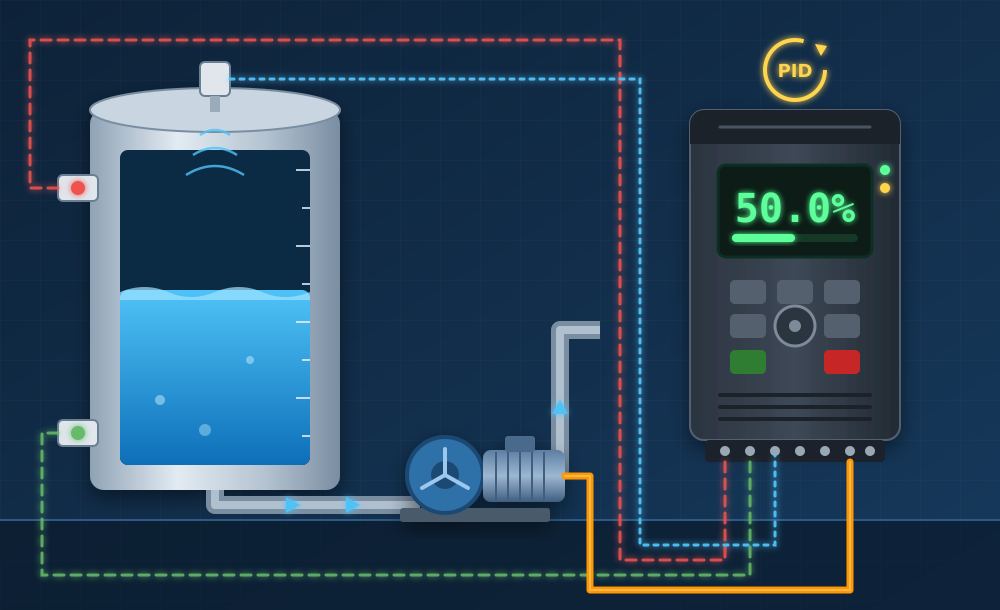
In this mode the drive’s PID controller keeps the level constant instead of switching the pump on and off. The level target is derived from the speed set point as a percentage of the maximum frequency in parameter 01-00. In the note’s example, with 01-00 = 50 Hz and a 25 Hz set point, the controller aims for a 50% tank level.
As in option 2, the default settings assume a signal that rises with the level. For ultrasonic sensors, the function of parameter 08-00 (C200, C2000, M300) or 10.01 (VFD-E, VFD-EL, VFD-EL-W) must be reversed.
| Function | C200, C2000, M300 | VFD-E, VFD-EL, VFD-EL-W |
|---|---|---|
| Feedback source | 03-00 = 5 (AVI) 03-01 = 5 (ACI) 03-02 = 5 (AUI*) | 10.01 = 0 or 1 (AVI) 10.01 = 2 or 3 (ACI) |
| PID level control | 08-00 = 1 (emptying) 08-00 = 4 (filling) | 10.01 = 0 or 2 (emptying) 10.01 = 1 or 3 (filling) |
* AUI input only available on C200 and C2000 drives.
Which option to choose
Digital switches remain the most robust and portable choice, the only one the note describes for pumping over between tanks, and the only two-point option for the compact VFD-E family. An analog sensor adds flexibility, because the start and stop levels become parameters rather than physical positions. Continuous PID control fits processes that need a stable level, with the drive adjusting pump speed instead of cycling the motor.
In all three cases the level logic runs inside the drive, which can remove the need for a separate controller on small pumping skids. Delta notes that the document is intended for qualified personnel and does not replace proper technical training. The full note, alongside other Delta technical notes, is available on the Delta EMEA AC motor drives page, and details of the current high-end range are on the C2000 Plus series page.
More news from the manufacturer is available in our Delta Electronics products section, and downloads are collected in the Delta download area.