
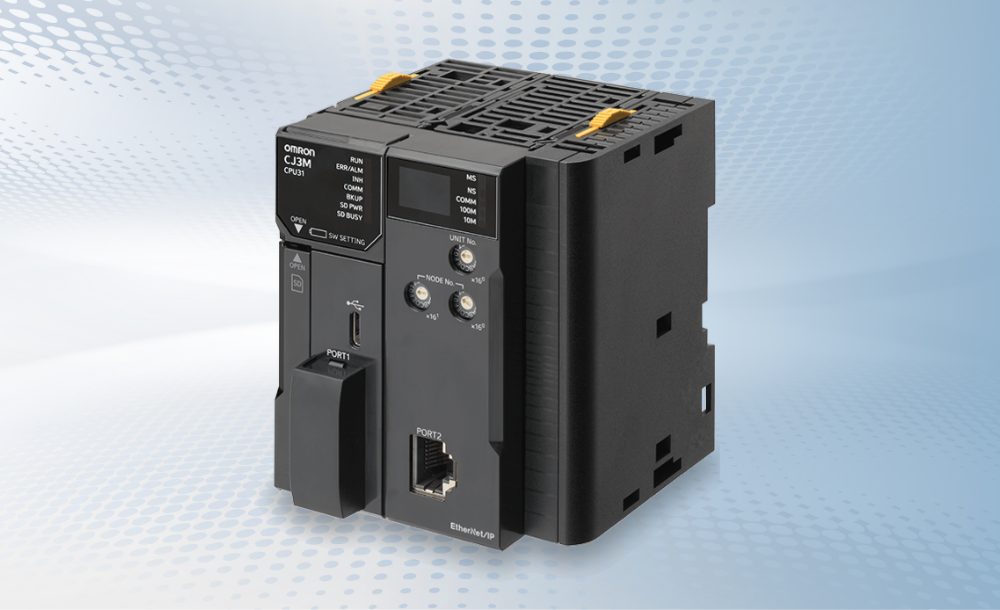
OMRON has released the CJ3M Programmable Controller, the newest generation of its modular CJ Series. The PLC targets new machines as well as the expansion and modernisation of existing lines. Its headline change is built-in cybersecurity, but it also brings more performance, simpler engineering and battery-free operation.
Security functions built into the CPU
Until now, many compact PLCs relied on the network around them for protection. The CJ3M, by contrast, handles key security tasks inside the controller itself. OMRON lists four main functions:
- Encrypted communications
- User authentication with role-based account management
- IP packet filtering
- Port open/close control
Together, these functions help block unauthorised access, data tampering and information leakage. In addition, the controller complies with China’s mandatory GB standards. OMRON also plans support for the EU Cyber Resilience Act (CRA), although this has not yet been confirmed.
Technical specifications
| Maximum I/O | Up to 5,120 points, with up to seven expansion racks |
| Program memory | Up to 100K steps, plus 40K steps for function blocks |
| Basic instruction time | 0.04 µs |
| Communications bandwidth | 12,000 pps |
| Ethernet functions | EtherNet/IP, Modbus/TCP, socket communications |
| CPU range | Ten models from 5K to 100K steps, with or without built-in EtherNet/IP |
| Positioning | Up to four axes with a Pulse I/O Block |
| Interfaces | USB Type-C and SD card |
The CPU also runs without a battery. A battery is only needed when the clock function is used and the unit may face long power interruptions. As a result, maintenance teams have one less consumable to track.
Engineering with CX-Programmer
Programming still takes place in CX-Programmer, part of the CX-One suite. Engineers can work in Ladder, Structured Text or Sequential Function Chart (SFC). Several changes target daily commissioning work:
- Trace targets can be registered directly from the Ladder or Watch Window.
- CPU tag sets for EtherNet/IP data links are generated automatically.
- Larger trace memory makes debugging easier.
Upgrading from CJ2M by replacing only the CPU
For the installed base, compatibility is probably the most practical point. The CJ3M accepts CJ2M programs, memory maps and I/O Units. Therefore, an existing CJ2M system can move to the new generation by swapping only the CPU Unit. OMRON describes the migration in four steps:
- Read out the existing project.
- Convert the data.
- Replace the CPU Unit.
- Transfer the program and verify operation.
A replacement path from the older CS Series is also available. Full details are on the OMRON CJ Series product page.
Why it matters for engineers
Regulation is pushing security into the device itself. The CRA, for example, will place security obligations on products with digital elements sold in the EU. Other suppliers are moving the same way, as shown by the ReeR MOSAIC cybersecurity update for the CRA.
For machine builders with CJ2M-based designs, the CJ3M offers a low-risk route. They gain encryption and access control without rewriting code or rewiring I/O. Meanwhile, integrators keep the familiar CX-One environment, so retraining needs stay small. Long-term global availability, which OMRON highlights, also matters for machines with long service lives.
More news from the manufacturer is available in our OMRON section. For a wider view of the topic, see our report on cybersecurity and industrial AI at SPS 2026.