
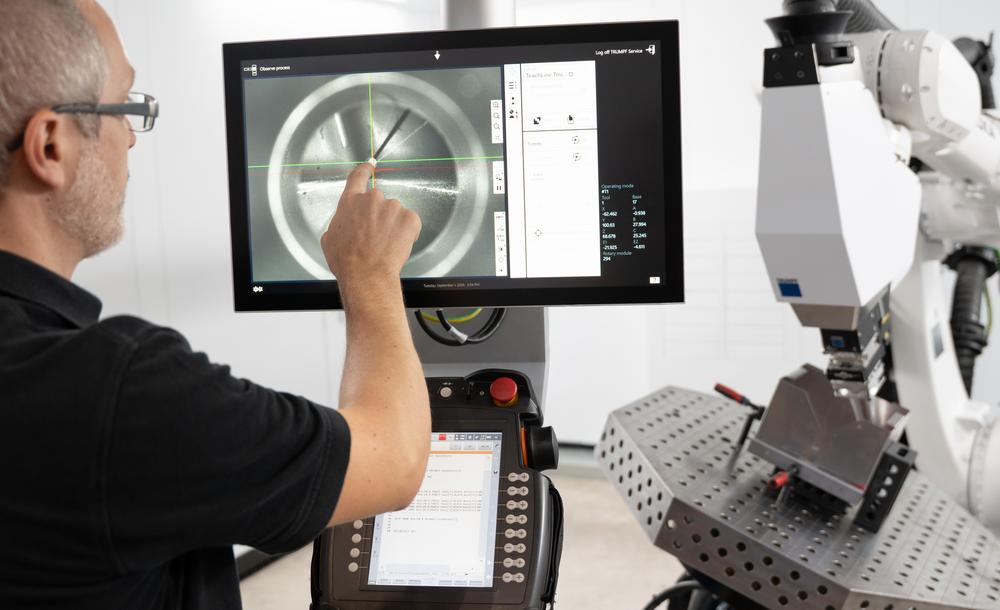
AI makes programming the new TruLaser Weld 3000 much faster and simpler // Compact welding optics reach deep into hard-to-access areas of a component // Designed for manufacturers with many part variants and little floor space
Many manufacturers struggle with the same three problems: they can’t find enough skilled workers, their components change frequently, and their shop floors are already full. TRUMPF addresses all three at EuroBLECH 2026 with the TruLaser Weld 3000. The new robotic laser welding cell uses artificial intelligence to cut programming time dramatically, and it fits into a very small footprint. The show runs October 20-23 in Hannover.
“The TruLaser Weld 3000 provides competitive advantages, particularly for companies that manufacture high-quality sheet metal assemblies and housings in small batches with a wide variety of variants. It enables stable processes, short cycle times, and thus a high degree of flexibility in production,” says Moritz Berger, product manager at TRUMPF.
Up to 50 percent less programming and setup time
Operators can program the TruLaser Weld 3000 in two ways. They can work at the machine in the traditional way, or they can program offline with TruTops Weld software, for example from an office workstation. Offline programming pays off when parts change often, because new programs can be prepared on a computer while the cell keeps welding. Programs generated from CAD data are also created much faster than programs taught by hand.
Any small deviations are then corrected with the TeachLine Touch function. Operators simply tap the machine’s screen to move a weld point to the right position. As a result, programming and setup take up to 50 percent less time. The optional TeachLine AI extension makes corrections even easier. Its AI-based process identifies deviations at the weld points and adapts the robot path to the real geometry of the part. This speeds up setup for new components. It also means that staff with less welding experience can run the cell confidently.
Smaller optics for a wider range of parts
TRUMPF has developed new welding optics for the TruLaser Weld 3000 that are roughly 40 percent smaller than before. The compact head lets the robot reach tight spots inside a part, such as the inside of deep housings, crates, and boxes. Manufacturers can therefore automate more of their part portfolio and spend less time on manual rework.
To keep the process stable and the weld quality high, TRUMPF builds on proven laser welding technologies:
- BrightLine Scan pairs a high-frequency scanner with motorized focus adjustment. It bridges gaps of up to 0.4 mm and produces wider seams that compensate for part tolerances.
- BrightLine Weld splits the laser power between an inner and an outer core of the laser light cable. This cuts spatter, especially in deep welding, and delivers clean, high-quality seams.
- FusionLine adds filler wire to the laser process for precise material deposition. It handles larger gaps of up to about 1.5 mm and materials that need filler metal.
Compact footprint, flexible setup
The protective enclosure of the TruLaser Weld 3000 covers just 3.65 x 3.65 meters. That is about 24 percent less floor space than the smallest TruLaser Weld 5000, which makes the new cell a strong fit for crowded production halls. Despite its small size, it can weld pallet-sized parts, thanks to a KUKA Iontec robot with a reach of 2,100 mm. For part positioning, users can choose a standard welding table, a tilt-rotate positioner, or a compact rotary changer that allows loading and unloading while the cell is welding.
Available with 3 kW or 4 kW of laser power, the TruLaser Weld 3000 welds stainless and structural steel up to 8 mm thick and aluminum up to 6 mm thick. Typical fields of use include equipment and plant engineering, sheet metal parts for data centers, medical technology, and the commercial kitchen and food industries.