
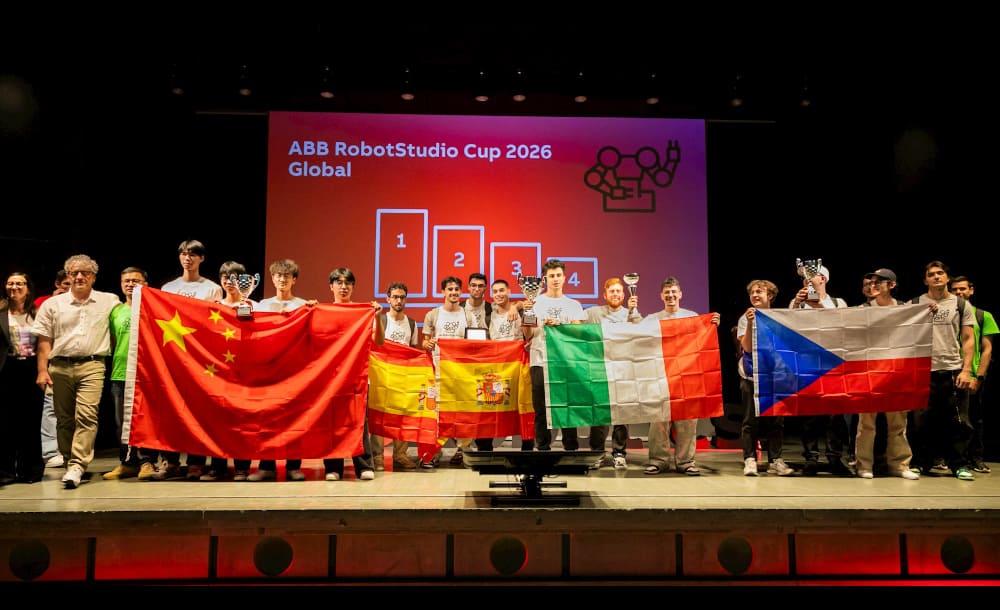
Four finalist teams, from China, Spain, Czech Republic and Italy competed in a series of challenges based on real-world problem-solving, using industrial-grade robotics tools, designed to test advanced robot programming skills. Tasks included intelligent parts sorting, precise palletizing and collision-free mobile route planning.
All the exercises required the use of RobotStudio, ABB Robotics’ simulation and offline programming software suite, paired with an ABB IRB 1100 robot. Together, these highlight the increasing importance of virtual simulation in the design, test and commissioning of precision robotic processes.
On receiving the winner’s trophy, Stefano Calista from Università degli Studi dell’Aquila said: “We’re delighted and proud to hold this title for our university. Access to real-world tools and scenarios in initiatives such as RobotStudio Cup is a valuable and powerful driver for STEM learning.”
ABB Robotics plays an active role in inspiring future automation talent and supporting STEM learning, providing students and educators hands-on access to its advanced robotics tools used by ABB Robotics’ customers worldwide. The ABB Robotics’ RobotStudio Cup is an annual event that enables students to strengthen their technical skills, problem solving capabilities and confidence in professional robot programming workflows. By providing this resource and platform for practical learning, ABB Robotics empowers people to harness the potential of robotics and AI in the workplace, and supports the growth of higher-value, creative and technical roles, for more productive, sustainable and resilient workplaces.
“Supporting the next generation of innovators and STEM learning is core to our mission at ABB Robotics,” said Marc Segura, President, ABB Robotics. “The growing role of automation and artificial intelligence is already changing how we work. To benefit, it is vital that people have the skills and knowledge to embrace this exicting transformation. We’re committed to nurturing future automation talent, and the level of skills demonstrated at this year’s event shows just how important this next generation will be in shaping the future of robotics – and in transforming how we work.”