
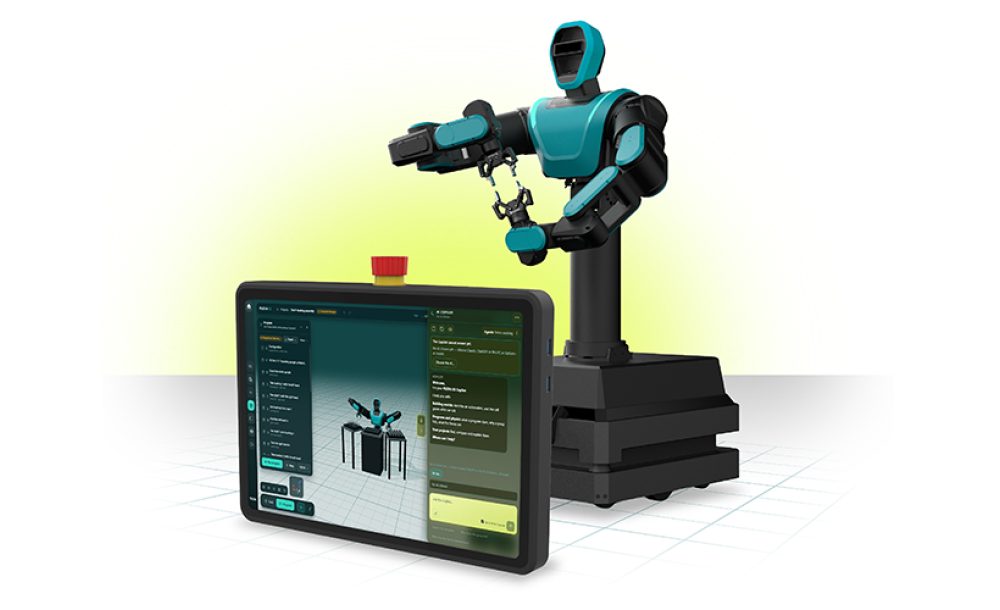
fruitcore robotics has introduced PLEXA OS, an AI-native operating system for its industrial humanoid PLEXA One. The software links AI agents, physics-based simulation and proven industrial robot control in one platform. Its goal is simple: turn an instruction into a reliable robot application without starting a new programming project each time.
Three software layers
PLEXA OS is organized in three layers that build on each other:
- Intelligence: AI agents read natural-language instructions, sketches or CAD data. Then they design the robot cell and generate the program. The user reviews and approves the proposal.
- Simulation: movements and process sequences are tested and refined in a physics-based virtual environment before deployment.
- Execution: this layer builds on fruitcore’s existing robot operating system. It provides deterministic control and coordinates connected equipment. In suitable applications, the integrated PLC functionality can replace a separate PLC.
Importantly, functional safety does not move to the AI. It stays with the robot’s embedded safety controls.
Three ways to run a task
Users can drive a task in three modes, and they can combine them:
- Agent mode: an AI agent chooses from a set of permitted capabilities.
- Program mode: defined logic is taught and tested for repeatable runs.
- Streaming mode: external systems supply the motion targets. These can be teleoperation controllers or learned policies, including VLA models.
As a result, conventional and AI-supported automation can run in the same architecture. For example, a robot can sort packages by reading their labels, without each movement being programmed.
Open interfaces for integrators
For system integration, PLEXA OS offers APIs, Python and TypeScript SDKs and the Model Context Protocol (MCP). These connect external apps, camera systems, MES and ERP. Through MCP, AI agents can read the robot status, preview motions and start approved tasks. Permissions are set per deployment. The details are published in the fruitcore developer documentation.
Other key features include:
- Graphical programming and guided workflows
- Integrated robot, peripheral and process control
- Defined roles, permissions and approvals
- Repeated trials in simulation for suitable applications
- Choice of supported cloud AI models or suitable models running locally
Why it matters for engineers
Today, a new robot application usually means a new engineering and programming project. PLEXA OS aims to shorten that path for material handling, assembly and multi-step automation. Moreover, approvals and simulation keep the engineer in control before anything moves on the shop floor. According to CEO Jens Riegger, industrial AI must go beyond understanding instructions and “turn them into reliable actions in the physical world.”
The launch continues fruitcore’s software strategy. Earlier, the company added an AI copilot to its horstOS operating system for HORST robots.
Availability
PLEXA OS is included with every PLEXA One, a modular humanoid platform made in Germany. An overview is available on the fruitcore software stack page. In addition, fruitcore will hold a free live webinar in German on 26 November 2026, from 11:00 to 11:45 CET. More news is listed in our fruitcore section.