
At this year’s IMTS show, Teradyne Robotics’ Universal Robots (UR) — the company credited with pioneering the collaborative robot category — pulled the wraps off Gen 7, the newest generation of its robotics platform.
Rather than a single product launch, Gen 7 is a ground-up overhaul of the entire UR ecosystem. Built around the new PolyScope X operating system, it pairs a redesigned control box, teach pendant, and tool flange to simplify even complex integration jobs for the people who use these machines daily.
Teradyne Robotics Group President Jean-Pierre Hathout framed the release as a response to rising demand for AI-capable automation, explaining that the update draws on two decades of cobot experience and well over 100,000 real-world installations. According to Hathout, the goal was to strip away integration friction and open the door to more sophisticated AI-driven applications on the factory floor.
What’s New in Gen 7
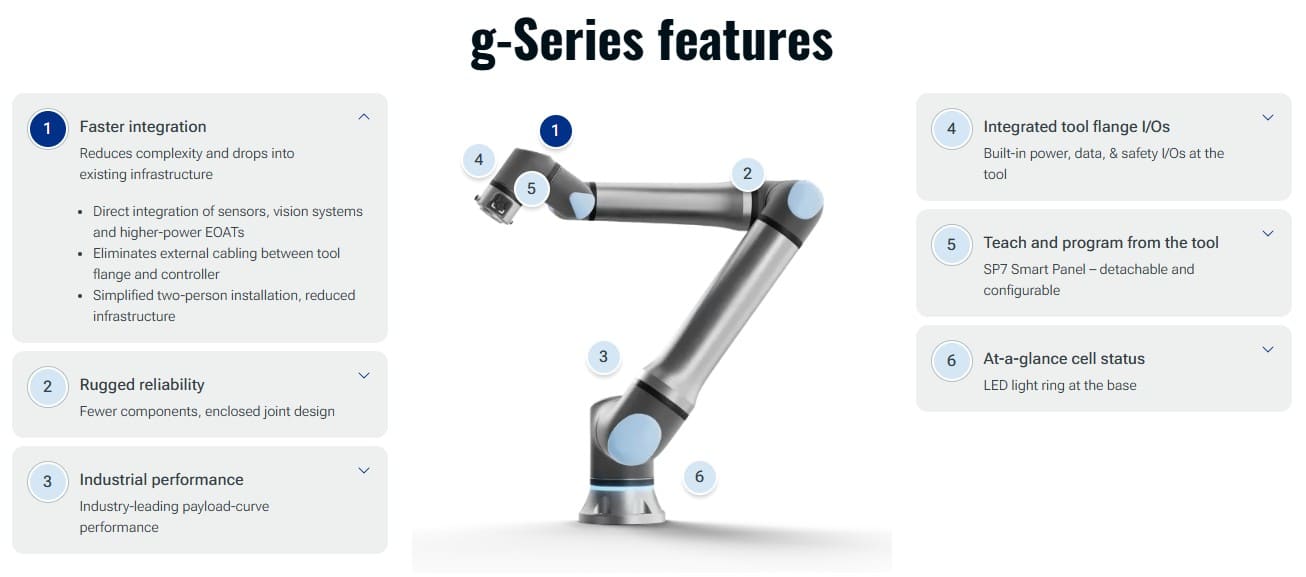
Next-generation arms built for AI. Three new g-Series arms join the lineup — the UR10g-1750, UR17g-1300, and UR18g-950 — each named for its payload capacity and reach. Their redesigned tool flange routes power, data, and safety signals directly to attached sensors and cameras, cutting down on wiring and making it far simpler to add the vision hardware that AI-driven tasks require. Built-in force-torque sensing and impedance control also give the arms tactile feedback, useful for delicate assembly or manipulation work.
A smaller, faster controller. The new CB7 Core controller packs 40% more processing power into a housing that’s 30% more compact than earlier versions. It can talk to PLCs, HMIs, MES systems, industrial PCs, and vision platforms simultaneously, often removing the need for extra network switches. It ships in both a standalone box and a compact panel-mount version, and it’s backward-compatible with e-Series and UR Series arms.
PolyScope X software. This is the operating layer tying everything together — offering modern programming tools, ISO 10218-1 safety compliance, and built-in cybersecurity protections. Open APIs and ROS2 support let developers build edge-AI applications, and optional add-ons unlock features like ProfiSafe and OPC-UA, along with access to third-party tools such as Rocketfarm Pally and Inbolt’s 3D vision guidance.
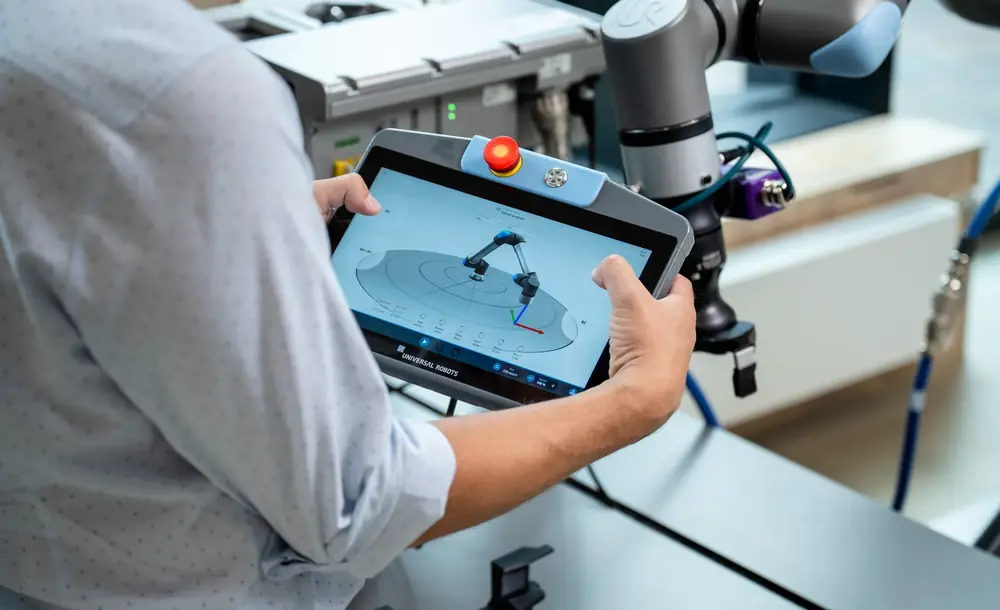
A lighter teach pendant. The TP7 Core pendant is over 20% lighter than its predecessor, with a full HD screen, configurable buttons, a new virtual joystick, and multiple ways to hold it comfortably during long shifts.
Tool-flange-mounted controls. The new SP7 Smart Panel puts freedrive, LED status indicators, and three programmable buttons right at the tool flange — useful for operations where workers need to teach or adjust the robot on the spot, such as high-mix, low-volume production runs.
Certifications across the board. Gen 7 carries a PLd, Category 3 safety architecture under ISO 13849-1. The g-Series arms are TÜV-certified to ISO 10218-1 and UL 1740, and Teradyne Robotics holds IEC 62443-4-1 ML3 cybersecurity certification.
Partners Showcase the Broader Ecosystem
UR used its IMTS booth to spotlight more than 20 ecosystem partners building on top of Gen 7, including Cognex, Schunk, Magswitch, Smooth Robotics, Psyonic, Robotiq, and Inbolt. These demos highlight the platform’s open architecture, which lets vision, gripping, and AI companies integrate directly with UR hardware and software.
Inbolt CEO Rudy Cohen noted that his company’s vision system now runs natively on the UR controller through PolyScope X, removing the need for a separate vision PC or added cabling — something he said lets manufacturers get parts positioned correctly without custom fixtures and move to production in hours rather than weeks.
All of this sits within UR+, the company’s certified partner-product ecosystem, where every add-on is tested by both UR and the partner before release — reducing integration risk for end users.