
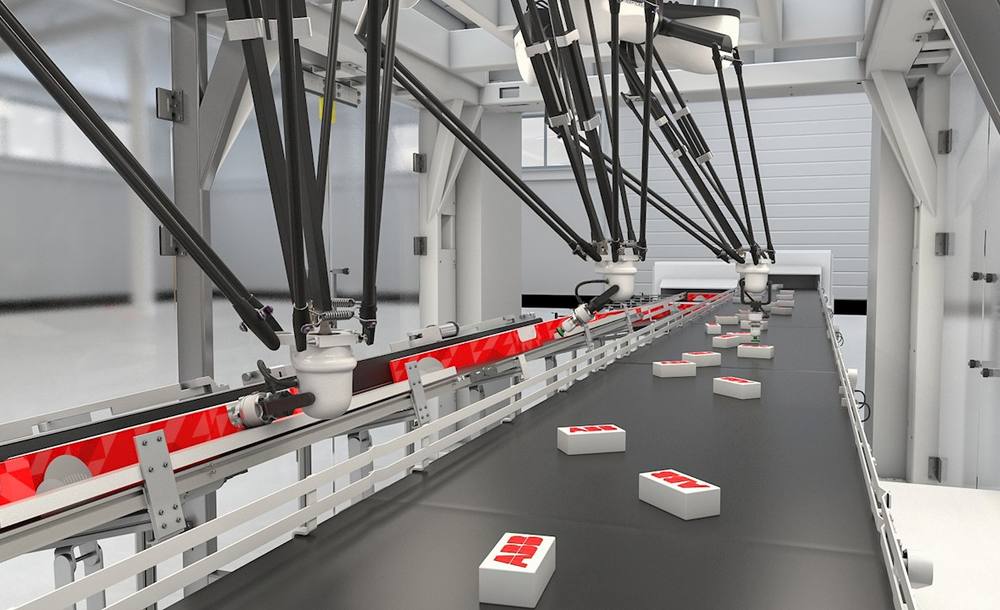
ABB Robotics has published a set of answers to the questions logistics managers and system integrators most often raise about robotic picking. The document covers its AI-powered Item Picking Family, made up of three pre-engineered modules for mixed-SKU order fulfilment, fashion induction and parcel induction, and explains how they are sized, integrated and validated before deployment.
Three modules for three picking tasks
The ABB Robotics Item Picking Family is split by application rather than by robot size. According to ABB, the selection process starts with the items, the packaging and how they are presented, followed by the required throughput and the surrounding workflow.
- Robotic Item Picker: general item picking and mixed-SKU order fulfilment.
- Robotic Fashion Inductor: apparel and accessories in polybags, paper bags and other common fashion packaging.
- Robotic Parcel Inductor: parcel singulation and sorter induction.
Target sectors include e-commerce, fashion, pharmaceuticals, electronics, parcel handling and general logistics, especially where items arrive unsorted, overlapping or randomly placed and where peak volumes have to be absorbed without adding staff.
Performance figures
| Parameter | Value (depending on application) |
|---|---|
| General item picking | Up to 1,400 picks per hour |
| Fashion induction | Up to 1,300 picks per hour |
| Parcel induction | Up to 1,500 picks per hour |
| Vision accuracy | Up to 99.5% |
| Typical payback | Under two years |
ABB stresses that real-world results depend on the items, their presentation, the workflow and the chosen configuration. The business case is built on throughput, accuracy and labor utilization, plus fewer errors, less rework and fewer returns.
AI vision for cluttered bins and deformable packaging
The vision system detects items in cluttered totes, boxes and containers, recognizes their position and orientation, selects a grasp point and guides the gripper along a collision-aware path. The supported item range covers cuboids, cylinders, tubes, bottles, blister packs, pouches, boxes, polybags and irregular shapes.
For the Robotic Fashion Inductor, the AI has been trained specifically to find stable grasp points on highly deformable items and to cope with light reflection on plastic film and pouch sagging, two well-known causes of failed picks in apparel logistics. New item profiles can be added with AI Robot Trainer, which lets teams build and adapt vision models around application-specific objects and product variants.
Integration, simulation and scalability
On the controls side, the modules connect to warehouse management systems, conveyors, sorters, PLCs and other operational technology. The Application Controller Platform coordinates robot, vision, gripper, picking logic, error handling and peripheral interfaces from a single application, running on OmniCore control.
Before installation, RobotStudio can be used to simulate the cell: layout, robot reach, paths, cycle times and interaction with other equipment. ABB positions this as a way to catch problems earlier and cut on-site programming and commissioning time. The modules are also intended to scale with changing volumes, product ranges and workflows.
Why it matters for integrators
The key point for system integrators is that the core picking application – detection, grasping and motion – is delivered pre-engineered instead of being developed from scratch. That shifts the integrator’s effort from vision and grasping R&D to the parts that differ from project to project: PLC and WMS interfacing, conveyor and sorter handling, and safety. Integrators who need a tailored solution can still combine ABB robots and cobots, vision, gripping, OmniCore, the Application Controller Platform and RobotStudio, with support from ABB specialists on items, workflows, performance targets and integration requirements.
More news from the manufacturer is available in our ABB products section, and other suppliers can be found in the automation manufacturers directory.