
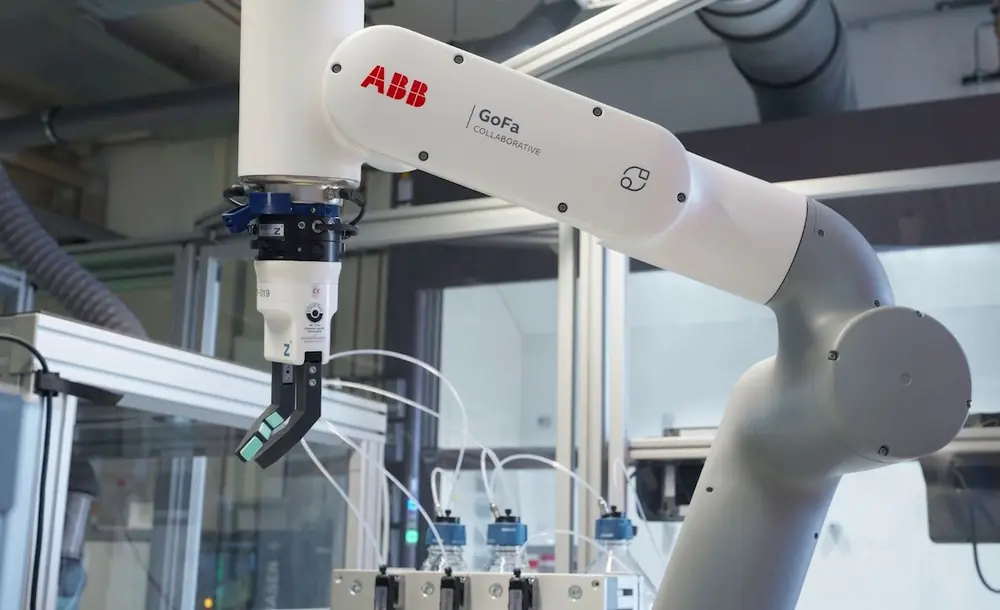
Materials science sits at an awkward crossroads in the energy transition. Breakthroughs in green hydrogen production or industrial CO₂ reuse all depend on finding the right materials first — yet that discovery process is notoriously slow. Berlin-based startup Dunia Innovations is trying to close that gap with an AI-driven “self-driving lab” that pairs machine learning with a collaborative robot from ABB Robotics and precision instruments from METTLER TOLEDO.
Why materials research lags behind digital AI
Large language models can draw on decades of curated, machine-readable text. Materials science has no equivalent. Experimentation is expensive, so researchers have historically tested only a narrow slice of possible chemical combinations. Records are often inconsistent, and much of the hands-on lab work — weighing, dosing, mixing — is still done by hand. That gap between what AI can imagine and what a lab can verify is exactly what Dunia set out to close.
A closed-loop “Design-Make-Test-Analyze” system
Dunia’s platform runs on a repeating cycle: AI models propose new material formulations, a robotic cell prepares and tests them, and the resulting data flows straight back into the algorithm to refine the next round of predictions. At the center of the physical side of that loop is a modular robotic cell built around ABB Robotics’ GoFa cobot, working alongside METTLER TOLEDO’s lab-grade dosing and measurement equipment. The cell was simulated and commissioned using ABB’s RobotStudio offline programming software, which let the team get the setup running quickly without disrupting other lab operations.
Because GoFa is designed for safe human-robot collaboration, it can share bench space with researchers while handling repetitive, precision-dependent steps — solid dosing, liquid dosing, and dispersion — that show up across nearly every materials-science workflow.
“Ultimately, any simulation is only as good as its proximity to reality. Robust datasets are generated through experiments. That’s why it is crucial for us to drastically shorten the path from a model idea to a real measurement,” says Marcus Tze-Kiat Ng, Co-Founder of Dunia Innovations.
Freeing scientists from three hours of manual prep
Before automation, lab specialists could lose up to three hours a day to manual weighing, sample prep, and mixing. Now those steps run overnight, so researchers arrive to prepared samples and can spend their time designing experiments and interpreting results instead.
“Our goal is to generate maximum insight with minimal experimental effort,” Ng adds.
The efficiency gain shows up directly in the numbers: in one project, Dunia’s AI-guided automation reached its target material in 20 experimental cycles. The company estimates a conventional, sequential testing approach would have needed more than 200 iterations to get there.
Jose-Manuel Collados, Business Line Managing Director for Service Robotics at ABB Robotics, frames it as a broader shift: “Robots are the physical manifestation of AI, and AI’s true value can only be realized when digital intelligence can drive reliable action in the real world. By combining ABB Robotics’ flexible robots with Dunia’s AI-driven materials discovery platform, researchers can automate and accelerate the entire Design-Make-Test-Analyze cycle, creating the foundation for AI Self-Driving Labs.”
Cutting the cost of the energy transition
The approach isn’t just faster — it can also point toward cheaper materials. In a recent green-hydrogen project, Dunia’s algorithm identified an electrode-material combination that avoided costly metals like platinum and ruthenium, lowering the capital cost of scaling up green and clean energy projects.
What’s next: three cells, then a Gigalab
Dunia’s current robotic cell is designed as a template. The next step is connecting three standardized cells with an autonomous mobile manipulator to create a fully automated, end-to-end materials-research line. Longer term, the company is planning a much larger facility — a “Gigalab” — where up to 60 automated cells would operate in parallel, aiming to deliver a new, market-ready material roughly every 30 days.