
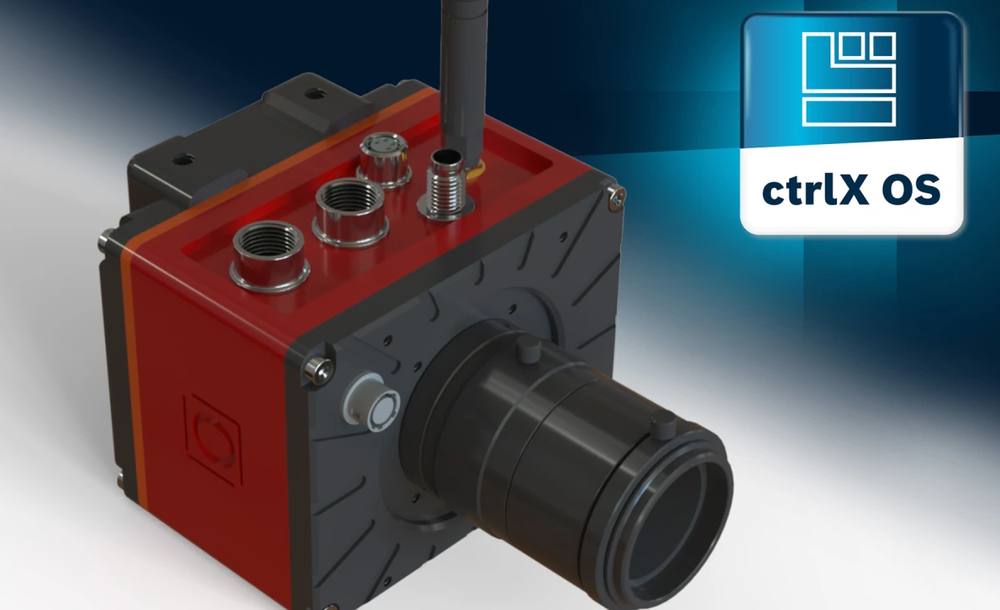
Machine vision applications vary enormously in the computing power they require, from a compact camera mounted on the machine to a high-performance server in the plant. Until now, that range has usually meant working with several platforms and development tools, adding engineering time to every project. evopro systems engineering AG wants to change that: the company has built its new vision automation platform on ctrlX OS, the Linux-based operating system from Bosch Rexroth, and has become an official ctrlX OS OEM partner.
Key points
- evopro systems engineering AG is now a ctrlX OS OEM partner
- The evoVIU VIUx is presented as the first software-defined camera on the new platform
- The VISIONWEBx vision software is now offered as an app in the ctrlX OS Store
A software-defined camera on a new platform
evopro, part of the Bertrandt group, is introducing the evoVIU VIUx, a camera that brings together machine vision, edge AI and automation right at the machine. To make this possible, evopro has ported its VISIONWEBx software to ctrlX OS. As a result, vision applications share a single development and runtime environment that runs on any hardware equipped with ctrlX OS.
According to Steffen Winkler, Senior Vice President Sales for Automation & Electrification Solutions at Bosch Rexroth, the partnership brings in an OEM that tightly links machine vision and automation. He explains that combining VISIONWEBx with ctrlX OS gives users a continuous foundation spanning cameras, edge controllers, IPCs and servers, so they can pick the right hardware and develop their vision application just once.
One code base, several performance levels
The core of the architecture is the port of VISIONWEBx to ctrlX OS. This browser-based environment lets engineers build, configure and run visual workflows, and because ctrlX OS is hardware-independent, the same environment works across different device classes.
In practice, an application can start on the evoVIU VIUx at the machine and later move to a ctrlX CORE controller, a ctrlX IPC with GPU, or a server running the virtualised version of ctrlX OS as demands grow. Engineering know-how and the development environment remain the same, so there is no need to redesign the vision solution every time the hardware changes.
Vision and automation in one device
The evoVIU VIUx takes the SmartCam concept into the software-defined era. Images are captured and processed where they originate, and results reach automated processes and AI-based decisions with minimal latency.
Processing power comes from an NXP i.MX95 processor paired with a Hailo-8 AI accelerator. Sensor options range from SWIR and high-resolution global-shutter sensors to ToF for 3D depth measurement, covering tasks such as quality inspection, OCR and code reading, anomaly and object detection, and process monitoring.
Because the camera is closely tied to the control system, the data it produces can feed downstream processes immediately. Drives and other automation components, including axes, can be connected over EtherCAT, while separate interfaces link the camera to both IT and OT networks.
Open architecture for vision and AI
ctrlX OS serves as the camera’s operating system and its software bridge to automation. Its open, app-based design lets vision and AI functions run alongside automation and communication tasks on one platform.
The partnership also highlights that ctrlX OS is not tied to Bosch Rexroth control hardware: device makers can use it as the base for their own products. evopro has additionally joined the ctrlX World partner network, so VISIONWEBx can be combined with other apps from the ctrlX OS ecosystem.
Stefan Kraus, Head of Product Development and Product Manager evoVIU at evopro, points out that physical AI depends on image processing, AI and automation working hand in hand, and that information from the environment must be turned straight into action. In his view, the open software architecture makes it possible to mix vision and AI functions freely with other automation tasks.
Applications from inspection to robotics
The platform targets a broad set of industrial uses. In production, it supports quality control, OCR and code reading, and process monitoring, with AI added as required. In robotics, visual data enables object recognition, localisation and pick-and-place, an approach also seen in solutions such as KUKA iiQKA.AI Vision. In intralogistics, the system can identify and track objects and monitor material flows, as in other robot-plus-machine-vision projects where image processing becomes a built-in part of the automated process.