
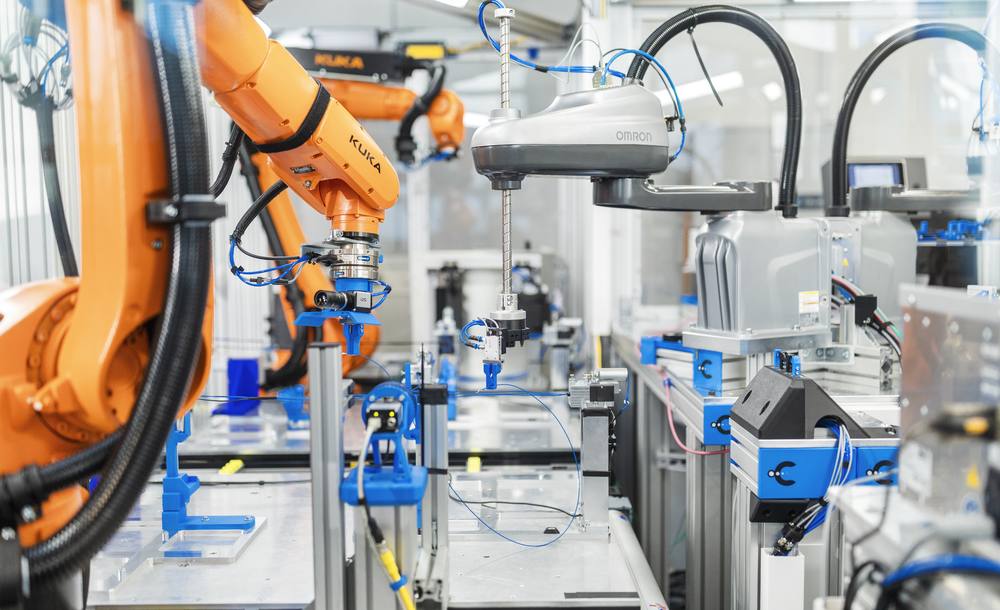
Why wire harness assembly has resisted automation
Wire harnesses for the automotive industry have always been assembled by hand. Stuttgart-based Cellios GmbH has now built a modular robot system that performs the whole assembly process automatically. It combines high-precision robot control with the MVTec MERLIC machine vision software. The system could make harness production viable again in high-wage countries, while cutting costs, improving quality and reducing CO₂ emissions.
Robots have been doing welding, painting, palletizing and many other jobs for decades. Wire harness assembly is one of the few big manufacturing tasks still done mostly by human hands. The problem is the material. Cables bend, twist and never keep a fixed shape, so a robot can’t handle them the way it handles a rigid part.
Because the work depends on manual labor, harness production has tended to follow low wages from one country to the next. That model is now under pressure. Demand keeps growing, companies want more resilient supply chains, and manufacturers want to bring production closer to their home markets. All of this has pushed automation up the agenda.
A spin-off from Fraunhofer IPA
Cellios was founded in 2024 as a spin-off of the Fraunhofer Institute for Manufacturing Engineering and Automation (IPA) in Stuttgart. It focuses on robot-based systems for cable assembly. Its main product is a family of modular robot cells that digitize and automate work that used to be done manually.
To build what the partners describe as the world’s first fully automated wire harness, Cellios worked with TE Connectivity. Dr. Frank Nägele, CTO at Cellios, says earlier approaches usually automated only individual steps, so pre-assembled cables still needed manual finishing. The goal with TE Connectivity was to automate the whole chain, from the first process step through to electrical testing.
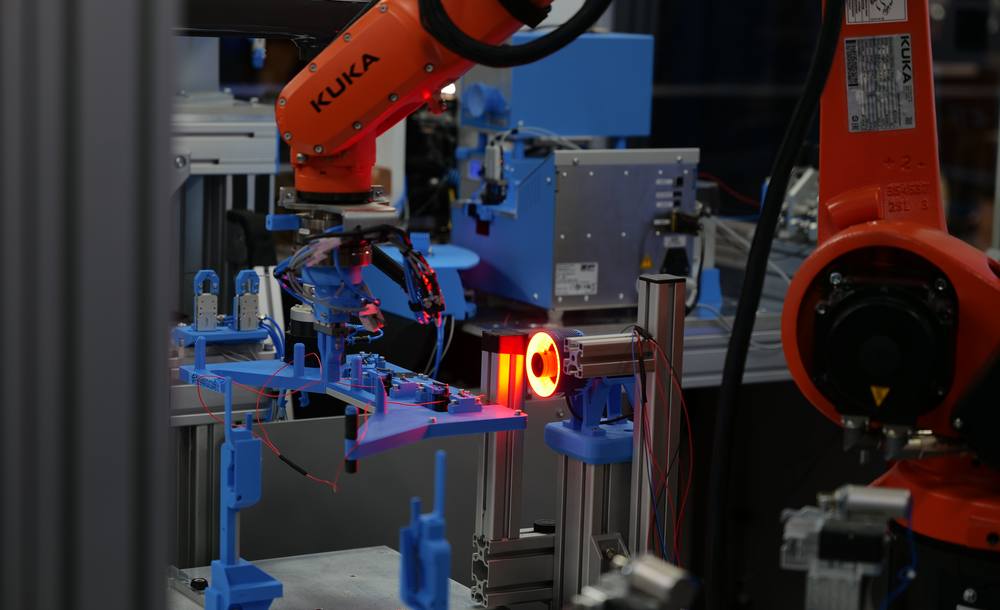
The main challenge: inserting a crimp to within 0.1 mm
The crimps, the terminated ends of each wire, are only a few millimeters wide, and they have to be pushed into equally small cavities in the connector. Because the cable is flexible, the crimp’s position in the gripper changes every time the cable is handled. Reliable insertion needs an accuracy of at least a tenth of a millimeter.
Nägele adds that the process side is just as difficult. Connectors and cable-processing machines were designed for people, not robots. Harnesses also come in a very wide range of variants, and Cellios wants its cells to handle that variety through flexible design.
A modular cell for each process step
Cellios splits harness assembly into separate modules:
- connector singulation
- cable preparation
- crimping
- cable routing
- splice connections made by ultrasonic welding
- taping
- end-of-line electrical testing
Routing followed by contact insertion has been the hardest part to automate. Operators used to do it directly on the routing board, and it took intense concentration, sharp eyesight and good manual dexterity.
In the Cellios cell, the robot first carries the gripped crimp to a 2D camera. The camera measures its position and orientation and sends the values to the robot as a correction. A second camera measures the target position in the connector. With both measurements, the robot makes fine corrective movements to line the crimp up with its cavity. A force-torque sensor on the robot then measures and regulates the insertion force, so the crimp seats correctly without damage. The vision system supplies the accuracy, and the force control supplies the delicate touch.
Machine vision gives the robot its eyes
Nägele puts it simply: without precise vision, the robot would be working blind and couldn’t correct its movements on its own. Sensors alone couldn’t reliably determine the crimp’s X-Y position and its rotation around the Z axis. Machine vision fills that gap. It identifies the parts to be inserted and detects deviations caused by earlier process steps, such as crimping, and by the unpredictable behavior of the cable itself.
Besides the robot, the cell includes robotic taping applicators, force-torque sensors, precision grippers for the connectors, and a conveyor system. Image processing runs on two 2D cameras. On the software side, Cellios combines its own control software with MVTec MERLIC, developed by Munich-based MVTec Software GmbH.
Why Cellios chose MVTec MERLIC
Cellios chose MERLIC mainly for its low-code approach. Users build applications by dragging and dropping tools in a structured graphical interface, so they don’t need deep programming or image-processing skills to get started.
Ulf Schulmeyer, MERLIC Product Manager at MVTec, says time to market is critical for young, innovative companies like Cellios. With the graphical interface, demanding tasks such as precisely matching very small components can be set up quickly, while still using MVTec’s proven algorithms.
In the Cellios application, MERLIC’s matching tools determine the exact position and orientation of each crimp. Its MQTT and REST interfaces connect the vision system to the rest of the cell, which extends its role beyond image processing. Setup was also easy. Two Cellios engineers built the application using only tutorial videos and sample projects, with no formal training.
Schulmeyer sees the project as proof that machine vision is expanding what robots can do. Once robots can see with human-like precision and flexibility, even very complex processes become automatable. In this setup, MERLIC turns image data into exact motion instructions for the robot.
Market launch planned for 2027
Cellios and TE Connectivity presented the prototype in November 2025 and plan to launch it commercially in early 2027. The benefits go beyond higher throughput:
- Reshoring: automation makes harness production competitive again in high-wage countries such as Germany.
- Sustainability: shorter transport routes reduce the carbon footprint of production.
- Quality and traceability: every insertion is monitored digitally, so each harness can be fully traced.
Based on early customer feedback, Cellios plans to extend the system to more harness variants and to new applications such as control cabinet wiring. Future versions of the vision system are expected to support self-healing processes and more advanced quality inspection.