
MERLIC 26.03, released on March 26, 2026, addresses the current requirements of the manufacturing industry as a machine vision software solution: The continuously increasing number of product variants, rapidly rising quality demands, and the shortage of skilled workers driven by demographic change all call for automated solutions such as industrial machine vision. “We see that many companies are engaging with machine vision for the first time or much more intensively. It is crucial that the setup of such an industrial image processing system can be easily integrated into existing installations,” explains Ulf Schulmeyer, Product Manager MERLIC at MVTec. MERLIC addresses exactly these needs: the current release offers not only powerful machine vision algorithms, but also a high degree of application flexibility, performance, and scalability.
High-performance AI methods expand the range of machine vision applications
MERLIC has been systematically enhanced in recent years. On the one hand, MERLIC remains a standard software solution for industrial machine vision. “MERLIC provides numerous powerful machine vision algorithms that can be used to realize virtually all tasks, such as code and text reading, various quality inspections, and collaboration with robots. In addition to rule-based methods, methods based on artificial intelligence (AI) are also available,” explains Schulmeyer.
In addition, MERLIC is designed so that even beginners in industrial machine vision can quickly benefit from its advantages. This is made possible by the graphical user interface, which allows complete machine vision applications to be created via drag-and-drop. Instead of implementing or programming algorithms step by step, applications are built by combining and configuring standardized tools.
Furthermore, MERLIC follows the approach of unifying image acquisition, image processing and analysis, integrated communication interfaces, and result visualization within a single environment. Thanks to support for common industry standards and various hardware types, applications can be developed, deployed, and operated without switching between different systems.
More than machine vision software: connectivity, process stability, traceability
On the other hand, MERLIC goes one step further by offering functionalities that extend beyond pure image processing and support users with regard to the entire application. First and foremost is its integration capability. Thanks to various plug-ins, users benefit from simple, fast, and seamless integration of the machine vision software into existing or new production environments. A key advantage is that no in-house programming or machine vision expertise is required. Specifically, plug-ins are available for programmable logic controllers (PLCs) from well-known manufacturers such as Siemens, Mitsubishi, Beckhoff, and Schneider Electric, as well as many other companies.
In addition, MERLIC provides features to increase the reliability of the entire machine vision application. For example, if the cycle rate on a production line is too high, errors in image acquisition may occur. Enhanced error detection in the Image Source Manager (ISM) documents missed trigger signals and detects discarded images as well as connection interruptions to devices. The software notifies users and helps them take measures to improve the stability of image acquisition.
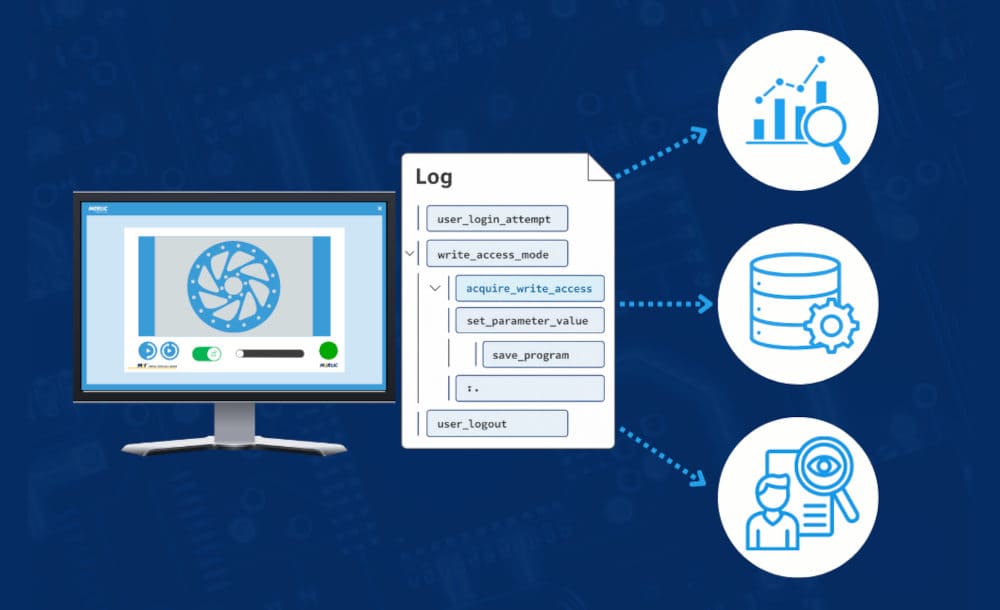
“We are very pleased that the ‘Frontend Observability’ feature is available starting with MERLIC 26.03. It supports the compliant execution of audit trails,” says Schulmeyer. This feature is an important tool in industrial quality assurance, as it enables complete traceability of user interactions. For this purpose, MERLIC 26.03 provides an open interface through which activities such as parameter changes or user logins can be automatically transmitted to existing observability or audit systems. In this way, even strict compliance and quality requirements in highly regulated production environments can easily be met.
Another current topic in automation is the EU Cyber Resilience Act (CRA), which will come into force gradually starting in September 2026. MVTec is already developing its software products in compliance with the CRA and supports its customers with questions related to the regulation.