
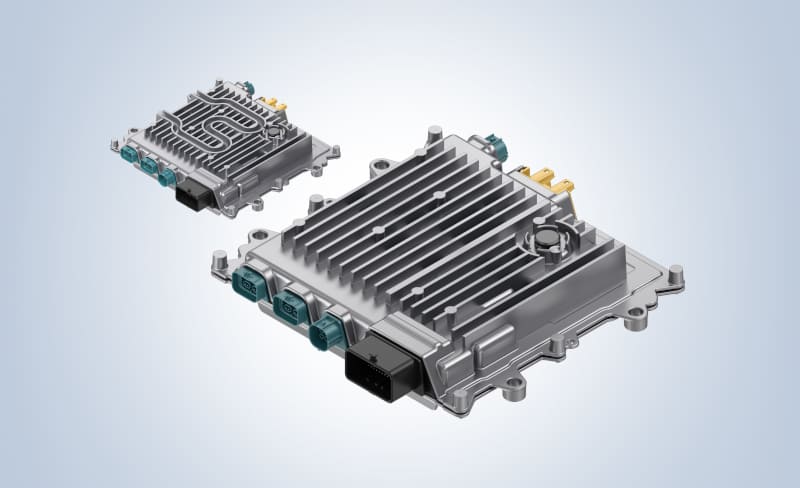
Bosch Rexroth establishes the system specifications for implementing robotics and automation in farming equipment. The advanced High Performance Computer Offroad Robotic Controller ORC2 opens the door to autonomous and intricate driving and working capabilities. The BODAS ecosystem already incorporates the Collision Avoidance System (CAS), which relies on sensors for detecting the environment. Furthermore, the Kinematic Position Sensing KPS indicates the precise position of actuators, like those found in tractor front loaders.
As the foundation for partial and full automation of farming equipment, the ORC2 provides an open, modular environment with an economically efficient High Performance Computer, including support for AI applications. The ORC2 is designed for safety applications, utilizing the popular real-time operating system QNX alongside an integrated ROS2 stack. Leveraging automotive technologies from the Bosch Group, Bosch Rexroth has created a functionally safe unit specifically designed for off-highway applications. It is designed to efficiently handle data from high-resolution sensors like LIDAR or radar, video data, intricate sensor information, and their combination. The control units incorporate into different concepts through multiple communication interfaces.
In the future, the expanding software stack will feature components like position and environment detection, image recognition, perception algorithms, and bird’s-eye view. Moreover, 360° individual detection will be introduced. This is a necessary step for executing support functions for secure functioning and workspace observation. Additionally, OEMs have the capability to create solutions independently on the ORC2
Collision Avoidance System detects people
Sensors for environment detection expand the proven BODAS Ecosystem. Bosch Rexroth’s Collision Avoidance System CAS for an effective collision protection, uses modularly selectable and combination of radar, ultrasound, and smart cameras. BODAS control units evaluate the sensor data to detect and classify objects. With radar sensors, CAS can detect up to 40 objects simultaneously. Near-field monitoring with ultrasound supports up to 12 sensors. In conjunction with smart cameras, CAS also recognizes people and reliably differentiates them from other objects. The CAS software is developed in accordance with safety standards EN ISO 13849, DIN EN ISO 25119, and DIN EN ISO 19014, thereby ensuring the functionally safe processing of detected objects. It supports the standardized communication interface according to ISO 21815-2. Communication with the powertrain, for example with our drive solutions AgDrive or the software eDA, enables automatic deceleration up to emergency braking, if desired by the machine manufacturer.
The solution platform Kinematic Position Sensing KPS precisely detects machine movements using inertial sensors, thus forming the technical basis for autonomous functions. KPS can also be modularly expanded with additional sensors such as linear or angle sensors, if required. The BODAS ecosystem connects the position information with the electronically controlled hydraulic components, thus creating the foundation for higher automation solutions such as lift height limitation.
If the KPS system is supplemented with pressure sensors, the easy-to-integrate Payload Estimation Loader (PEL) function records the weight of lifted loads throughout the machine’s entire working range, even while in motion. The system can be used on all inclines and at all operating points.
Short development times for new concepts
BODAS offers manufacturers full flexibility to scale, unlock, or subsequently install high-performance functions at the software level. This enables manufacturers to freely and individually scale the price and performance of their vehicles and link them with new business models. At the same time, the ecosystem shortens the development times for new agricultural vehicle concepts through extensive libraries. The solution portfolio is prepared for the requirements of the new Machinery Regulation, effective from early 2027, and the Cyber Resilience Act, effective from December 2027.