
The search for suitable automation solutions is currently at the top of the list for many companies. How can we get faster and become more flexible? What solutions are available to help us (better) fulfill our quality assurance and documentation obligations? Are there technical solutions to compensate for the loss of long-serving employees and their experience? – At EMO Hannover 2025, organizer VDW (German Machine Tool Builders’ Association) expects a broad range of automation solutions, from simple handling systems to autonomous factories with self-driving systems.
“Given the rising expenses and a lack of qualified personnel, automation is crucial for the sector,” highlights VDW Executive Director Dr. Markus Heering. For the desired competitive advantages to be realized, there must be an ideal alignment between the user and the solution. Not all companies share the same automation needs, and solutions need to be uniform to be genuinely effective. Heering states that a key fundamental requirement is that the systems must be user-friendly, scalable, and sufficiently flexible to meet specific needs. Moreover, the solutions should enable integration for both extensive series productions and cost-effective manufacturing of single items.
Automation relieves the burden on employees
Simple automation solutions include pallet changers and handling systems. A growing trend is the integration of ancillary processes such as cleaning, labeling or measuring, explains VDW. Many machine manufacturers are upgrading their machines with automation solutions, and supporting operators with intuitive user interfaces and assistance systems. EMO is likely to focus on systems that use AI (artificial intelligence) to provide employees with optimal support, whether by answering questions, providing instructions, or offering solutions to problems. This is expected to be particularly useful in future to support new or less experienced employees.
Another major topic for automation at EMO will be the use of robots. According to the IFR (International Federation of Robotics), around 4.3 million industrial robots are currently in use worldwide. Last year alone, their number rose by 10 percent. The IFR also expects double-digit growth rates in the coming years. In terms of robot density (number of robots per 10,000 employees), South Korea (1,012) and Singapore (730) were the frontrunners in 2024, ahead of Germany (415) in third place. For Dr. Dietmar Ley, Chairman of the VDMA Robotics + Automation Association, one thing is certain: “Robotics and automation are key technologies for the future growth of national economies, as they increase productivity, drive innovation, and open up new opportunities.”
Cobots as straightforward productivity drivers
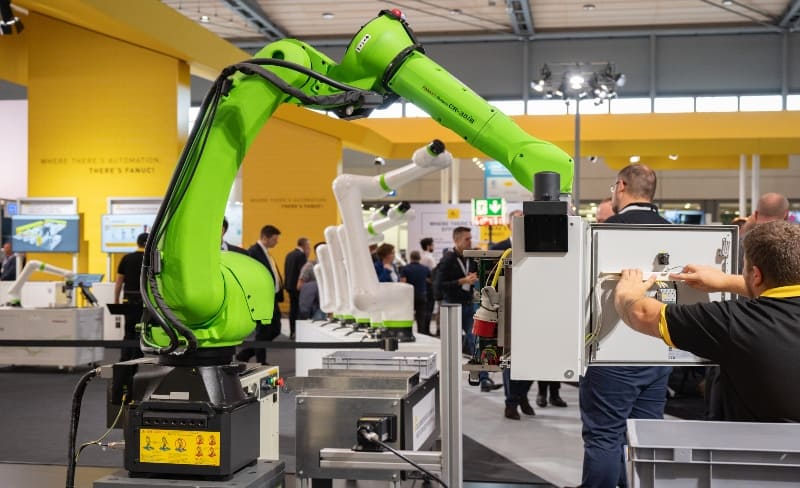
Many small and medium-sized companies, and those with rather small production runs, are asking themselves whether it actually makes sense for them to use industrial robots. In this scenario, cobots (collaborative robots) could be an interesting option. Thanks to their ease of use and rapid deployment, they are suitable for companies of all sizes. They also offer the benefit of being a straightforward introduction to automation, and can be connected using the plug-and-play principle. This makes them particularly well-suited to pick-and-place tasks or loading and unloading of machines. Cobots can also take on internal transportation tasks. They work well in harmony with AMR (autonomous mobile robots) and can help to increase efficiency in production not only by loading machines but also handling materials. At EMO, numerous exhibitors will be offering automation solutions with robots, including Kuka, Robojob, Wick, Apex, Fanuc and many more.
Human-machine interaction benefits from AI
Artificial intelligence is also increasingly being integrated into cobots. The robot not only learns to recognize and grasp various objects, such as unsorted components, it can also respond to commands and complete quality assurance tasks. Experts believe cobots have very promising future prospects to offer, especially as they are flexible and mobile, and are constantly opening up new fields of application. The machine tool industry is becoming increasingly aware of how well industrial robots and cobots can complement each other. In this scenario, the cobot handles flexible automation and assistance, while the industrial robot ensures high levels of efficiency in large series, according to the experts.
Collaborations between humans and machines are likely to play a major role in the future of automation. The key to its success is that people do not need any programming skills to work with robots. In what is quite a charming interaction, operators can communicate with their “colleague” simply through language, facial expressions and gestures, to give instructions or have questions answered.
You can find out what EMO exhibitors have to offer in terms of technological solutions for automation in the run-up to the trade fair on the Made for Automation landing page at https://emo-hannover.com/automation. Here, exhibiting companies will be gradually adding information until the end of EMO in September on what systems and methods you can use to increase the efficiency of your production.