
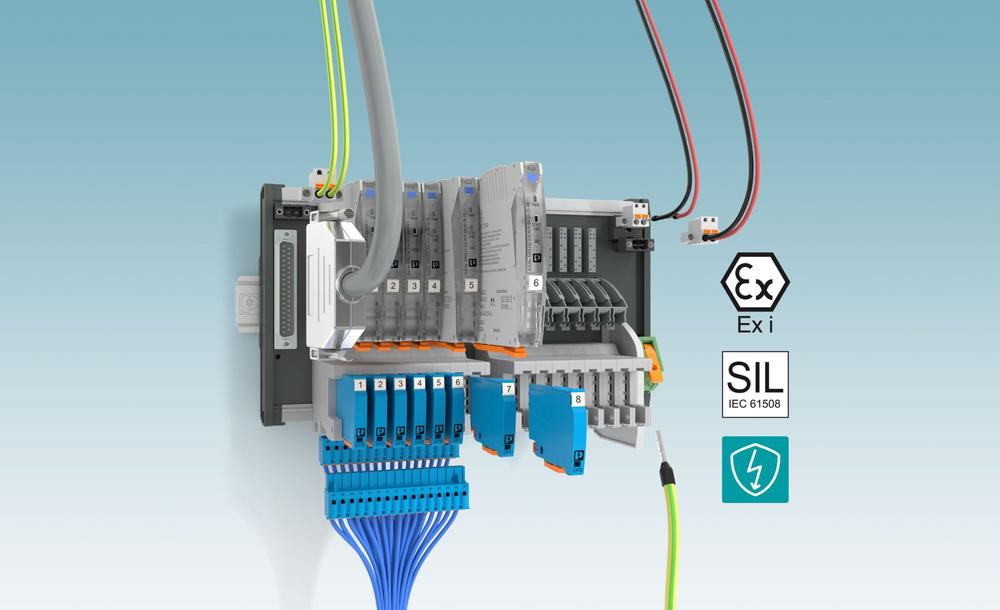
Phoenix Contact has introduced VIP I/O-Marshalling, a modular plug-and-play system that brings signal conditioning and signal marshalling together in a single compact solution for universal I/O controllers. By combining both functions, the system reduces the need for dedicated marshalling cabinets and helps engineering teams cut lead times in complex process automation projects by up to 30 percent, while also lowering overall investment costs.
Why universal I/O needs a new marshalling approach
In a conventional point-to-point architecture, field signals have to be sorted by type, conditioned on different levels and then wired to specific I/O cards. Universal I/O controllers simplify this by letting each channel be configured in software, so dedicated hardware per signal type is no longer required. The marshalling and interface layers, however, have usually remained rigid. VIP I/O-Marshalling closes that gap: signal paths can be planned, installed and tested independently of the final signal type, which allows project phases to run in parallel instead of one after another. The result is a consistent universal I/O concept from the field level up to the control level.
Compact design and broad controller compatibility
Thanks to its slim architecture, the system needs less space in the control cabinet and supports a high signal density. It works with universal I/O controllers from vendors such as Schneider Electric, Honeywell and Siemens, and its standard D-SUB interface makes it possible to connect other controllers as well.
Tool-free installation with pluggable function modules
VIP I/O-Marshalling is built around universal termination boards that accept pluggable function modules, including signal conditioners, measuring transducers, relays, safety relays, fuse modules and surge protection devices. Each channel receives the plug-in module that matches its signal type and safety requirements. For demanding applications, SIL and Ex i variants provide functional safety and intrinsically safe explosion protection for all substance groups and Ex zones.
Field wiring and power supply are connected to the termination board using Push-in Technology, while a standard D-SUB system cable links the board to the universal I/O controller. Because the wiring stays fixed, the signal type can be changed later simply by swapping the plug-in module. This approach reduces material costs and wiring effort, helps avoid wiring errors, shortens downtime and increases plant availability, giving operators more efficiency, better plannability and greater investment security in process automation.