
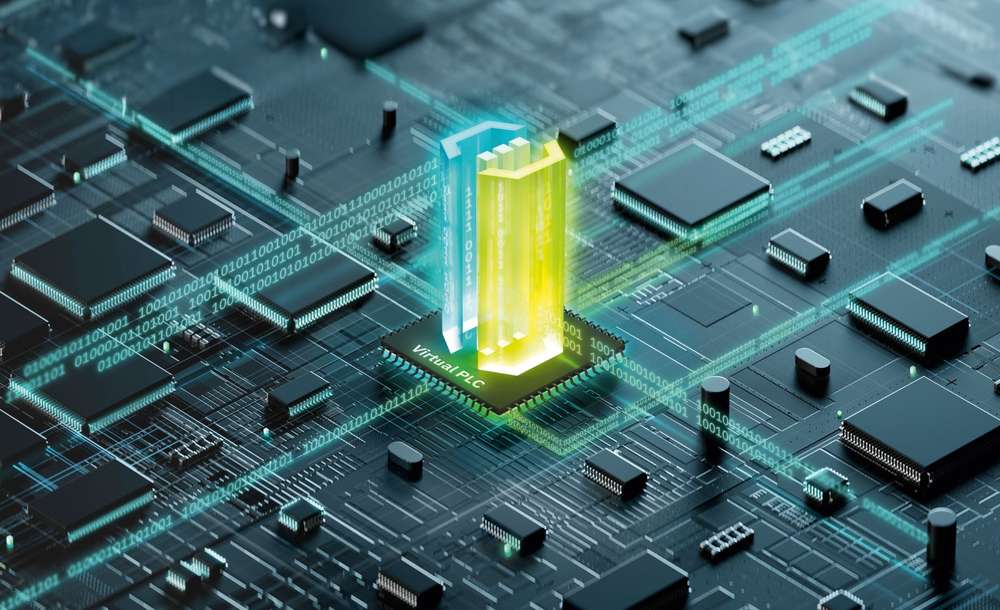
Phoenix Contact has expanded its control portfolio with Virtual PLCnext Control, a software-only controller that decouples automation logic from dedicated hardware. The solution runs on industrial PCs, edge devices and server infrastructure, bringing the worlds of IT and OT closer together and taking a further step towards software-defined automation.
Real-time control meets IT architecture
Virtual PLCnext Control is based on the open PLCnext Technology ecosystem. It combines the deterministic real-time behaviour required in industrial control with the flexibility of modern IT environments. Users can run their control applications regardless of the underlying hardware, scale them as needed and keep the engineering workflows they already know.
For programming, the virtual controller supports the IEC 61131-3 languages alongside high-level languages such as C++ and C#. On the communication side, it handles Profinet, OPC UA, Modbus/TCP, MQTT and REST APIs, so it fits into both classic fieldbus networks, as reflected in the industrial Ethernet market, and cloud or IT-based systems.
Container-based deployment
The software uses a container architecture, which makes installation, updates and adaptations much simpler than with a traditional hardware PLC. This approach opens up several deployment models:
- Embedded in devices, as the control core of a machine or system
- At the edge, running close to the process for low-latency tasks
- In the data centre, where several virtual controller instances can share the same server infrastructure
Running multiple controllers on common hardware helps reduce the number of physical devices in a plant and centralises maintenance. According to Phoenix Contact, the solution meets industrial requirements for cybersecurity, data consistency and real-time processing.
A step towards software-defined automation
Lena Kuhlmann, Sales Product Manager Automation at Phoenix Contact, sees the launch as a way to help customers move further into software-defined automation. Separating the control function from the hardware lets manufacturers and machine builders plan their automation around software, update it continuously and connect it more easily with IT systems such as databases or MES, a trend also seen in solutions that link PLCs directly to SQL Server.
Through the PLCnext Community and the PLCnext Store, users also gain access to shared knowledge, apps and software functions that can extend the capabilities of the virtual controller.