
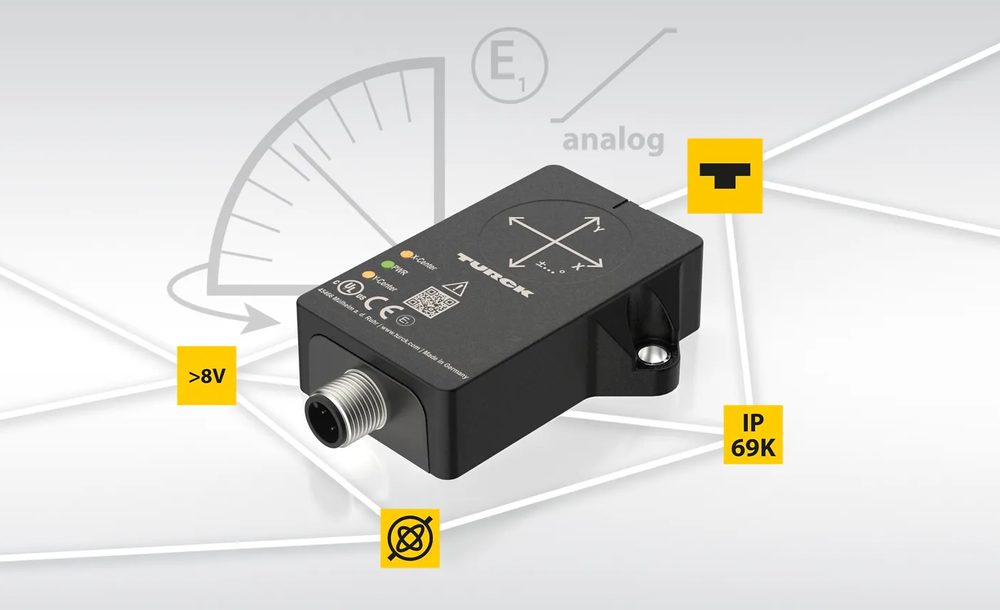
TURCK QR20 inclinometers: analog versions for mobile equipment
TURCK has added analog versions to its QR20 inclinometer series, designed specifically for mobile machinery. The sensors work from a supply voltage as low as 8 V DC and comply with automotive EMC requirements, so they provide accurate inclination readings even in the 12 V electrical systems found in mobile work machines.
The dynamic versions combine the signals of a MEMS accelerometer and a gyroscope through sensor fusion. This lets them report the angle quickly and accurately despite vibration, shocks and disruptive accelerations. The static versions determine the angle using acceleration alone. Both principles are available in 1-axis models with a 360° measuring range and in 2-axis models with a ±85° range.
Built for vehicle environments, electrically and mechanically
The QR20 housing tolerates shocks of up to 200 g and works across a temperature range of -40 to +85 °C. Its translucent construction lets the status displays operate without separate LED lenses, which removes a possible route for moisture to enter. The sensors achieve protection ratings IP66, IP67, IP68 and IP69K, and for especially harsh conditions the GUARD-QR20 protective housing is offered as an accessory.
On the electrical side, the devices are specified for immunity to interference of 100 V/m according to ISO 11452-2 and 200 mA according to ISO 11452-4. They also withstand conducted disturbances per ISO 7637-2 Level 4 and load-dump events per ISO 16750-2, and they hold E1 type approval.
Flexible analog output and measuring range through IODD
Using IODD parameterization in the TURCK Automation Suite (TAS), users choose the output signal from six options: 4 to 20 mA, 0 to 20 mA, 0.1 to 4.9 V, 0 to 5 V, 0.5 to 4.5 V or 0 to 10 V. Each axis can also have its own measuring range, filter and center point, either by typing in an angle in degrees or by taking over the current angular position.
No software is needed for a quick setup. The Easy Teach function is activated by wiring a jumper between pin 5 and pin 1, and the patented spirit level function shows the alignment directly on the device.
Key benefits
- Suitable for 12/24 V vehicle electrical systems
- Sensor fusion delivers precise inclination values despite vibration and disruptive acceleration
- Fast commissioning with the spirit level function, center point teach and TAS
- A single sensor type covers six analog signals through IODD parameterization