
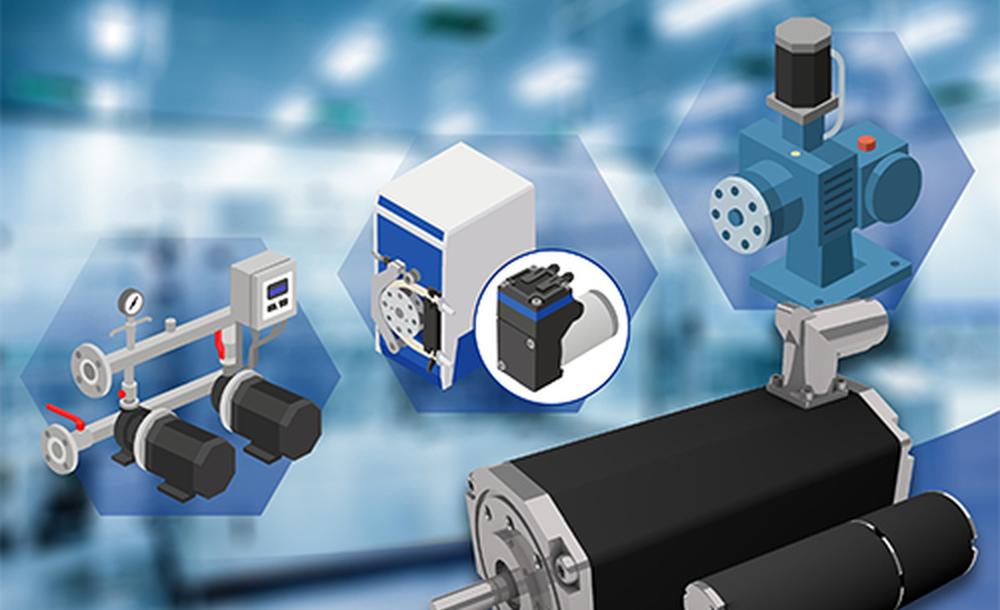
Pump OEMs can now rely on modular brushless DC drive systems that improve flow accuracy, cut energy use and simplify integration in medical, industrial, hydraulic and process applications.
Today’s pump designers are under pressure from several directions at once: customers expect lower energy consumption, tighter flow control, quieter running, longer lifetimes, smaller footprints and seamless integration into digital networks. To help original equipment manufacturers meet these expectations, Dunkermotoren has developed configurable brushless DC (BLDC) motor solutions designed with pump applications in mind.
The German drive specialist does not look at the motor in isolation. Instead, it works alongside pump builders and system integrators to develop a complete drive concept, bringing together the motor, drive electronics, feedback devices, communication interfaces and application engineering. Each concept is shaped around the specific pump, its load behavior and the conditions in which it will operate. Consolidating what would normally be several separately sourced parts into one modular motion platform allows OEMs to reduce engineering workload, streamline their bill of materials and bring systems together faster, without losing the flexibility to handle different pump designs.
According to Michael Burgert, Product Manager at Dunkermotoren, choosing the right motor is no longer enough on its own to guarantee pump performance. He explains that manufacturers gain the most from modular platforms that unite drive technology, onboard intelligence, connectivity and engineering support, as this makes integration easier while delivering the accuracy, efficiency and dependability their applications require.
Different Pumps, Different Drive Requirements
There is no universal pump drive. Required flow and pressure, duty cycle, available space, ambient conditions and communication needs all shape what the ideal drive configuration looks like.
Medical devices: accuracy with minimal noise. Equipment such as dialysis machines depends on pumps that move blood, dialysate and other fluids with high consistency over long treatment periods. Stable motor control keeps flow rates repeatable, while low noise and vibration create a calmer setting for both patients and clinical staff. Compact motors with built-in electronics also give designers more freedom when space inside the device is limited.
Hydraulics: responding to variable loads. In rail vehicles, mobile machinery and industrial equipment, hydraulic pumps frequently face shifting loads, confined mounting spaces, vibration, shocks, temperature swings and repeated start-stop operation. With closed-loop BLDC control, hydraulic pressure can be generated on demand and adapted to what the system actually needs, striking a balance between dynamic response and energy use.
Cooling and process circulation: saving energy with variable speed. In cooling loops, HVAC installations and process-fluid circulation, efficiency comes first. Rather than running permanently at maximum output, variable-speed BLDC motors adjust flow and pressure to real-time thermal or process demand, avoiding wasted energy while keeping temperature and process conditions stable.
Dosing and metering: consistent volumes every time. Water treatment plants, chemical processing, laboratory instruments and automated filling lines all rely on delivering exact quantities of fluid. Fast, repeatable motor control keeps dosing reliable even as operating conditions vary.
The Growing Appeal of BLDC Technology
What these applications share is the need for accurate, responsive control. Electronically commutated BLDC motors regulate speed and torque precisely, which results in steadier flow, better pressure management and more accurate dosing. Because there are no mechanical brushes, wear is minimal, maintenance is reduced, operation is quieter and service life is extended. Lower energy losses also mean reduced operating costs and less heat, a significant advantage for pumps that run continuously or for extended periods. This combination of characteristics explains why BLDC motors are increasingly chosen for everything from compact medical equipment and networked dosing units to process machinery and electro-hydraulic power packs.
The main advantages for pump manufacturers are:
- Precise speed and torque regulation for stable flow, pressure and dosing
- Variable-speed operation that aligns pump output with actual demand
- Quiet, low-vibration running for sensitive environments
- Less wear and maintenance thanks to brushless design
- High efficiency and reduced heat generation
- Long, reliable service life under demanding duty cycles
Scalable Smart Motor Platforms
How well the entire drive system is integrated has a growing influence on pump performance. Dunkermotoren’s smart motor platforms offer graduated levels of control, connectivity and diagnostics, so the drive can be matched to the complexity of each application.
dGo – straightforward control. Designed for applications that need basic speed control, dGo is a cost-effective option offering speed regulation, direction control and fault detection. Custom functions, such as tailored speed profiles or blockage detection, can be added as needed.
dMove – added connectivity. When more communication is required, dMove brings CANopen connectivity and access to operating values including speed, current and temperature. This enables monitoring and control within networked pump systems and also suits applications that need positioning or torque control.
dPro – advanced networking and diagnostics. For highly connected automation systems, dPro supports CANopen, PROFINET, EtherCAT and EtherNet/IP. It gives access to motor and application data for in-depth diagnostics, condition monitoring, predictive maintenance and IoT integration. Applications demanding high pumping accuracy, detailed operating data or Safe Torque Off (STO) benefit from these features, while vector-controlled commutation helps lower energy consumption.
Engineering Expertise Beyond the Motor
Because every pump application is different, Dunkermotoren provides application-specific configuration and engineering support covering both mechanical and electrical integration. Its engineers analyze torque, speed profiles, thermal behavior, duty cycles, space constraints and environmental conditions so that motor behavior fits the requirements of the complete pump system.
Customization options can include:
- Application-specific shafts and mounting configurations
- Special motor dimensions and interfaces adapted to the pump housing
- Encoders, integrated electronics and communication interfaces
- Custom control functions and speed profiles
- Gearboxes where the torque and speed profile call for them
This close collaboration helps simplify integration, reduce development time and ensure dependable long-term operation from the first concept through to series production.
One Platform for the Next Generation of Pumps
As pumps become more intelligent, efficient and connected, the drive system has a decisive impact on overall performance. Following its modular motion solutions philosophy, Dunkermotoren brings together BLDC motors, smart control platforms, communication interfaces, feedback systems and engineering know-how in a scalable drive architecture. The outcome is a single platform that adapts to a broad range of pump requirements, eases integration and shortens time to market.