
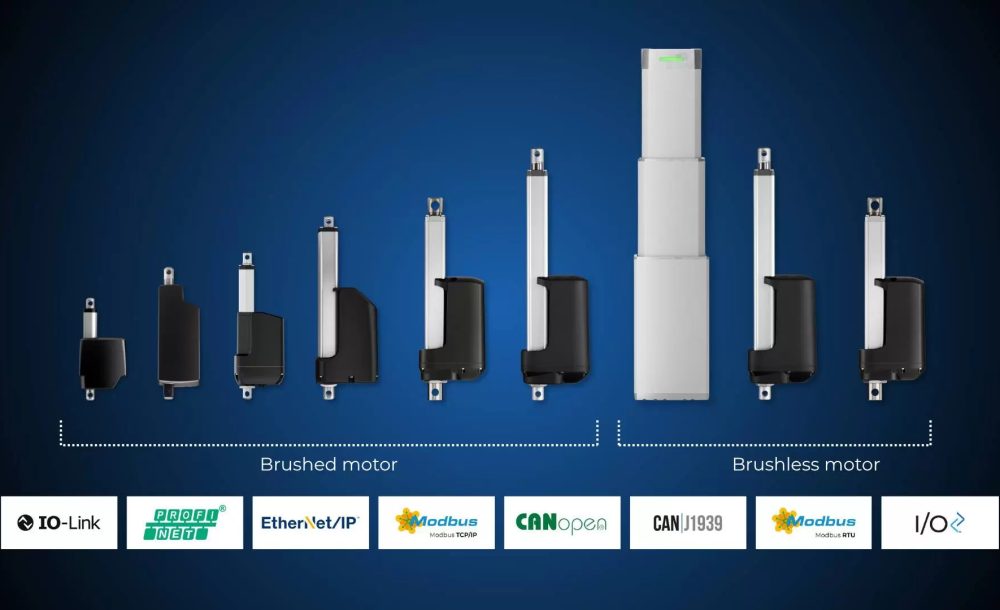
LINAK has expanded the message behind its IC™ actuator portfolio: linear motion should plug straight into the automation system a machine already uses. Thanks to an integrated controller, these electric actuators and lifting columns talk directly to the PLC. As a result, engineers no longer need external controllers, gateways or custom wiring.
Eight interfaces, one actuator platform
Each IC actuator ships with a built-in communication interface. Machine builders can therefore choose the protocol their control architecture already runs:
- IO-Link®
- PROFINET
- EtherNet/IP™
- Modbus TCP/IP
- CANopen
- CAN SAE J1939®
- Modbus RTU
- LINAK I/O™ (universal interface)
The CAN-based options also address off-highway machinery, while the Ethernet protocols target factory automation. In addition, several options comply with Danfoss PLUS+1®.
What the integrated controller does
LINAK groups the IC concept into three building blocks. First, the built-in interface simplifies integration. Second, the onboard controller removes the external control box from the design. Third, built-in functions give the PLC more control over motion, feedback and diagnostics. With IO-Link, for example, the controller reads real-time position, speed, run-time and current. The actuators are configured with the LINAK BusLink software.
Field results: SANOVO and Schur Automation
Two machine builders show the practical effect. SANOVO uses LA21 actuators with IO-Link in an egg packaging machine. The actuators handle precise positioning and automatic format changeovers. Because the design became simpler, SANOVO removed mechanical parts, cylinders and sensors. According to LINAK, this saves about EUR 2,000 per machine in components and labour.
Schur Automation, on the other hand, runs LA25 actuators over EtherNet/IP. The units integrate directly into its existing architecture. Consequently, its software developers save hours of programming, since they no longer have to build the connection themselves.
LA25 at a glance
| Parameter | LA25 |
|---|---|
| Load | Up to 2,500 N |
| IP rating | IP66 dynamic / IP69K static |
| Ambient temperature | -40 °C to +85 °C |
| Housing | Aluminium |
| Parallel operation | Up to 8 actuators |
Why it matters for engineers
Pneumatic cylinders and fixed mechanical stops still dominate many format adjustments. However, they need sensors, valves and manual changeover. A networked electric actuator replaces that chain with one device the PLC can position and monitor. For OEMs, the benefit is fewer parts and faster commissioning. For end users, it means recipe-driven changeovers and diagnostic data for maintenance. Above all, keeping the existing fieldbus avoids gateways and extra function blocks.
More details are available on the LINAK LA25 product page and in LINAK’s overview of actuators with IO-Link. You can also browse more LINAK news on Automation Fair or read how Linak first offered its LA25 linear actuator with IO-Link.