
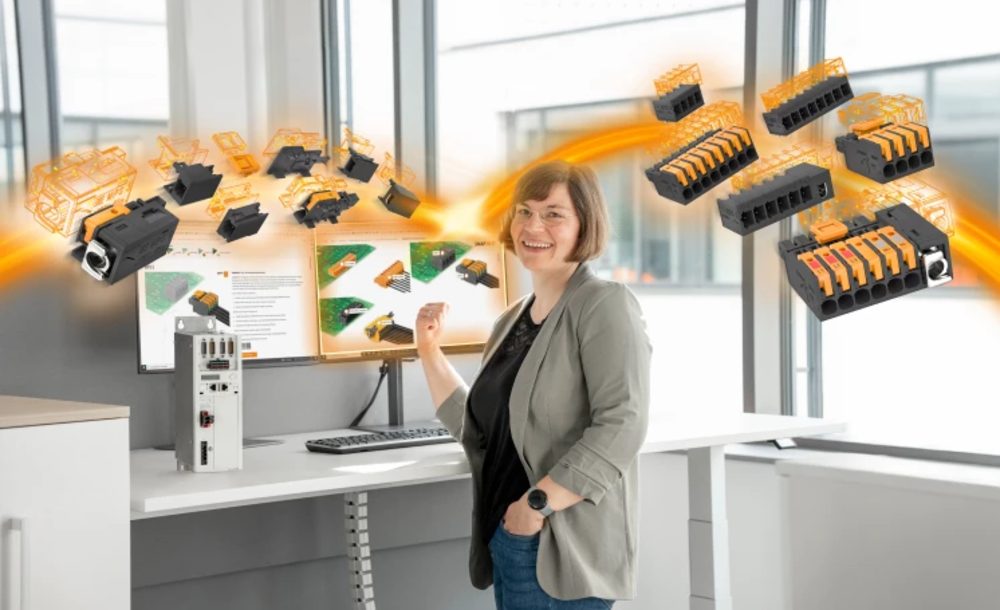
Weidmüller has outlined how device connection technology is changing in industrial equipment and control cabinet building. The company combines tool-free SNAP-IN wiring, hybrid Single Pair Ethernet connectors and its PCB Connector Services. Together, they aim to shorten development cycles and make wiring ready for automation.
Why screw and spring connections reach their limits
For many years, screw and push-in spring terminals were the standard choice. However, highly automated production exposes their weak points. Screw terminals need a defined tightening torque and a later inspection step. As a result, they take time and require manual work.
Spring-clamp terminals, on the other hand, work without tools. Still, they need prepared conductors and careful handling. Therefore, neither technology suits robot-based wiring very well.
SNAP-IN: tool-free contact for automated wiring
SNAP-IN takes a different approach. The user inserts the stripped conductor directly, and the clamp closes automatically. A newly developed spring mechanism contacts all common conductor types without extra preparation. In addition, the system confirms a correct connection in three ways:
- an audible click when the clamp engages,
- a visible change in the pusher position,
- a tactile response at the pusher.
According to Weidmüller, the connection is vibration-proof and gas-tight, and it is designed for long-term electrical stability. To release the conductor, the user simply presses the pusher. Consequently, wires can be replaced or repositioned quickly.
Weidmüller now uses SNAP-IN across a wide portfolio. It includes terminal blocks, PCB connectors, heavy-duty connectors, push-pull power connectors and power supplies. Thus, engineers can apply the same principle at different power levels.
Single Pair Ethernet down to the field level
At the same time, Ethernet is moving into sensors and field devices. Single Pair Ethernet (SPE) plays a key role here, because it carries data and power through one compact interface.
Weidmüller has therefore added hybrid SPE connectors to its OMNIMATE range. The new connectors use the mating face defined in IEC 63171-7, second edition. This standard interface allows interoperable connections between products from different suppliers. As a result, users can build continuous Ethernet architectures from the sensor up to IT and cloud systems, with no extra gateways or media changes.
PCB Connector Services across the device lifecycle
Beyond the hardware, Weidmüller supports the whole development process with its PCB Connector Services:
- Concept phase: overviews of technologies, products and typical applications.
- Product selection: digital tools that find suitable connectors by device type or by installation situation.
- Design-in: engineering data, 3D models and EDA libraries for PCB layout.
- Consulting: support with standards questions, such as clearance and creepage distances and certification.
- Production: tools that help integrate connectors into automated placement and assembly.
For series production, connectors come in both THR and SMD versions. Consequently, they fit into a continuous reflow process, so no separate assembly step is needed.
Why it matters for device builders
For machine and device manufacturers, wiring often becomes a bottleneck when production scales up. Removing crimping and torque checks shortens process times. Furthermore, it makes every contact more repeatable. Standardised SPE interfaces also reduce the risk of tying a design to a single supplier.
Weidmüller has also shown other connectivity and automation topics recently. See its SPS 2026 plans for open automation and panel building, or browse all Weidmüller news.