
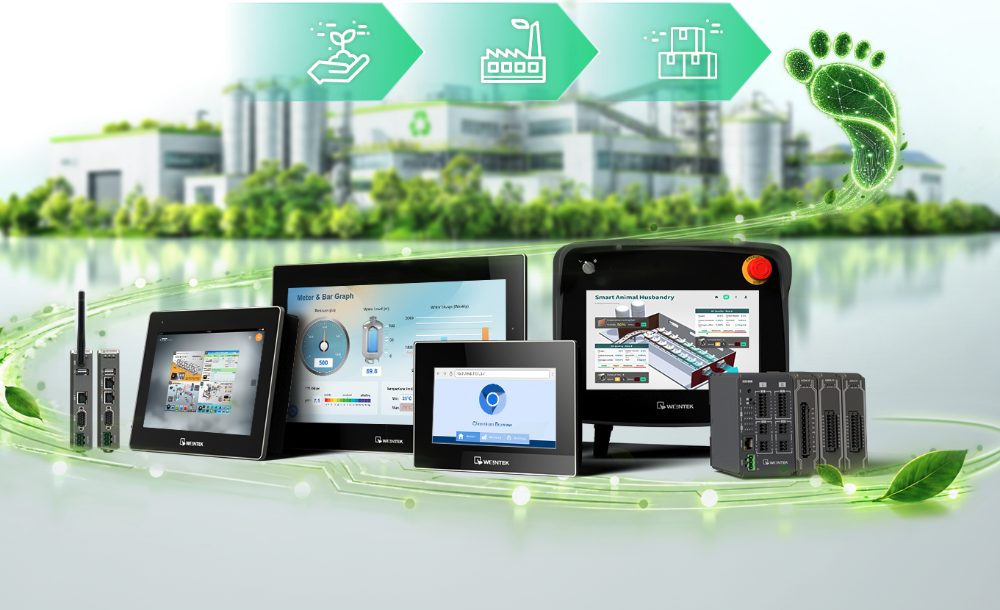
Weintek has completed a product carbon footprint assessment for its entire portfolio. The study, finished in September 2026, tracks CO₂e emissions from raw material acquisition to the finished product. As a result, machine builders and integrators can now obtain per-model carbon data for Weintek HMIs, gateways and I/O modules.
Which Weintek products are covered
The assessment spans the full line, so it applies to almost any Weintek device found in a control cabinet or on a machine. It covers two groups of products:
- HMI and panel products: cMT X Advanced, Standard and Basic, cMT X Handheld, cMT X Headless, cMT Headless, cMT X Web Panel, cMT Viewer Panel and the iP Series.
- Gateways, I/O and peripherals: G Series gateways, iR Series couplers, iR Series I/O modules and accessories.
For readers who already use these panels, our overview of the cMT X Series Standard HMIs gives more background on the hardware.
Method: ISO 14067 and a cradle-to-gate boundary
Weintek based the work on ISO 14067:2018, the international standard for product carbon footprints. The company chose a cradle-to-gate boundary. In other words, the figures include raw materials, manufacturing and packaging up to the factory gate.
However, some stages are outside the scope. Distribution, sales, customer use and end-of-life disposal are not part of the calculation. Engineers who build a full life-cycle figure for a machine therefore need to add the use phase themselves.
Weintek also keeps each data record for at least five years. This makes later tracking and verification possible. In addition, the company rates data quality with a Pedigree Matrix. The matrix scores five aspects on a scale from 1 to 5:
- Reliability
- Completeness
- Time relevance
- Geographic relevance
- Technical relevance
Why carbon data is becoming a supply chain requirement
Regulation is a key driver. The EU Carbon Border Adjustment Mechanism (CBAM) started its transitional phase in 2023. Full implementation for the covered carbon-intensive sectors begins in 2026. Meanwhile, Taiwan has written its 2050 net-zero target into its Climate Change Response Act.
According to Weintek, the assessment serves three goals:
- Find emission hotspots. The data shows where emissions come from, such as raw materials, transport or manufacturing. Weintek can then decide where to cut first.
- Answer customer requests. Consistent, traceable figures help with sustainability questionnaires, supply chain audits and carbon disclosure.
- Track progress over time. The results act as a baseline. Weintek plans to update the data and compare emissions year by year.
Why it matters for machine builders and integrators
Many OEMs now receive carbon questionnaires from their own customers. These forms often ask about bought-in components such as HMIs and remote I/O. With model-level figures from the supplier, that part of the bill of materials becomes easier to document.
The cradle-to-gate scope also fits the way component data is usually combined. A machine builder can add the footprint of each part and then calculate the energy use of the machine separately. This also applies to installed systems. For example, plants that already run Weintek hardware with the CODESYS SoftPLC and PROFINET support can look up figures for those devices.
Next steps and where to find the data
Weintek describes the assessment as a starting point. Next, the company will look at alternatives to carbon-intensive materials. It will also optimise raw material transport and review energy and resource efficiency at its factories.
The carbon footprint figures for each model appear in the product specifications. You can find them in the Weintek specification download area. For more news from the manufacturer, visit our Weintek section.