
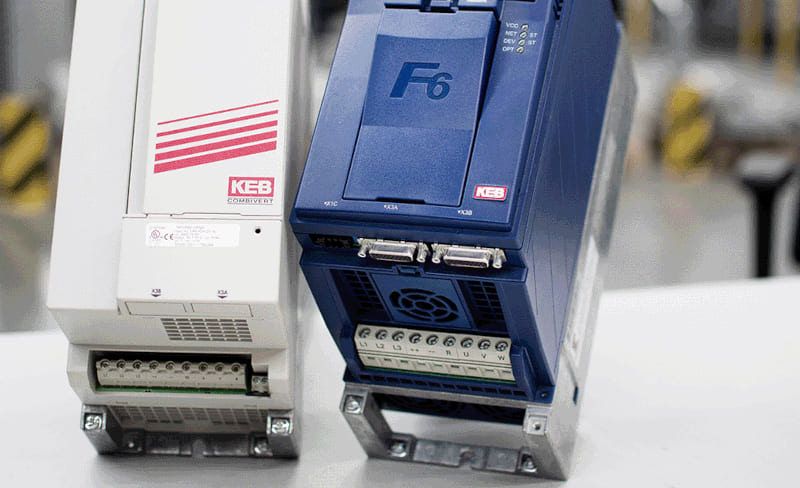
Following over 20 years and countless deployed applications, the COMBIVERT F5 frequency inverter was moved to the after-sales sector in July 2023 and will no longer be available for purchase. The COMBIVERT F6 and S6 have dignified successors available now, offering numerous new features. Benjamin Mönnig, Head of Application Sales at KEB, clarifies the distinctions between “old” and “new” inverters and discusses the implications of the F5 discontinuation for clients.
Why was it time for a new inverter generation?
Benjamin Mönnig: The requirements for our customers’ machines and systems are constantly changing – and so are the demands on drive technology. Therefore, the goal was to develop an inverter that offers maximum innovation and flexibility in addition to compact design and higher performance. Another aspect was also that the COMBIVERT F5 series consisted of many separate versions and our customers had to order individual versions of the F5 for a wide variety of applications. With the COMBIVERT F6, we are now taking a particularly economical approach. With it, we have launched a genuine all-rounder on the market that comes with a significantly wider range of features. Finally, the decision to launch a new generation of converters also made sense in order to have all the necessary components available in the long term.
What are the key features that set the F6 and S6 apart from the F5?
The COMBIVERT F6 has a higher power density with more compact dimensions. We have paid particular attention to distinct multifunctionality. This applies, for example, to the bus systems integrated from the outset or the various cooling concepts. The F6 is also a drive that can control all types of motors with or without encoders using just one firmware. The drive controller has two multi-encoder interfaces for evaluating the most common encoders, and interaction with other drives is possible via CAN cross communication. The F6 and S6 also go one step further in terms of sustainability: the drive controllers are recyclable by up to 75 percent and have up to 18 percent less power loss.
While the F5 was still referred to as a classic frequency inverter, the sixth generation devices are called “drive controllers”. Why is that?
With our new generation, the frequency inverters have become “drive controllers”. Whereas frequency inverters in the classic sense are designed to operate asynchronous motors, the F6 is capable of controlling IPM, synchronous reluctance or high-torque motors. In addition, the new drives feature servo characteristics and thus more overload. And in the area of safety technology, a drive controller also goes far beyond the frequency inverter: While STO was on board as standard for the F5, numerous other safety features are also available for the F6 and S6. In the Pro variant, we are talking about encoderless safety technology, FSoE and bus cycle times of 250µ, depending on requirements.
The F5 was part of the KEB portfolio for a long time. What do you personally associate with the inverter?
Over the years, we have regularly equipped exciting and no infrequently challenging applications with the F5 frequency inverter, where you always learned something new. A special characteristic of the F5 was certainly that it was the first inverter to be able to implement the sensorless control methods ASCL (Asynchronous Closed Loop) and SCL (Sensorless Closed Loop) developed by KEB, with which a very high speed and torque accuracy was achieved. To experience such a technological advance in such a direct way was very exciting.