
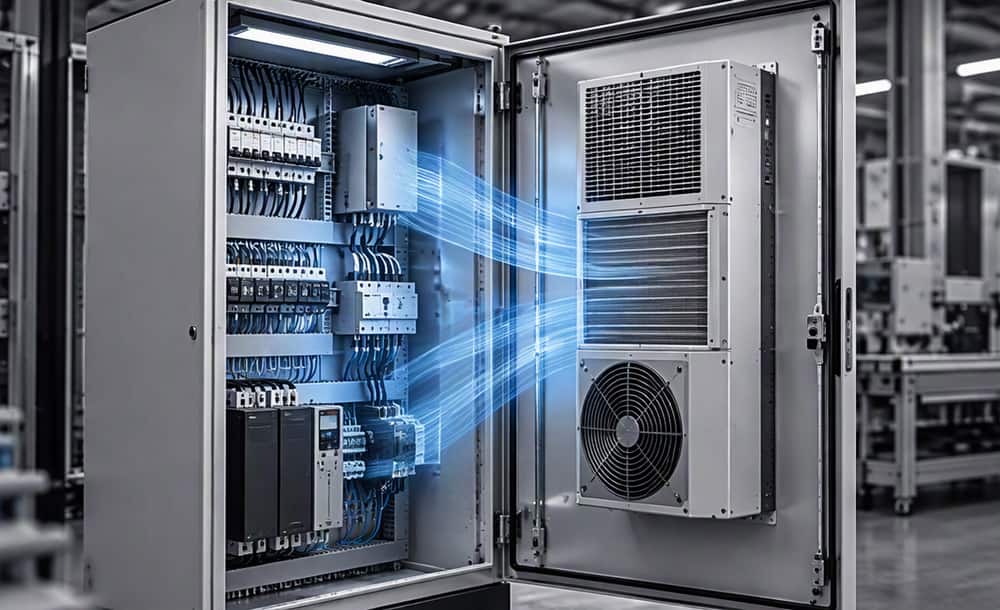
Cooling units for electrical enclosures are about to face stricter rules in Europe. From 1 January 2027, the next phase of the revised EU F-Gas Regulation (EU) 2024/573 restricts the use of fluorinated refrigerants with a high global warming potential (GWP) in certain air-conditioning applications. The aim is to cut greenhouse gas emissions by speeding up the switch to refrigerants with a lower climate impact.
For machine builders, panel builders and plant operators, this affects how they will select enclosure cooling solutions from now on. nVent, through its HOFFMAN brand, says it has been preparing its portfolio for this transition.
What changes in 2027
As part of the regulation’s phase-down, new self-contained air-conditioning units up to 12 kW will generally have to use refrigerants with a GWP below 150. Where safety requirements rule out lower-GWP alternatives, refrigerants with a GWP up to 750 remain permitted. Equipment that is already installed and running can stay in operation.
In practice, the refrigerants most widely used in enclosure cooling so far, R-134a and R-410A, will be restricted in specific applications. Alternatives such as R-513A, R-1234yf and R-32 will play a much bigger role.
How nVent HOFFMAN is adapting its cooling units
According to nVent, many HOFFMAN enclosure air conditioners have already moved from R-134a to R-513A, which reduces GWP by around 56% without compromising cooling performance or reliability. The manufacturer now offers several refrigerant options to cover both current and future requirements:
- R-1234yf and R-32: for applications that need the lowest possible GWP.
- R-513A: for applications where specific safety requirements apply, such as installations where mildly flammable (A2L) refrigerants are not suitable.
This lets users choose the refrigerant that best fits each installation, balancing regulatory compliance, safety and thermal performance.
New criteria for selecting enclosure cooling
Switching refrigerants is not just about swapping one gas for another. Some low-GWP refrigerants, such as R-1234yf and R-32, are classified as mildly flammable (A2L). That affects where and how the units can be installed, the risk assessment of the machine or plant, and maintenance procedures. Engineers will also need to consider cooling capacity, ambient conditions, protection rating and availability of spare parts over the life of the equipment.
To help customers through the transition, nVent has prepared technical resources explaining the regulatory changes, the available refrigerant options and the key factors to consider when selecting an enclosure cooling unit.
Planning ahead
With the deadline only a few months away, OEMs and panel builders should review their current enclosure cooling specifications now. Identifying which machines and projects will need low-GWP units from 2027 helps avoid last-minute redesigns, certification delays and supply bottlenecks, and makes it easier to stay compliant in every European market.