
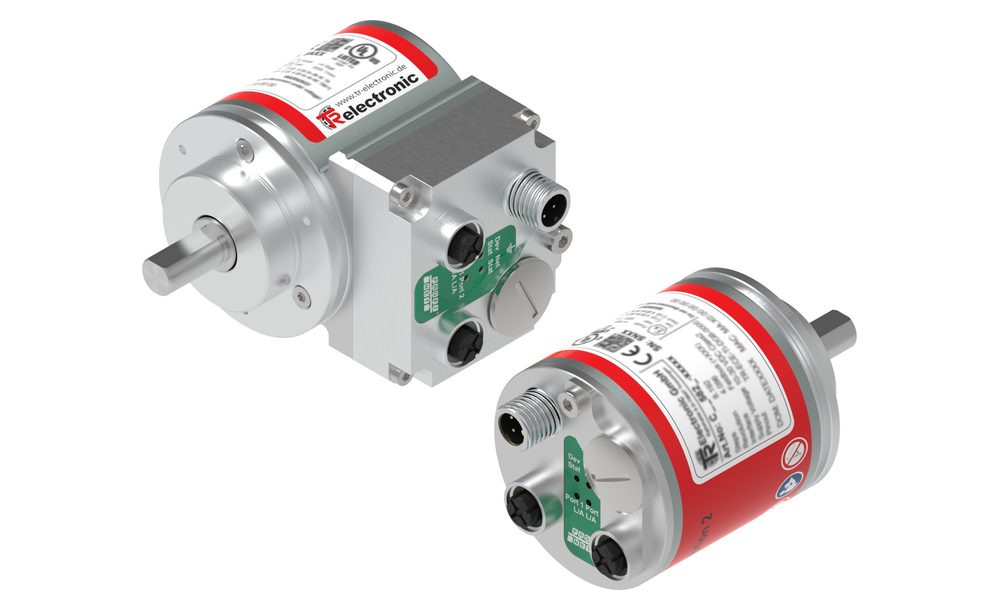
TR Electronic has raised the standard resolution of its optical absolute multiturn encoders in the CE_582, CE_802 and CE_1102 families. Instead of 15 bits, the devices now resolve up to 18 bits per revolution. Moreover, the price stays the same, so machine builders get finer position data without paying more.
From 32,768 to 262,144 steps per revolution
Resolution defines how many steps one mechanical revolution is divided into. Until now, 15 bits, or 32,768 steps, was the standard for these three series. With 18 bits, the encoders split one turn into 262,144 steps, which is eight times finer. TR Electronic has been shipping this version since 1 September 2026.
In addition, two accuracy figures improve along with the resolution:
| Parameter | Previous standard | New standard |
|---|---|---|
| Resolution per revolution | 15 bit (32,768 steps) | Up to 18 bit (262,144 steps) |
| Repeatability | ±0.01° | ±0.002° |
| Linearity deviation | ±0.02° | ±0.01° |
| Price | Unchanged | |
Smoother speed control on slow axes
The biggest benefit shows up in the speed output. The encoder calculates speed from the position change over a fixed cycle. On slow axes, however, only a few position steps fall into each cycle. As a result, the speed signal becomes stepped. The drive controller reads these steps as speed ripple and reacts with current and torque changes, so the axis runs rough.
Anyone who has commissioned a slow, smooth electric axis knows this problem. With 18 bits, position quantisation becomes eight times finer. Consequently, the speed value is resolved much better and the axis runs more quietly. It is similar to measuring a distance in millimetres instead of centimetres: the finer scale reveals small differences.
One version, full range, also for existing machines
For project engineers, the change removes a typical early decision. There is no longer any need to choose between 15 bits and a higher-resolution variant just in case. Every device already contains the full 18-bit resolution. Therefore, a plant can still be optimised later, even when the need was not foreseeable during design.
For existing customers, nothing changes in their agreements. Devices that were already specified and delivered keep exactly the agreed delivery state, including a lower-resolution parameter set. Users who want the extra bits simply switch the resolution to 18 bits with the usual tools. They can do this via the fieldbus, via Industrial Ethernet or with the TRWinProg setup software. No hardware intervention is required.
Part of the modular Generation 2 platform
The encoders belong to the Generation 2 range of TR Electronic C__582 absolute encoders and their larger siblings. The platform covers motion tasks in series machines, special machines and plant engineering. Starting from the 58 mm industry standard housing, customers configure their encoder from a modular kit. Several shaft designs and a wide choice of interfaces make it easy to match both the mechanics and the control system. For larger shafts, the 802 and 1102 series offer hollow through shafts up to 50 mm. For tight spaces, the compact true-absolute 362 multiturn series is available as well.
Why it matters for engineers
- More performance at the same price, so the upgrade needs no budget discussion.
- Smoother speed control, especially at low speeds where quantisation hurts most.
- Better repeatability (±0.002°) and linearity (±0.01°) for positioning tasks.
- One ordered version covers the whole resolution range.
- Existing plants can be improved by parameterisation, without swapping hardware.
For more encoder news from this manufacturer, visit our TR-Electronic news section. There you will also find articles on the TR Electronic SIL encoders for the new Machinery Regulation and on the encoders revised for PROFINET.