
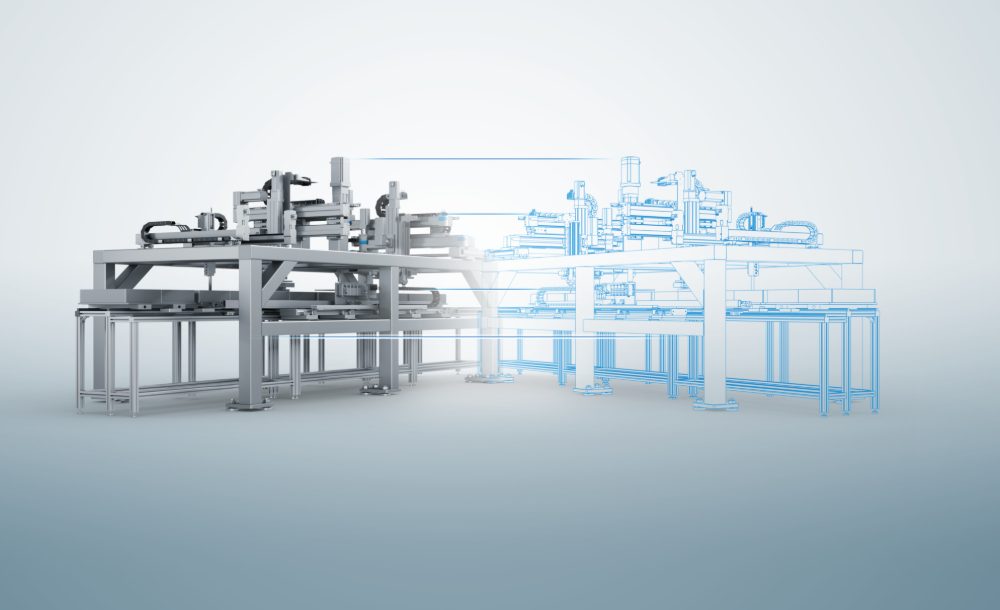
Festo is extending its hardware quality standards to digital product and simulation models. Together with NVIDIA, the company is building digital twins for Physical AI. The goal is simple: machine builders should be able to develop and validate automation solutions virtually, with results that hold up on the real machine.
From USD export to behaviour-accurate models
When a machine combines several functions, engineers need to know how they interact before anything is installed. Virtual models help here. They allow teams to assess concepts, optimise sequences and solve integration problems while development is still running.
Festo is not starting from zero. The company already uses NVIDIA Isaac Sim, an open simulation framework, together with synthetic data for robotic perception. In addition, its products can already be exported as USD (Universal Scene Description) data. The next step is to add motion behaviour and application-relevant properties to these models. As a result, simulations should reflect how components actually behave in the field.
Lab measurements as the benchmark
A digital twin is only useful if engineers can trust it. For this reason, Festo plans a systematic check of model quality:
- Measurements from Festo’s own laboratories are compared with results from NVIDIA Isaac Sim.
- Tests run under defined operating conditions.
- Simulated movements and dynamic behaviour are matched against data from real components.
- Where the two differ, the models are refined in a targeted way.
Isaac Sim is based on NVIDIA Omniverse libraries. Therefore, the evaluation can take place inside complete automation scenarios, not just for isolated components.
“Our digital models must be just as trustworthy as our hardware,” says Jan R. Seyler, Head of Physical AI and Digital Thread at Festo.
Virtual handling application with ABB Robotics
A first practical result is a joint project with ABB Robotics and NVIDIA. In a shared handling application, the partners link digital twins of a three-axis Festo handling system with ABB RobotStudio®. The software chain looks like this:
- Festo digital twins: models of the three-axis handling system.
- ABB RobotStudio® HyperReality: an extension that connects RobotStudio with NVIDIA Omniverse libraries for photorealistic, physics-based simulation.
- ABB Virtual Controller: runs robot programs virtually with the same control software used on real ABB robots.
With this setup, machine builders can clarify process and integration questions before physical assembly. Consequently, commissioning should be faster and time-to-market shorter. ABB Robotics sees the project as a way to advance virtual commissioning and to bring industrial-grade Physical AI into wider use.
Why it matters for machine builders
Virtual commissioning is not new. However, its value has always depended on model accuracy. Generic CAD geometry shows where parts are, but it does not show how an axis accelerates, settles or reacts under load. If a simulation hides these effects, the problems simply move to the shop floor.
Festo’s approach targets exactly this gap. First, it gives component models real motion behaviour. Then, it validates them against lab data. For integrators who combine Festo handling systems with ABB robots, this means fewer surprises at start-up. It also means more reliable training environments for AI-based and autonomous systems, which learn from simulated data.
In the long term, Festo wants to narrow the gap between simulation and reality. Ideally, solutions developed virtually will move to real machines with minimal adaptation. Further news from the company is available in our Festo news section. For another example of NVIDIA technology in industrial robotics, read about SICK Dynamic Safety and NVIDIA Halos, or browse our digital twins and simulation articles.
Source: Festo press release.