
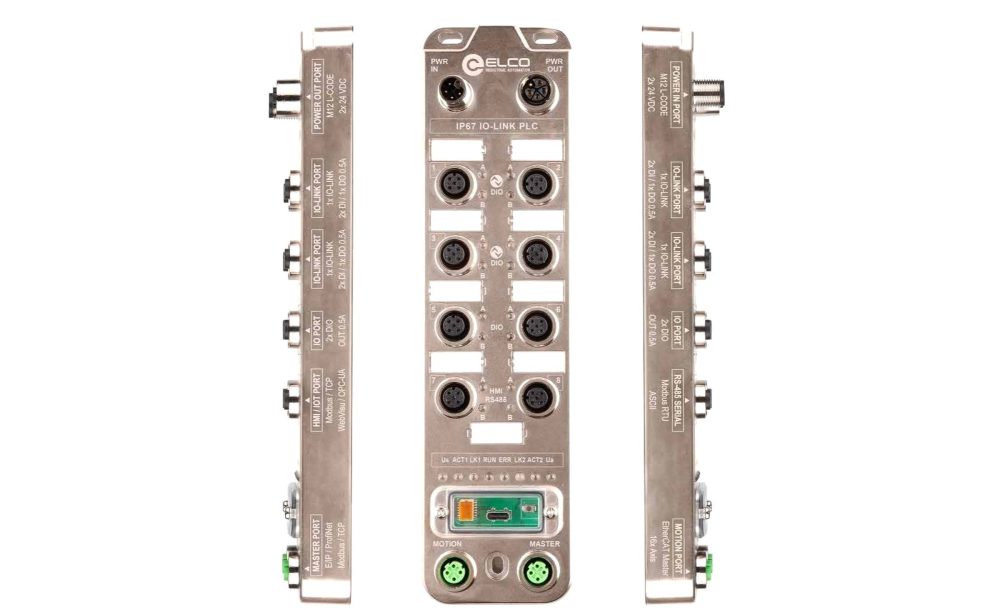
ELCO Industrie Automation has launched the IP67 IO-Link PLC, a field-mounted controller that merges a CODESYS PLC and an IO-Link master in one rugged housing. The device is available now, and ELCO will show it at SPS 2026 in Nuremberg. As a result, machine builders can move control and communication out of the cabinet and onto the machine itself.
Two devices become one
Until now, decentralized machine concepts usually needed two components: an IO-Link module in the field and a separate controller in a cabinet. ELCO removes that split. The new FCEN-4LKM-8A-M-PLC brings six functions together in a single IP67 module:
- CODESYS PLC
- Industrial Ethernet communication
- IO-Link master
- Motion controller
- RS485 interface
- Integrated web HMI
In practice, this means fewer parts to buy, mount and wire. It also saves space, because no extra control cabinet is needed for control and communication.
Technical specifications
| Processor | Quad-core ARM Cortex-A7, 1.2 GHz per core |
| Memory | 16 MB program, 2 MB custom variables, 128 kB non-volatile |
| Programming | CODESYS |
| Main Ethernet port | PROFINET, EtherNet/IP, EtherCAT, Modbus TCP |
| IO-Link | 4 IO-Link master ports |
| Digital I/O | 2 I/O ports, each with 2 digital inputs and outputs |
| Motion control | Dedicated EtherCAT motion port, up to 16 axes at a 4 ms bus cycle |
| Serial interface | RS485 with Modbus RTU and ASCII |
| Visualization | CODESYS WebVisu over HTTP/HTTPS, up to 32 simultaneous users |
| IT connectivity | OPC UA server, MQTT |
| Protection / housing | IP67, metal housing |
Connectivity from sensor to cloud
The main Ethernet port speaks the four most common protocols. Therefore, the module fits into all common control environments. On the field side, sensors and actuators plug straight into the four IO-Link ports and the two digital I/O ports.
The RS485 port adds a second field channel. For example, it can link RFID readers, weighing stations or other controllers via Modbus RTU or ASCII. Meanwhile, a separate motion port drives servo drives over EtherCAT.
For operators, the built-in web server runs CODESYS WebVisu. Any HTML5 browser can therefore display the machine screens, with encrypted HTTPS if required. Alternatively, the PLC works with almost any Modbus TCP panel. On top of that, the OPC UA server and MQTT pass machine data to higher-level systems and IIoT platforms.
Part of a complete decentralized system
ELCO positions the PLC as the core of its field-level portfolio. The system also covers cascadable IO-Link hubs, multi-protocol IO-Link masters, valve systems and decentralized frequency inverters with IO-Link master ports. In addition, ELCO supplies sensors, encoders and M8/M12 connectivity, so a machine can be automated with parts from one vendor.
According to ELCO CTO Kai Brunner, the concept “significantly cuts wiring effort” and reduces the need for additional hardware.
Why it matters for machine builders
Modular machines benefit most. Each machine module can carry its own controller, I/O and drives. Consequently, commissioning and testing per module becomes easier. Engineers also keep working in CODESYS, so existing IEC 61131-3 skills carry over. The trend is clear across the industry; similar field-level concepts appear in our coverage of Murrelektronik’s decentralized automation at SPS 2026.
See it at SPS 2026
ELCO exhibits the IP67 IO-Link PLC from 24 to 26 November 2026 in Hall 10.0, Stand 331. More news from the fair is collected under our SPS news tag, and further products from the company are listed in the ELCO news section.