
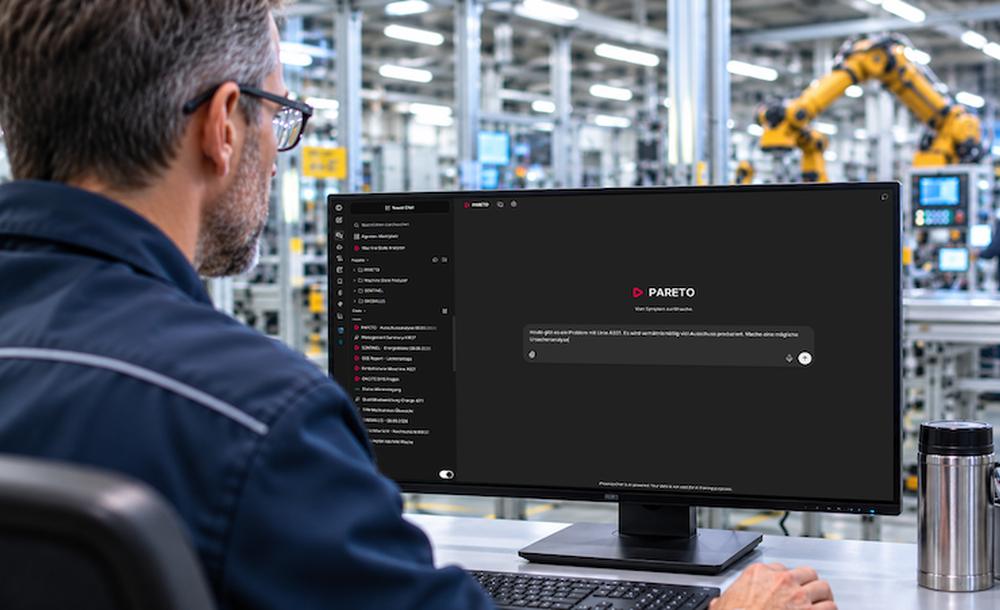
German Edge Cloud (GEC) will show how specialized industrial AI agents find the root causes of production faults at SPS 2026. The live demo centers on PARETO, an agent that already shortens root cause analysis from days to minutes in a series production plant. Visitors can see it in Hall 6, Booth 130, in the Software Defined Industry area powered by SmartFactory-KL.
PARETO: from scrap to root cause
Scrap often appears without an obvious cause. Teams must collect production and quality data from several process steps, check correlations and involve experts. Meanwhile, more faulty parts can leave the line.
PARETO automates much of this work. The agent evaluates production and quality data, links the individual process steps and detects recurring fault patterns. In the SmartFactory-KL demo, it traces repeated quality problems back to a defective component. It backs the finding with the underlying data and recommends removing the part from the process.
The decision stays with the plant staff. They receive a solid basis for action and can intervene before further quality losses occur. As a result, overall equipment effectiveness (OEE) improves and costs fall.
Proven at AUMOVIO in Frankfurt
PARETO is already running in the AUMOVIO plant in Frankfurt-Rödelheim, which belonged to Continental until the spin-off. The plant produces brake systems in a highly automated series production. According to GEC, analyses that used to take several days now take a few minutes.
Together with GEC, AUMOVIO is also building the “Overall Factory Brain”. It combines production data with employee knowledge and makes both usable for industrial AI applications.
Three agents on one data basis
- PARETO: root cause analysis based on production and quality data.
- SENTINEL: monitors the factory’s balanced scorecard, including OEE, First Pass Yield (FPY), First Run Yield (FRY) and Mean Time to Repair (MTTR), and flags anomalies early.
- DAEDALUS: secures the experience of skilled staff and links it to current manufacturing data. New employees therefore reach relevant production knowledge faster.
All three agents use the same data and knowledge base. Instead of isolated AI applications, the result is an expandable system of specialized agents.
Platform and deployment options
The technical basis is the ONCITE Industrial AI Platform powered by PHOENIQS, a Swiss cloud and AI partner of GEC. The ONCITE Digital Production System (DPS) acts as the data hub. With ONCITE Distributed Edge, GEC extends this architecture to the production site. The solution runs on PHOENIQS Cloud On-Prem, so DPS, the AI platform and the agents can run locally. Depending on the use case, data can be processed at the edge, on-premises or in the cloud, and the company keeps control of its production data.
Why it matters for engineers
Most plants already collect the data needed for root cause analysis, but it sits in separate systems. An agent that reads production and quality data together reduces manual searching. Moreover, GEC says the agents can move between production environments with few adjustments. That matters for groups that want to transfer a proven use case to further plants.
Where to see it at SPS
GEC offers several AI Agents demo sessions at the SmartFactory-KL booth. On 25 November at 11:35 in Hall 6, Peter Bonerz (AUMOVIO), Michael Ryffel (PHOENIQS) and Thomas Harde (GEC) discuss the use case in a panel. The same day at 10:00, GEC joins the “Breakfast & Facts” format with Schwarz Digits and Hilscher in NCC Ost, room Istanbul.
More information is available on the GEC SPS 2026 page, and the Industrial AI applications overview describes the company’s AI use cases. For more fair coverage, see our SPS news and the article Siemens at SPS 2026: TIA Portal V21.1 and Industrial AI.