
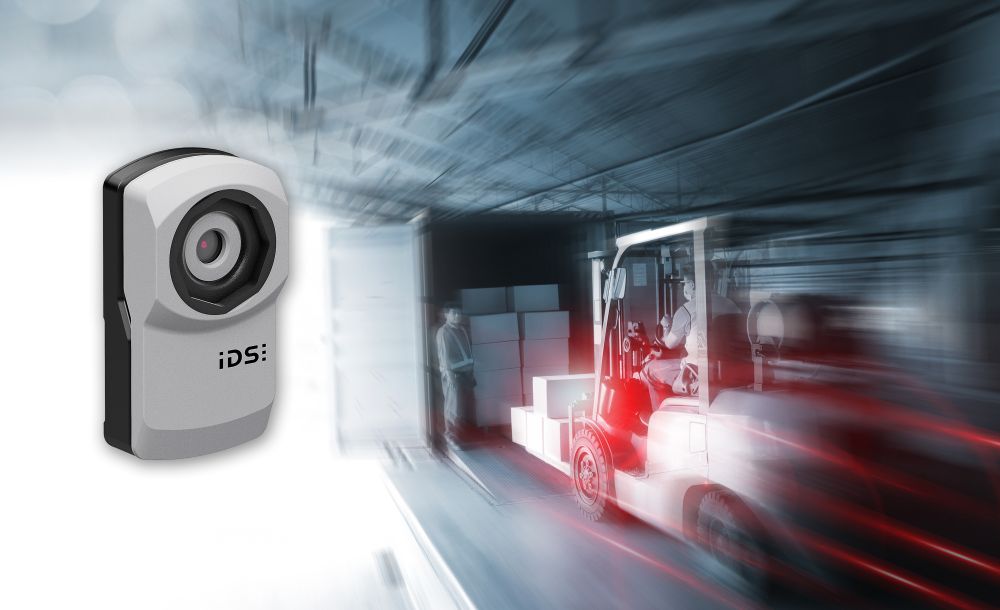
Munich-based IT service provider CANCOM has built a camera system that documents forklift loading operations automatically. The images come from an IDS uEye XC autofocus camera mounted on the truck cabin. AI models from DENKweit then filter and analyse the images, so drivers no longer have to stop and take photos by hand.
How the system documents each load
The camera points forward and records continuously while the forklift moves. First, it captures the delivery note. After that, it follows each step of the loading sequence: manoeuvring, picking up and setting down every pallet, and finally securing the load once the truck is parked.
As a result, drivers skip the manual documentation breaks that used to interrupt their work. At the same time, the company gets a consistent image record of every shipment. This record is useful when a customer questions a delivery or a damaged pallet.
AI filtering and OCR in real time
The camera sends its images over a standard USB Video Class (UVC) interface to the on-board vehicle terminal. No extra drivers are needed. From the terminal, the images travel to a local AI server for real-time analysis.
- Step 1 – Classification: an AI classifier rates each frame for content and relevance. More than 99% of the images are discarded at this stage.
- Step 2 – Object detection and OCR: DENKnet models from DENKweit find delivery notes and pallet structures and read the tour number.
- Step 3 – Assignment: the tour number links every relevant image to its tour, and the images are stored centrally.
- Step 4 – Pallet data: the system counts the pallets in an image and identifies their dimensions.
Autofocus for near and far shots
One camera has to handle two very different distances. According to Thomas Fuchs, Team Leader AIoT at CANCOM, the delivery note is captured at about 35 cm. In contrast, the loading scene needs a field of view of 2 to 3 m. The uEye XC switches focus automatically and keeps the images sharp, even when lighting changes.
| Camera model | UV-36L0XC (uEye XC family) |
| Sensor | 13 megapixels |
| Interface | USB Video Class (UVC), no driver required |
| Image functions | Autofocus, auto white balance, colour correction, adjustable brightness, contrast and sharpness |
| Terminal OS | Windows IoT, central device management |
Because the camera behaves like a standard webcam, integration is simple. The terminals detect it automatically, and IT staff can manage all devices from one central system.
From edge to data centre
DENKweit delivers its AI models as containers. Therefore, CANCOM can scale them from the edge to the data centre and run them in Kubernetes, with GPU acceleration where needed. A first working model needs only a small set of training images. However, accuracy improves clearly as the training data grows in quality and variety.
Why it matters for automation engineers
Classic machine vision relies on rule-based pipelines that take time to design and are hard to change. Here, learning-based models replace those rules. Consequently, a new task needs training data rather than new code. In addition, integrated GPUs are now powerful enough for many applications, so the hardware stays affordable.
Fuchs puts the economics plainly: projects that once cost well into six figures and took months can now be done in weeks, at a much lower cost. CANCOM plans to reuse the technology in further projects, both in logistics and in other industries. For integrators, the key takeaway is that a UVC industrial camera plus containerised AI can turn manual documentation into an automatic, traceable process.
For more details, see the IDS uEye XC autofocus camera page and the UV-36L0XC product data. You can also browse more IDS Imaging news on Automation Fair or read about the rugged IDS uEye SFA monitoring camera.