
Robot safety no longer stops at the safety fence. That is the central message of a new interview in which two KUKA experts explain what the revised ISO 10218 standard means for manufacturers, system integrators and plant operators. André Hetzke, Product Compliance Consultant, and Stefan Schleipen, Chief Software Architect, also cover how the Machinery Regulation and the Cyber Resilience Act (CRA) change the picture.
What changed in ISO 10218:2025
ISO 10218:2025 is the first major update of the robot safety standard since 2011. Robots are now more connected and software-configurable, and they work closer to people and other machines. The new edition reflects this.
It clarifies existing requirements and adds new safety functions. Examples include:
- Safe speed monitoring
- Manual high-speed operation (T2)
- Single point of control
- Start and restart interlocks
- A new Normal Stop function
The biggest shift is cybersecurity. If cyber threats can affect safety-related functions, they must now be assessed and mitigated. In other words, functional safety and cybersecurity are linked more closely than ever.
Who is responsible for what
The standard applies to robot manufacturers, integrators and operators. ISO 10218-1 covers the industrial robot as partly completed machinery. ISO 10218-2 covers robot systems, applications and cell integration. Therefore, a compliant robot does not make a compliant system on its own.
- Manufacturer: the robot product.
- Integrator: safe design and conformity of the complete system.
- Operator: safe operation and controlled change management.
The standard is international but adapted regionally, for example as EN ISO 10218 in Europe. Customer specifications may also demand compliance.
Existing systems, cobots and retrofits
Installed systems do not need replacement or re-assessment just because a new standard exists. That holds as long as they stay safe, well maintained and unmodified. A significant modification is different. It calls for a new risk assessment and a new conformity assessment procedure.
The experts also remind readers that “cobot” is an industry term, not a term defined in the standard. A cobot does not guarantee a safe collaborative application. Whether a cell can run without fencing depends on the risk assessment of the whole system, including the tool, the workpiece and the motion sequences.
Cybersecurity, CRA and the Machinery Regulation
The three texts complement each other. ISO 10218 addresses cybersecurity where it affects functional safety. The Machinery Regulation requires protection of critical functions against corruption. The CRA adds broad requirements for digital products over their whole lifetime, including vulnerability handling and security updates.
For operators, this means practical steps. Segment machine and corporate networks, define roles and permissions, and secure remote access. In addition, plan how to test and install updates during maintenance windows. Cybersecurity is a continuous process, not a one-time commissioning task.
KUKA platforms and support
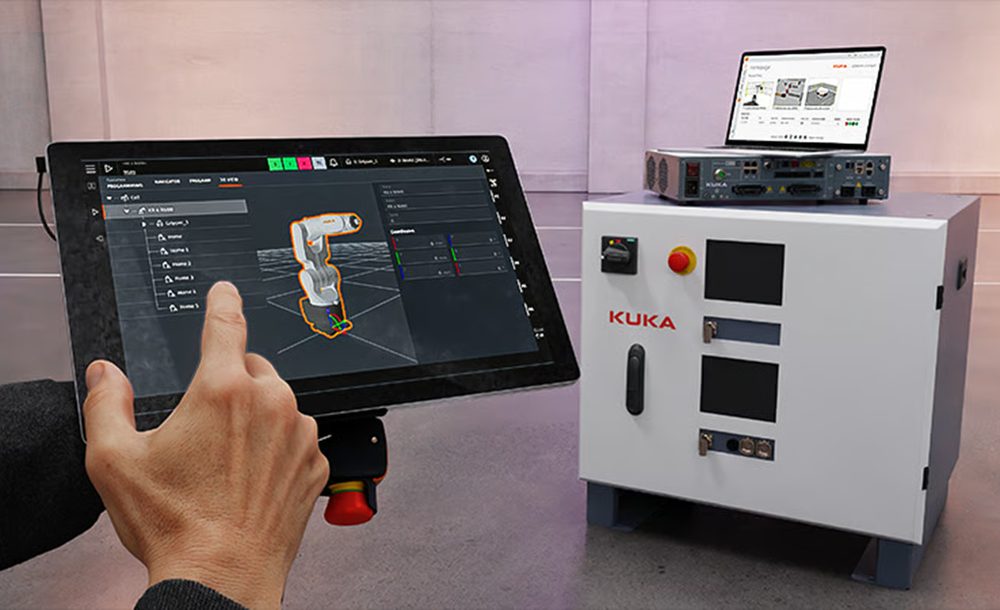
KUKA points to its KR C5-2 controller, the iiQKA.OS2 operating system and AMR.OS 3.X for mobile robots as the recommended basis for new projects. The platforms follow security by design, defense in depth and least privilege. They build on IEC 62443-4-1 for secure development and IEC 62443-4-2 for product requirements. According to the interview, iiQKA.OS2 holds Security Level 2 certification.
For existing installations, KUKA offers system assessments, controller updates, migration from KSS to iiQKA.OS2, retrofit solutions, lifecycle planning and training.
Why it matters for engineers
Start with an inventory of your robots, controllers, software versions and network connections. Then assign clear responsibility for updates, vulnerabilities and remote access. For new cells and modernizations, choose platforms with ongoing software maintenance. These steps prepare projects for the Machinery Regulation, which applies from January 2027.
Read the full interview on the KUKA press page. You can also see how the controller platform earned its certification in the KUKA iiQKA.OS2 Security Level 2 announcement. More news is in our KUKA news section, including KUKA robots obtaining Level 2 to IEC 62443-4-2, and under the cybersecurity tag.