
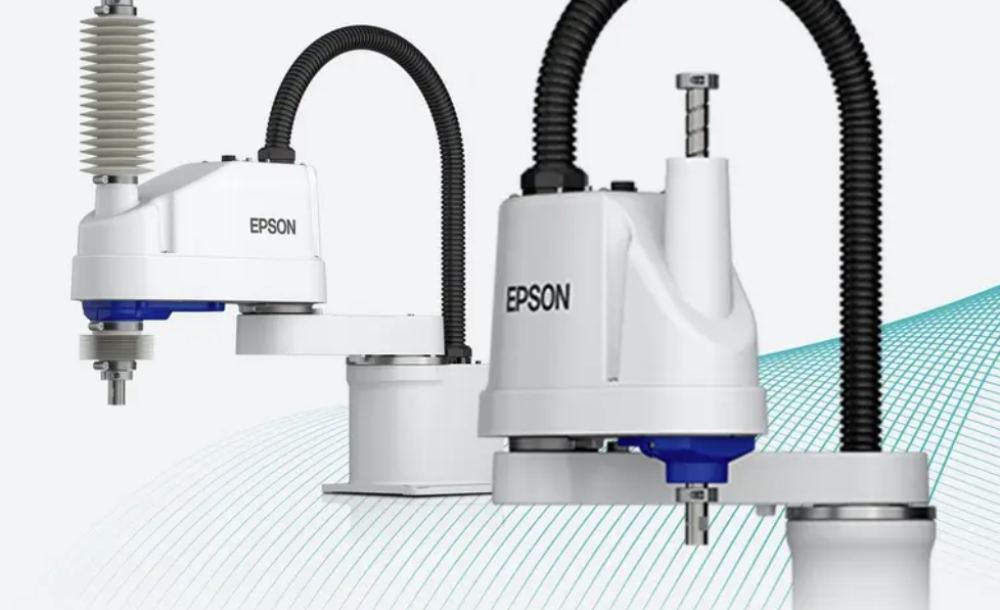
Epson Europe has published new research on how European manufacturers see industrial robots. The results show strong interest in SCARA robots. They also show that integration effort and a lack of skilled staff still slow down many projects.
SCARA robots attract growing interest
According to the study, 44% of manufacturers with European operations are using, implementing or considering SCARA robots. Their main reason is simple: SCARA arms are fast and precise in repetitive handling tasks.
Pick-and-place is the most likely application, with 31% of respondents. Packaging follows with 24%. Together, these two tasks account for 55% of the potential use cases.
Integration is the main barrier
Many companies want robots to raise productivity and ease labour pressure. However, fitting a robot into an existing line is not trivial. In fact, 21% of respondents name integration with current production as a major barrier.
The survey also asked what would encourage adoption most. The answers point clearly to ease of use:
- Simpler integration: 31%
- Intuitive or low-code programming: 13%
- All-in-one systems with an integrated controller: 9%
- High-speed precision: 7%
Epson’s own SCARA range follows this idea. Earlier launches such as the LS-C series and the LS50C are examples of this range on Automation Fair.
Skills shortage slows projects
The research also highlights a people problem. Recruiting automation or engineering specialists is the greatest workforce challenge for 43% of manufacturers. As a result, 22% report project delays, and 18% say integration becomes harder.
Confidence is low as well. Only 14% are very confident that their business has the skills to implement and support industrial robots. Meanwhile, 45% are not very or not at all confident.
AI will change skills needs
Looking ahead, 69% expect AI-enabled automation to change or increase the skills their workforce needs over the next three years. Opinions differ on the effect: 26% think it will widen the skills gap, while 13% believe it will reduce the need for specialist skills.
Volker Spanier, Head of Robotics Solutions at Epson EMEAR, says that integration challenges and skills shortages keep holding back investment. He adds that simpler integration and programming can help manufacturers use the capability of modern robots.
Why it matters for engineers
For integrators and machine builders, the message is practical. Customers ask for robots that are quick to commission and easy to program. Therefore, low-code tools, compact all-in-one controllers and clear commissioning steps will weigh as much as speed or payload in future projects.
The figures come from Epson’s survey of manufacturers with European operations. The company has not detailed the sample size in the release. You can read the full announcement in the Epson Europe press release, and find more robot news in our Epson category.