
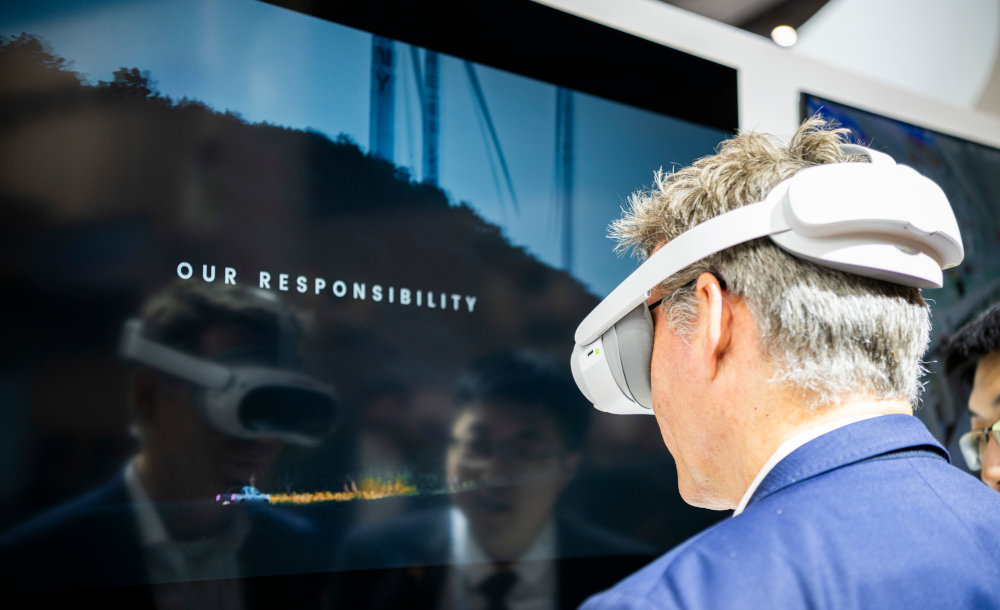
The ongoing digital evolution is providing a significant boost to both land-based and marine wind power sectors. During the upcoming WindEnergy Hamburg event, scheduled from September 22 to 25, 2026, forward-thinking exhibitors will showcase advanced AI applications designed to maximize the operational output and efficiency of modern wind assets.
While wind turbines may appear straightforward from the outside, they incorporate a vast array of sophisticated, high-tech digital systems. Modern setups rely heavily on advanced tech features, including intelligent grid synchronization, highly responsive automation systems, remote diagnostics, and predictive failure analysis driven by artificial intelligence. Within the renewable energy market, big data analytics and AI have become crucial assets.
These tools allow operators to implement proactive maintenance schedules, analyze operational data with pinpoint accuracy, and continuously refine production strategies. Visitors to WindEnergy Hamburg will find a specialized section in Hall A3 dedicated entirely to companies focused on machine learning and digital workflows. “This area provides a platform for enterprises to demonstrate next-generation software tools that help manufacturers unlock hidden capabilities and optimize energy generation,” notes Andreas Arnheim, Director of WindEnergy Hamburg and WindEnergy Asia-Pacific powered by RECHARGE.
Intelligent Applications for Enhanced Wind Operations
Accurate meteorological forecasting remains a cornerstone of efficient wind farm management. Enhanced weather models allow asset managers to schedule power outputs more reliably, thereby reinforcing overall grid stability. BlueWX, a Japanese participant, is set to display a highly creative approach in this field. “By adapting our patented wind forecasting models originally designed for aviation safety, we create highly localized, deep learning-driven forecasting applications with superior precision,” states Kaz Watanabe, the company’s Chief Executive Officer. “We look forward to presenting our software at the event and engaging with industry professionals aiming to upgrade their forecasting metrics.”
Maximizing energy generation via intelligent automation is also the core objective of Stuttgart-based MesH Engineering. Their RegViento Controller focuses on boosting total wind farm productivity through coordinated, intelligent turbine management. “At the exhibition, operators can test our RegViento Explorer interface first-hand to observe how our central control system optimizes overall park efficiency,” points out Dr.-Ing. Matthias Kretschmer, Project Head for RegViento at MesH Engineering. “For instance, slightly throttling upfront turbines or dynamically adjusting their orientation can significantly minimize wake deficits for downwind equipment, enhancing the energy output of the entire location.”
Concurrently, Cologne-based software specialist Octonomy will present a tailored solution designed for the intricate documentation demands of the sector. Their AI platform aggregates all operational materials—such as blueprints, wiring diagrams, and technical manuals—delivering answers to specific maintenance queries in seconds with a 96% accuracy rate. Octonomy supports major energy providers like Prokon, which manages and maintains numerous wind assets throughout Germany. The platform empowers engineering teams to diagnose technical faults rapidly and coordinate on-site repairs more effectively. “Partnering with Octonomy has allowed us to cut physical maintenance dispatches by half, while ensuring the strict data security required by critical infrastructure,” comments Dr. Yousef Farschtschi, Head of IT at Prokon.
Advanced Analytical Systems for Fault Detection
Contemporary wind generation units integrate an extensive network of specialized technologies. Multiple onboard sensors continuously stream operational metrics to central management hubs. Furthermore, intelligent panoramic imaging systems actively protect endangered birds, such as white-tailed eagles and red kites, by preventing collisions. Specialist software developers leverage this operational data to perform deep automated evaluations. Turkey’s Kavaken has engineered an AI-driven platform that spots equipment irregularities, such as unexpected thermal spikes in critical components or sudden drops in energy production. These early warnings give operators the chance to address minor faults before they escalate into catastrophic mechanical failures, ultimately extending asset longevity.
In a similar vein, British startup Werover focuses on identifying structural issues early through its “Windrover” device. This hardware utilizes a magnetic sensor mounted on the turbine tower to capture acoustic data from the rotating blades. The system flags audio anomalies, such as structural sound changes caused by lightning strikes. Balca Yilmaz, CEO and co-founder of Werover, remarks: “Windrover removes the necessity for frequent manual blade inspections, drastically lowering operational downtime and maintenance expenses.”
From a manufacturing perspective, CSP Intelligence offers a proven enterprise platform called Integrated Process Data Management (IPM). Based in Bavaria, this software firm employs AI to analyze assembly data, flag production flaws early, and elevate quality control standards. “Our Curve Anomaly AI utilizes camera-guided computer vision to audit critical bolted joints, instantly flagging if an assembly step was executed incorrectly,” explains Philipp Glässler, Product Manager at CSP. This offers massive advantages to wind equipment manufacturers, as verifying high-stress structural connections on the nacelle, tower, and blades during production prevents catastrophic failures once the unit is deployed.
The diverse tools presented by these companies highlight how data-centric technologies are reshaping the renewable sector. “Whether dealing with global manufacturers, software developers, utilities, or agile startups, direct cross-industry collaboration is vital to navigating the digital transition successfully,” concludes Claus Ulrich Selbach, Vice President Exhibitions Maritime & Energy at Hamburg Messe und Congress. “WindEnergy Hamburg serves as an unmatched venue to build new commercial partnerships face-to-face, reinforce existing networks, and discover innovative strategies for corporate growth.”