
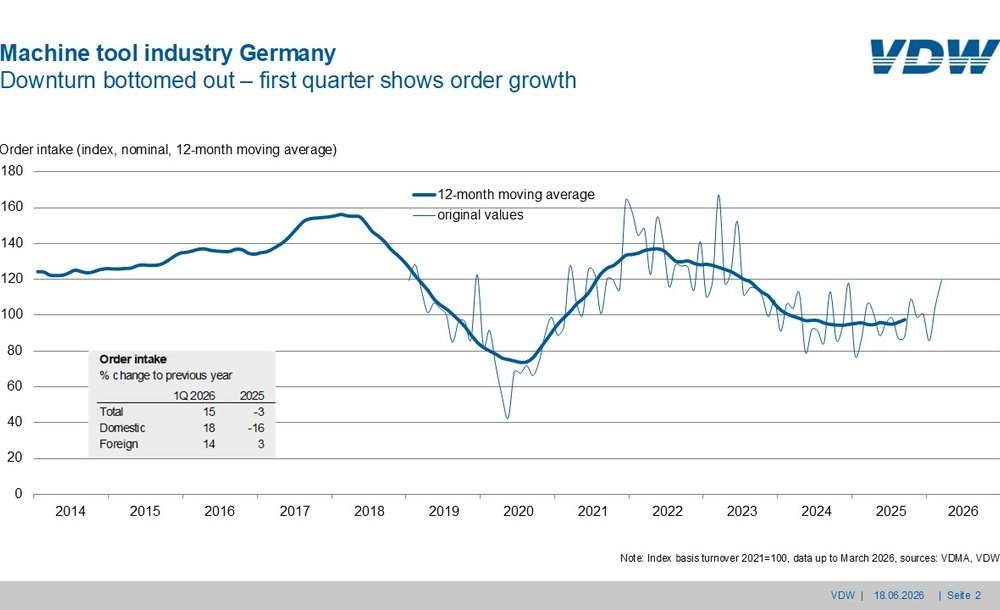
After three straight years of contraction, Germany’s machine tool sector has posted its first encouraging signal: new order intake climbed 15 percent in the first quarter of 2026. The improvement, however, comes with caveats. Output, exports and headcount all kept shrinking during the same period, and fresh instability stemming from the Middle East conflict is pushing costs higher and making manufacturers more hesitant to commit to new investment.
“We appear to be past the low point, but calling this a genuine turnaround would be premature. The next few months will tell us whether this recovery has staying power,” said Bernhard Geis, who heads Economics and Statistics at the VDW, Germany’s machine tool builders’ association.
A Fragile Rebound
Domestic and export orders both contributed to the gain, rising 18 percent and 14 percent respectively — but the headline number overstates the strength of the recovery. Much of the increase is measured against an unusually weak base from the prior year, especially in the domestic market. One-off orders and individual large projects, rather than a broad pickup in demand, account for much of the movement. Service and retrofit work continues to provide a steadier revenue stream for manufacturers.
Performance also diverges sharply by end market. Aerospace, defense, medical devices and electronics are all trending upward, while automotive, its supplier base, and general mechanical engineering remain under pressure.
Production and Exports Still Falling
Manufacturing output fell 11 percent year-on-year to roughly €2.8 billion in the quarter. Domestic sales were hit harder than exports, down 13 percent versus a 10 percent export decline. Regional results varied widely: the U.S. market grew 8 percent, while Europe contracted 11 percent. Asia was the weakest region, down 18 percent overall, driven largely by a 32 percent collapse in shipments to China. Facing intense price competition there, German manufacturers with local production footprints are increasingly leaning on a “local for local” strategy. India, by contrast, is expanding fast and has moved up to become Germany’s third-largest export market.
Imports and Domestic Demand Also Soft
Imports slipped 8 percent in the first quarter — a smaller drop than domestic sales, though still a sign of broader weakness. Japanese suppliers were a notable exception, growing their German sales even as the overall market cooled. Combined, domestic apparent consumption fell 10 percent, underscoring how subdued capital investment remains in Germany.
Employment Continues to Shrink
Capacity utilization slipped further to 73 percent. That pressure is now showing up clearly in headcount: the sector employed 60,600 people in March, down almost 9 percent from a year earlier as companies right-size operations to match lower demand.
Outlook
Geis struck a cautious tone: “The order growth we’re seeing is a meaningful signal, but it isn’t a green light. A durable recovery still depends on stronger investment confidence and a more predictable economic environment.”