
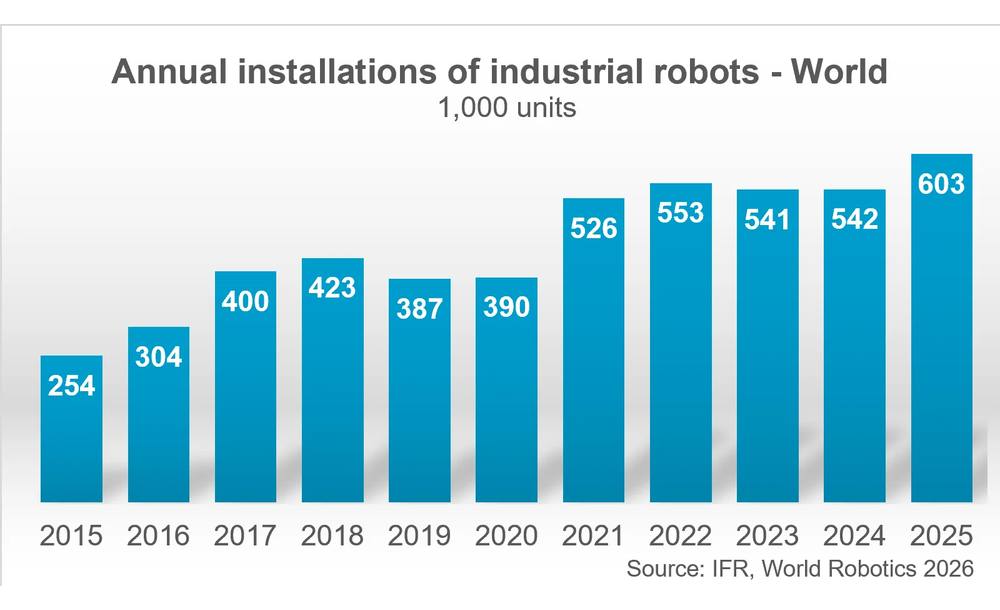
The number of industrial robots in operation around the world reached an all-time high of 5 million units in 2025, a 9% increase on the previous year. Behind this milestone is a strong rise in new deployments: manufacturers installed more than 600,000 robots during the year, 11% more than in 2024.
According to Jane Heffner, President of the International Federation of Robotics (IFR), factory automation is advancing rapidly. She points out that today’s installed base of five million robots is more than twice the figure recorded seven years ago. Asia is growing fastest, the Americas come second, and Europe is advancing at a more moderate pace.
Asia: China extends its lead
China consolidated its position as the global leader in robot adoption. Installations grew 20% year-on-year to 354,000 units, surpassing the previous annual record by nearly 60,000 robots and representing 59% of all installations worldwide. Domestic Chinese suppliers once again outsold international brands in their home market, with installations up 15% to 195,000 units. Their share of the Chinese market reached 55%, slightly below the 57% recorded in 2024.
Japan remains Asia’s second-largest robot market, but installations dropped 19% to 36,219 units. As a result, Japan slipped from second to third place globally, now behind the United States. Only modest growth is expected in the coming years, with no strong rebound anticipated in the short or medium term.
South Korea installed 30,000 robots, 1% fewer than the previous year, and kept its position as the world’s fourth-largest market. Installations have hovered around 31,000 units per year since 2019. However, new automotive investments scheduled for 2027 and 2028 could push Korean demand beyond this plateau, with growth possible from 2027.
India recorded close to 10,500 installations, a 15% increase that places the country sixth worldwide, just behind Germany. While its volumes are still well below those of the top five markets, India’s momentum is impressive: annual installations grew at a compound annual rate of 27% between 2020 and 2025.
Americas: The US moves into second place
The United States overtook Japan in 2025 to become the world’s second-largest industrial robot market after China. Installations increased 12% to nearly 38,500 units, the third-highest annual total ever recorded for the country.
Mexico saw a third consecutive year of decline, with installations falling 7% to under 5,200 units. Canada, by contrast, grew 5% to almost 4,000 units, continuing an average annual growth rate of 9% since 2020.
Brazil stood out with a 38% jump to nearly 4,300 new robots. The automotive sector drove this growth, installing close to 2,100 units, more than three times the previous year’s figure. Investments by Chinese carmakers in Brazil are considered the most likely reason for this surge.
Europe: A slower pace
Germany remains the largest robot market in Europe and the fifth-largest in the world, accounting for 41% of all installations in the European Union. Although installations grew by an average of 2% per year between 2020 and 2025, sales fell 8% in 2025 to below 25,000 units. The automotive industry is still Germany’s main robot user, although its share is gradually shrinking.
Italy, Europe’s second-largest market, recorded an 11% decline to around 7,800 units. France regained third place with almost 4,500 units despite an 8% drop, while Spain followed closely with about 4,300 units, down 15%.
Outlook: Growth set to continue
The IFR expects global robot demand to maintain its long-term upward trend. Installations are forecast to grow 9% to 655,000 units in 2026 and to reach 806,000 units by 2029. While regional performance varies considerably, China, the US and India are expected to remain key growth engines.
Efforts to build more resilient supply chains, together with shifts in trade and industrial policy across major economies, are encouraging manufacturers to relocate production. Expanding manufacturing capacity in high-wage countries and in regions facing labor shortages will increase demand for automation. This may reshape where robots are installed, but it does not signal an end to the global growth trend.
Long-term factors such as demographic change will keep supporting demand. At the same time, technological progress is widening the range of applications that are both technically possible and economically viable. Developments in artificial intelligence, machine vision and sensor technology are making robots more capable, while simpler programming and easier system integration are lowering deployment costs and opening automation to new industries and users.