
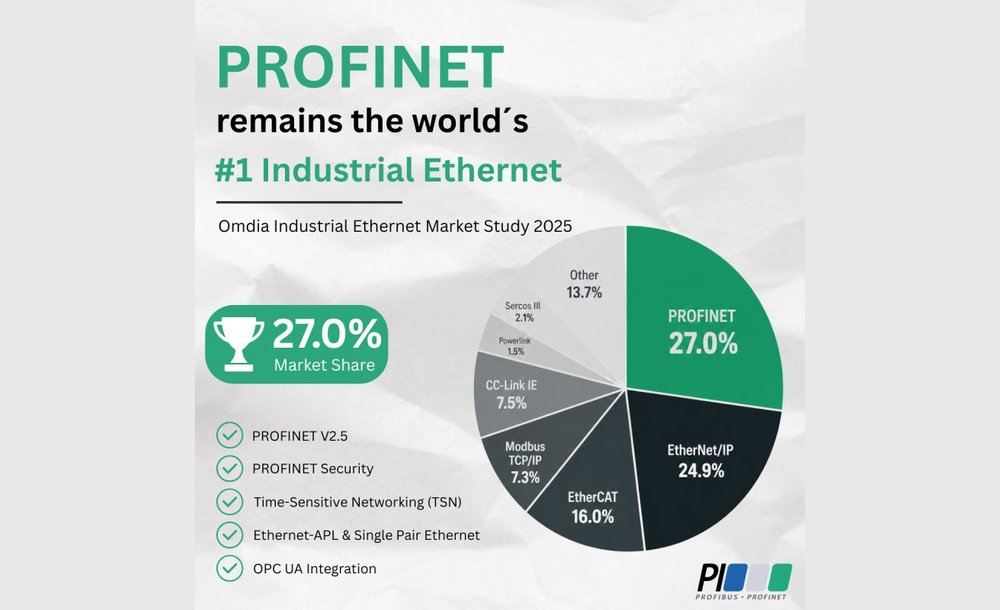
New research from Omdia has once again placed PROFINET at the head of the industrial Ethernet protocol market. Despite a fast-changing landscape, the technology has held its leading position, which the PI Community attributes to steady technical progress and a rapid pace of innovation. The recently released PROFINET V2.5 specification brings together several technologies that will shape the future of automation: security, Time-Sensitive Networking (TSN), and extensions for Ethernet-APL and Single Pair Ethernet (SPE). Together they make PROFINET a continuous communication backbone that runs from the field level up to the cloud.
Close integration with complementary technologies is another reason for its success. IO-Link stands out in particular, as it allows efficient, end-to-end communication with sensors and actuators and has contributed heavily to the shared market growth of both technologies. PROFINET is also central to Ethernet-APL, and the first real process plants already run PROFINET over APL in daily operation. At the same time, PI is actively promoting SPE and helping to steer how that technology develops.
Vertical integration is another area where PROFINET sets the pace. Broad mappings to OPC UA make it possible to deliver standardized, semantically rich data across every layer of the automation pyramid. Support for robot interfaces through SRCI (Standard Robot Command Interface) also opens the door to a segment that is growing quickly.
Today PROFINET already covers concrete use cases along the whole data value chain, from basic data collection to AI-driven analysis. Running real-time communication alongside standard TCP/IP Ethernet is becoming more and more valuable, because it gives direct access to plant data without loading the controllers or interrupting operation. Typical applications include asset tracking, condition monitoring, and the secure, structured delivery of data for reporting, optimization and future AI use.
Scalable network designs reinforce this flexibility, for example by using Gigabit links only where data volumes are highest. Meanwhile, PROFINET keeps its central strength: compatibility across generations.
According to Xaver Schmidt, Omdia’s confirmation of PROFINET’s market position is clear proof of its innovative strength and long-term viability. He explains that the mix of openness, integration and technological depth is what makes PROFINET the right platform for automation today and tomorrow.
Looking ahead, industrial communication will face growing demands, particularly around digitalization, security and artificial intelligence. PROFINET is well placed to help shape these trends and to extend its leadership even further.