
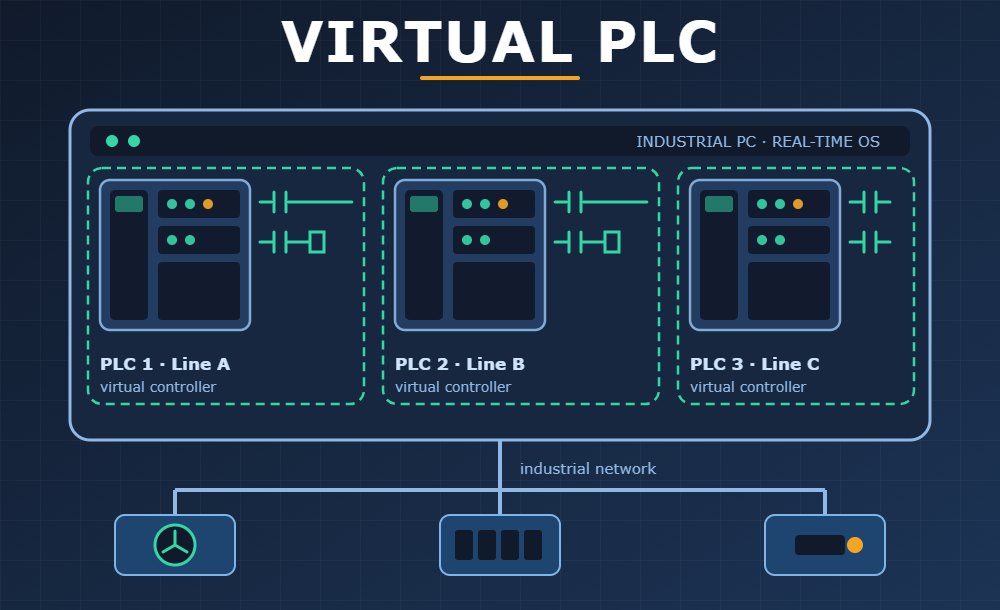
A virtual PLC is a controller that runs as software on standard IT hardware instead of in a dedicated device. The idea sounds simple. However, it changes how teams deploy, update and scale control logic. This guide explains how it works and when it makes sense.
What a virtual PLC is
A traditional PLC bundles the CPU, the operating system and the runtime in one box. A virtual PLC separates the control software from the hardware. The software runs on an industrial PC or a server, usually on top of a real-time operating system. The field I/O still connects through the industrial network.
Soft PLCs are not new, and runtimes such as CODESYS have run on PCs for years. What is new is the packaging. Large vendors now deliver the controller as an app and manage it centrally.
Example: SIMATIC S7-1500V
Siemens offers its virtual controller as the SIMATIC S7-1500V. Siemens describes it as a hardware-independent controller. You download it as an Industrial Edge app, manage it centrally and deploy it with Industrial Edge Runtime. It keeps familiar STEP 7 functions, so engineers can reuse their tools and habits.
According to a Machine Design report from Automate 2026, this virtual version runs on an industrial PC with a real-time Linux operating system. Siemens also cites Audi as a user that virtualized part of its shop floor with the S7-1500V. Other vendors follow the same direction. For example, industry coverage says Rockwell plans Logix Edge for late 2026, which runs the Logix engine on an industrial PC.
Hardware PLC vs virtual PLC
| Aspect | Hardware PLC | Virtual PLC |
|---|---|---|
| Runs on | Dedicated controller | Industrial PC or server |
| Rollout | Device by device, often on site | Central management of many instances |
| Scaling | Add more controllers | Add instances on shared hardware |
| Skills | Automation engineering | Automation plus IT know-how |
| Main risk | Failure of a single device | Failure of a shared host |
When a virtual PLC makes sense
- You run many similar lines or stations and want to update them from one place.
- Your plant already uses IT infrastructure and edge platforms.
- You want to test control logic before commissioning, without touching real hardware.
- You plan to combine control with analytics or AI applications on the same platform.
When hardware is still the better choice
- The machine is small and stands alone.
- The application needs very short, strictly deterministic cycle times.
- Safety functions are involved. Check the vendor documentation for what the virtual controller supports.
- No IT staff is available to maintain the host.
What to check before you start
- Real-time behavior. Measure jitter on the host under realistic load.
- Availability. Plan redundancy and backups, because one host may run several controllers.
- Cybersecurity. Control now runs on IT infrastructure. Therefore, apply the practices from our IEC 62443 guide for machine builders.
- I/O connection. Confirm how the controller reaches field devices over the network.
- Licensing. Compare license costs per instance with the cost of hardware.
Why it matters for engineers
Control logic is moving from fixed hardware to managed software. As a result, automation engineers increasingly work next to IT teams. Start with a pilot on a non-critical line. Then measure performance and effort before you scale. To follow the vendors behind this shift, browse our manufacturer pages.