
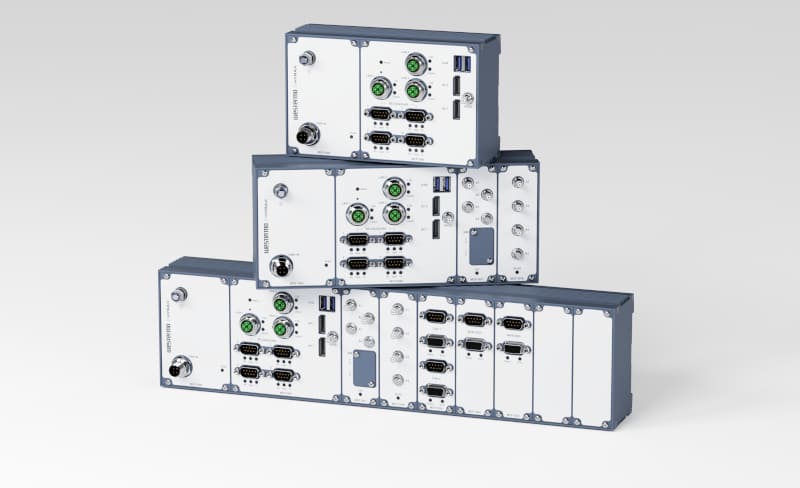
Westermo has launched the Hyrax-1000, a sturdy, modular computing platform that provides adaptable performance scaling with multiple CPU choices. Designed based on the open ModBlox7 standard, the Hyrax-1000 is a customizable BoxPC with extensive storage capabilities, perfect for railway applications. Although it has a small design, the basic version includes a complete range of interfaces, such as Gigabit Ethernet, RS232/422/485, DisplayPort, and USB 3.0.
Due to its modular architecture, the system is capable of being expanded with as many as seven interface or communication modules, allowing for highly customized configurations. The adaptable housing design permits DIN rail, wall, and 19” rack installation, facilitating seamless integration in various industrial settings. Created in accordance with the railway standard EN 50155, the Hyrax-1000 requires no maintenance and can operate within a temperature range of -40°C to +70°C. It offers a versatile, future-proof option for train manufacturers, railway operators, and system integrators looking for alternatives to proprietary BoxPC solutions.
Driving Modular Innovation in Industrial Computing
Today’s industrial computing market is largely dominated by rigid, proprietary systems that struggle to meet modern requirements for compactness, low weight, and cost-efficiency, performance and interface flexibility.
Addressing these limitations, the ModBlox7 standard – developed by PICMG, a non-profit consortium of over 130 member companies – introduces an open, modular platform architecture optimized for scalable embedded systems.
By eliminating the need for complex components such as backplanes or shelf controllers, ModBlox7 significantly reduces system costs while maintaining flexibility and performance. This allows manufacturers to create cost-effective and adaptable computing solutions that can evolve with changing application needs.
Westermo Helps Shape the ModBlox7 Standard
Today, more than ever, an open standard is essential for modern embedded systems – one that combines the advantages of traditional system designs with those of BoxPCs. This requires a standardized form factor, including suitable mounting options as well as clearly defined interfaces between the functional units within the BoxPC.
This approach is supported by PICMG and its member companies. The consortium continues to drive the development of embedded computing specifications, including the new ModBlox7 form factor, and promotes the adoption of open standards across a wide range of embedded computing applications. Westermo played a leading role in defining the new specification, collaborating with 18 industry partners through a dedicated task force within PICMG.
For industrial users, the key advantages of an open BoxPC standard are cost-optimized system design and easy component interchangeability, enabling tailored solutions for specific applications. Manufacturers also benefit by focusing on their core technologies without the need to develop every embedded component themselves.
Advancing standardization with new modules
Together with its partners, Westermo is driving standardization within the PICMG, with the goal to enable cross-vendor compatibility and interoperability. The Hyrax-1000 is the first commercial realisation of the ModBlox7 vison – a modular, scalable and individually configurable system with integrated GNSS support, ideal for customized embedded edge computing in many challenging areas, such as the railway sector. Typical use cases include telematics, diagnostic systems, passenger infotainment, IoT gateways, edge computing, and data-based cloud services.
The fanless, maintenance-free design of the Hyrax-1000 allows flexible mounting, including DIN rail, wall or 19″ rack or sub-rack, for seamless integration into vehicles or control cabinets, even in space-constrained environments. Thanks to its modular concept, a wide range of extension modules can be implemented to meet customer-specific requirements and functions. The extension modules are pre-assembled units, enabling flexible configurations and short delivery times for custom systems.
Available wireless extension modules include options such as Wi-Fi 3×3 MIMO (802.11ac) and LTE, with support for up to four SIM cards per module for maximum network coverage and operational flexibility. The Wi-Fi interfaces support client operation, e.g. for train-to-ground communication, as well as access point mode for connecting onboard clients.